I flew in on the red-eye from the West Coast to Atlanta, rented a car, and drove the rental car 45 minutes northeast to the small town where my mother lives just as the sun was coming up. I’ve made this trip from west to east coast numerous times over the last few months and several times in a crisis mode, as I am now. My mother has gotten weaker and smaller and more vulnerable with each passing week, kicked off by a debilitating virus at the end of December.
Bleary-eyed, I walk into her darkened room at the assisted living home at around 5:30 a.m. The hospice caretaker is writing on a pad, sitting quietly in the often-reupholstered wing chair, my mother’s favorite place to sit, her grandfather’s chair. Many of her things have been moved to make room for a large, steel-framed hospital bed, with protective bars along the sides of the bed, that takes up most of the space. I slip the cold, metal bars down so I can move closer. I take my mother’s hand, smaller but still soft and smooth, in mine. Her brown eyes open and widen, with great intensity.
“It’s you,” her lips move into an almost smile, with great effort. She looks at me directly, extremely focused.
“Yes, I’m here, Mother. I love you.” I reach down to gather her frail, thin shoulders in my arms to hug her, to touch her, to let her know how much I love her. My ear is close to her lips.
“I’m dying.” She whispers, slowly and deliberately. She pauses. “Good-bye. I love you.”
I hug her. Tighter. Tears flood my eyes and spill in waves down my cheeks. Emotion clogs my throat. My mother has always, even when I was a small child, talked to me with unembellished honesty, sometimes entrusting me with secrets and knowledge well beyond what a child normally receives. She always tried to help me understand why things happen the way they do or the rationale behind her beliefs and values and those of others. She taught me to look at people as individuals. Once again she is sharing her honest assessment of the situation, at once bringing me into the inner circle of her secret thoughts, collaboratively, helping me to understand, and preparing me for what is ahead in her usual thoughtful, loving, and thoroughly open way. And this time, I know that she has summoned from somewhere deep inside her the energy to focus just on me, let me know how much she loves me, and help me with this transition I’m about to experience. She has somehow put her dementia and physical frailty aside to deliver this intense affection directly to me. The nicest gift I could ever receive.
This transition is a much larger one than I expected. I am no longer part of the sandwich generation. My mother has been my only living parent. I will no longer receive direct support and sustenance from my mother, although the dementia that my mother experienced much reduced her ability to express these emotions in the last years. But I still felt them every time her brown eyes got big and excited when I entered her room. She has never failed to recognize me and rejoice in seeing me, in her intense but increasingly smaller ways.
Suddenly, I am no longer arranging my schedule and that of my family to fly to see her as often as possible. I won’t be taking her on shopping excursions, to see movies or museums, or out to lunch and dinner. I won’t be making time in my life for calls and visits or analysis of her prescriptions, medical care, or bills. I won’t be ordering yellow roses or lavender orchids, her favorites, to brighten her room—and her face. I won’t be seeing her big brown eyes widen with joy when I come through the door. The void is huge. The transition is difficult. But I know that death is part of life. My mother taught me that.
Showing posts with label aging. Show all posts
Showing posts with label aging. Show all posts
Saturday, May 19, 2007


Saturday, February 17, 2007
Boomers Put Our Own Twist on Exercise
 I've just returned from my health club. My NIA teacher didn't show up (a rare occurrence) so I headed for the weight room where I flipped through magazines and chatted with one of my fellow NIA classmates, while zipping along on the recumbent bike for 20 minutes, scooted through the weight machines, and then headed to the pool for a swim. For some reason, I started noticing that 99% of the people in the room were leading-edge Boomers. Then I began to think about how weight rooms had changed. No more Nordic Track machines. Only one stair-climbing machine and one stationary bike. Now, there are stretching machines, rows of recumbent bikes (great for weak or injured knees), elliptical motion training machines (also good on knees), and big orange and green plastic balls for Pilates and yoga stretches. And of course, many more weight machines. Only one young woman was running on one of the old treadmills.
It turns out my observations are on the money. The research folks at American Sports Data inform me that "older Americans are transforming the landscape of physical fitness." It turns out that the number of people who are 55 belonging to health clubs surged by 33% from 1999-2004 whereas the 18-34 crowd had zero growth in memberships.
". . .the compound measurement of Yoga/Tai Chi has grown by 118% . . . . At 11.2 million participants, Recumbent Cycling, a particularly back-friendly exercise. . . has grown 66%. . . . surpassed only by Fitness Walking and Aquatics." And the conclusion? "Mature exercise enthusiasts are not merely playing havoc with abstract fitness statistics; they are rocking the foundations of fitness facilities across the U.S. "
Interesting facts: Pilates participation has increased 506% during the period of the research report, elliptical training machines, 306%, Yoga, 118%, Nordic ski machines, -40%, aerobic rider exercise, -58%, stair-climbing machines, -29%.
These are great trends to contemplate. Boomers as a group are continuing to value physical exercise and fitness as one important key to a vibrant, active life. And, if we need to find new exercises that put less strain on our joints and backs, then we find them and we continue to stay fit. Boomers may yet succeed at making the concept of wellness and prevention a perfectly natural part of our culture and thinking.
Tuesday, December 19, 2006
NIA Study: Cognitive Skills Training Keeps Our Brains Sharp
Great news today from the ACTIVE (the Advanced Cognitive Training for Independent and Vital Elderly) study, a large longitudinal study funded by the National Institute on Aging and the National Institute of Nursing Research, both parts of the NIH. People who actively train on specific cognitive skills (in this case, memory, processing speed, and reasoning) experience long-term benefits that generalize into everyday living. The group who trained were much more likely to succeed at everyday tasks like driving, managing money, and general problem-solving than their peers who did not participate in these mental exercises. In other words, they kept their mental edge. The conclusion: "use it or lose it" really does apply to the brain, too, and cognitive training can make a big difference.
Heretofore, one of the researchers--Timothy Salthouse--has been very negative about cognitive skills training and has been quoted widely. He has questioned whether there is any worthwhile effect--short or long-term--or if cognitive training can generalize to real-life situations.
Today we got a very different and much more positive view of this important research. Kudos to everyone involved and especially to lead author Sherry L. Willis, PhD of Pennsylvania State University and her co-authors at six other affiliated institutions.
Heretofore, one of the researchers--Timothy Salthouse--has been very negative about cognitive skills training and has been quoted widely. He has questioned whether there is any worthwhile effect--short or long-term--or if cognitive training can generalize to real-life situations.
Today we got a very different and much more positive view of this important research. Kudos to everyone involved and especially to lead author Sherry L. Willis, PhD of Pennsylvania State University and her co-authors at six other affiliated institutions.
Friday, November 17, 2006
Compound in Red Wine: Endurance and Longevity Go Up, Obesity Goes Down
Nicholas Wade's article in today's NY Times summarizes even more research results coming out of the studies of mice that consumed resveratrol, one of the main ingredients in red wine. The study of resveratrol, given in huge quantities to the mice, may open up a whole new field of drugs to prevent diabetes and reduce obesity, which in and of itself is likely to lower the incidences of stroke and heart attacks, at the very least, and prolong life. This ingredient in red wine has also been shown to dramatically increase endurance and longevity in the mice who took it compared to the ones who didn't. In fact, they resembled "trained athletes" without the training, with lowered heart rate and similar muscle fibers. The latest findings were published in Online Cell and the study was led by Dr. Johan Auwerx at the Institute of Genetics and Molecular and Cellular Biology in Illkirch, France.
The articles and the research point out that the same effects in humans would require the consumption of about 100 bottles of red wine a day. Since that's not possible, it makes sense to wait for the scientists to figure out how to isolate and condense resverarol into capsule form.
For a great series of articles on this research, check out Rob Stein's summaries in the Washington Post of the various aspects of the research: "A second pour of good news about substance in red wine, " "A compound in red wine makes fat mice healthy."and "Red wine compound promises longevity, study finds."
The articles and the research point out that the same effects in humans would require the consumption of about 100 bottles of red wine a day. Since that's not possible, it makes sense to wait for the scientists to figure out how to isolate and condense resverarol into capsule form.
For a great series of articles on this research, check out Rob Stein's summaries in the Washington Post of the various aspects of the research: "A second pour of good news about substance in red wine, " "A compound in red wine makes fat mice healthy."and "Red wine compound promises longevity, study finds."
Tuesday, November 07, 2006
Cross-Train Your Brain!
An article in the Nov.6 Fortune Magazine highlights some very interesting research on the brain's ability to learn skills faster through cross-training rather than through repetitive practice on just one skill. Senior Fortune writer Jerry Useem and Jia Lynn Jang write about Dr. Rachael Seidler's research and J. Cog Neuroscience article.
Traditionally, we have believed that to be good or even expert at a particular skill or activity, we must learn skills specifically related to that activity. Dr. Seidler hypothesized that learning skills across several activities could quicken learning and increase overall expertise. She in fact found that subjects exposed to multiple visuomotor skills (compared to a group that focused on acquiring just one skill) were able to transfer skills and parts of skills to acquire new skills more quickly than the other group. In other words, more experience helped create more neural connections and helped make learning faster for those who "cross-trained." They were able to transfer all or parts of skills they knew to learn new skills so they could not only learn them faster but move to higher levels of expertise more quickly.
The authors go on to give fascinating examples of well-known personalities who "cross-trained" in multiple areas and became expert in multiple skills, using experience in one area to apply to others for quicker learning. A couple of examples: Leonardo da Vinci--architect, painter, sculptor, inventor, mathematician, anatomist; Gordon Parks: Life Photographer, Director of Shaft, author, musician. And Condi Rice--diplomat, university professor and administrator, concert-level pianist who plays with Yo-Yo Ma in her spare time.
Gen. Peter Pace, chairman of the Joint Chiefs of Staff, was asked to relate his undergraduate training in nuclear propulsion systems to what he's doing today: "I'm not applying those exact skills every day, but it taught me ways to think through problems--visualizing, conceptualizing--that I do use every day. Your mind touches on these resources and you're not even aware of it."
My take-away from these findings: the hypothesis of cognitive reserve makes more and more sense. Cross-training on multiple cognitive skills aids new learning, builds on the brain's experience, and creates new pathways and connections that can in fact build a mental savings account. Cross-training our brains can only help mental agility over time--cha-ching, cha-ching, cha-ching in that savings account upstairs. As this article points out, "The more varied our skills. . . the more varied the neural pathways in use."
Technorati tags: cognition, brain, longevity, aging, brain exercise, Alzheimer's, health and wellness, brain health
Traditionally, we have believed that to be good or even expert at a particular skill or activity, we must learn skills specifically related to that activity. Dr. Seidler hypothesized that learning skills across several activities could quicken learning and increase overall expertise. She in fact found that subjects exposed to multiple visuomotor skills (compared to a group that focused on acquiring just one skill) were able to transfer skills and parts of skills to acquire new skills more quickly than the other group. In other words, more experience helped create more neural connections and helped make learning faster for those who "cross-trained." They were able to transfer all or parts of skills they knew to learn new skills so they could not only learn them faster but move to higher levels of expertise more quickly.
The authors go on to give fascinating examples of well-known personalities who "cross-trained" in multiple areas and became expert in multiple skills, using experience in one area to apply to others for quicker learning. A couple of examples: Leonardo da Vinci--architect, painter, sculptor, inventor, mathematician, anatomist; Gordon Parks: Life Photographer, Director of Shaft, author, musician. And Condi Rice--diplomat, university professor and administrator, concert-level pianist who plays with Yo-Yo Ma in her spare time.
Gen. Peter Pace, chairman of the Joint Chiefs of Staff, was asked to relate his undergraduate training in nuclear propulsion systems to what he's doing today: "I'm not applying those exact skills every day, but it taught me ways to think through problems--visualizing, conceptualizing--that I do use every day. Your mind touches on these resources and you're not even aware of it."
My take-away from these findings: the hypothesis of cognitive reserve makes more and more sense. Cross-training on multiple cognitive skills aids new learning, builds on the brain's experience, and creates new pathways and connections that can in fact build a mental savings account. Cross-training our brains can only help mental agility over time--cha-ching, cha-ching, cha-ching in that savings account upstairs. As this article points out, "The more varied our skills. . . the more varied the neural pathways in use."
Technorati tags: cognition, brain, longevity, aging, brain exercise, Alzheimer's, health and wellness, brain health
Tuesday, October 31, 2006
Cut Calories: One Way to Live Better and Longer
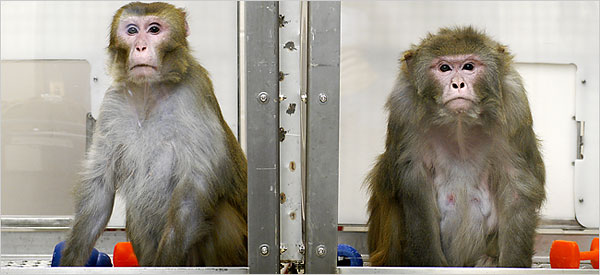
Jeff Miller of the University of Wisconsin-Madison caught Canto and Owen on camera for the NY Times Science News today. "Canto, left, a rhesus monkey, is aging fairly well at 25 on a calorie restriction diet. Owen, though only a year older than Canto, is frail and moves slowly. He eats a normal diet."
Thanks to Michael Mason, who wrote about the research at the Wisconsin National Primate Research Center. We've all heard about calorie restricted diets for quite some time and some good indicators about improved overall health have come out of the research. But now, it's beginning to look more real. Mason says it best, "In the last year, calorie-restricted diets have been shown in various animals to affect molecular pathways likely to be involved in the progression of Alzheimer's disease, diabetes, heart disease, Parkinson's disease, and cancer." Some researchers are beginning to say this approach is even better than exercise at preventing or delay typical age-related diseases. Of course, a balanced diet is critical, even with restricted caloric intake of about 30% below typical levels, and must include the vitamins and minerals that our bodies need. Pushing away from the table sooner is looking better and better.
The article goes on to discuss other ways of extending the quality of life and longevity with the idea that slowing down aging also slows down diseases, such as heart disease and Alzheimer's.
Technorati tags: cognition, brain, longevity, aging, calorie restriction, Alzheimer's, health and wellness, brain health,
Thanks to Michael Mason, who wrote about the research at the Wisconsin National Primate Research Center. We've all heard about calorie restricted diets for quite some time and some good indicators about improved overall health have come out of the research. But now, it's beginning to look more real. Mason says it best, "In the last year, calorie-restricted diets have been shown in various animals to affect molecular pathways likely to be involved in the progression of Alzheimer's disease, diabetes, heart disease, Parkinson's disease, and cancer." Some researchers are beginning to say this approach is even better than exercise at preventing or delay typical age-related diseases. Of course, a balanced diet is critical, even with restricted caloric intake of about 30% below typical levels, and must include the vitamins and minerals that our bodies need. Pushing away from the table sooner is looking better and better.
The article goes on to discuss other ways of extending the quality of life and longevity with the idea that slowing down aging also slows down diseases, such as heart disease and Alzheimer's.
Technorati tags: cognition, brain, longevity, aging, calorie restriction, Alzheimer's, health and wellness, brain health,
Tuesday, October 24, 2006
We Are What They Think We Are
In the October 20 issue of Science, researchers Dar-Nimrod and Heine from the University of British Columbia reported on a study they conducted. They told one group of women that women do not perform well in science and math, using a disguised research study report as the basis of this "fact." The other group was not shown the "study results." And guess what? Well, of course. The women who thought that women were naturally bad at math and science performed much more poorly than the group that just got to wing it, using their own perceptions and skills. Chris Lee at Nobel Intent also commented on this study and as he points out, "scientific theories that promulgate genetic explanations for performance difference become self-fulfilling. . . there are enough high-performing women scientists in all fields to indicate that genetics is unlikely to be a major contributor to women's average under-performance in math and science."
These results are amazingly similar to the research conducted with blue and brown-eyed children in the 50s. One group was inferior one day and the other group was deemed inferior the next day with the expected results: huge drops in self-esteem, feelings of interiority and associated behaviors, such as shyness, loss of humor, etc.
This study also reminds me of the recent finding regarding people who ignore the stereotypes associated with a certain age. Researchers found that indeed they behaved in every way like people many years younger. We seem to want to fit the stereotype one way or another. Are these behaviors a result of mirror-psych neurons?
Technorati tags: cognition, brain, neuroscience, aging,
These results are amazingly similar to the research conducted with blue and brown-eyed children in the 50s. One group was inferior one day and the other group was deemed inferior the next day with the expected results: huge drops in self-esteem, feelings of interiority and associated behaviors, such as shyness, loss of humor, etc.
This study also reminds me of the recent finding regarding people who ignore the stereotypes associated with a certain age. Researchers found that indeed they behaved in every way like people many years younger. We seem to want to fit the stereotype one way or another. Are these behaviors a result of mirror-psych neurons?
Technorati tags: cognition, brain, neuroscience, aging,
Sunday, October 15, 2006
Scheherazade
My mother sits in her grandfather's wing chair upholstered many times over, now covered in worn fabric with a creamy yellow background with small blue flowers. We have just moved all of her things, again. Her paintings fill the opposite wall, two and three deep, almost up to the ceiling. The high ceiling of the room, which we call an apartment, provides the space for my mother's precious drawings, prints, paintings, and found art that make up the framework of familiarity and memory of her 80-something-year-old life. We feel comforted by that and hope she is, too. Her children, my sister, the baby and now in her 40s, my brother who is retired, and myself, the oldest, have moved her choices of furniture and keepsakes into the "apartment" with one door leading out into the world and one door leading to the nurses' station and the cheerful atrium with dining tables and comfortable living room sofas.
I sense that Mother feels numb. I think she wants to laugh and smile and cry again. She wants to be interested again in life, love and adventure. She has always had such a strong inner life, protecting her most prized possession, her creativity. But now, her eyes have lost their gleam, their energy and willfulness, their life. Her life. She often complains of the intense pain in her lower back and has focused on her pain, the pain of going on and on and on, the pain of living beyond her routine, her fulfillments, her husband, her friends, the pain of having to learn everything, and every person, in a new place, all over again. She seems tired, worn with living. She often falls, sometimes head first, sometimes against the bed or the bureau, leading to more pain, more confusion. And fear.
Her muscles have contracted to nothing, her thin-skinned arms hang with flesh instead of flexing with taut muscles as they did in her gardening days, symbolic of all that has faded, evaporated, gone away. Her skin is paper-thin and so wrinkled, cream crepe with dark purple, light mauve and brown tie-dyed colorations, in strange patterns. her own patterns. She always covers her arms now with fabric, not with the lively colored stones of her many, many bracelets. She avoids deep v-neck shirts and blouses, for the same reason, and has lost interest in her vast collection of earrings and necklaces. She still takes some glory in her beautiful silver white hair. She hangs on to her weekly hair appointments like they're the last life raft available from the sinking ship of age. And she does perk up visibly after having her shampoo and coif; she clearly feels comfortable reminiscences of her former beauty and self.
I flew in from California to see her. We have had a heavy schedule of movies this week. My mother loves for me to take her to movies and restaurants when I am in town. We go in the early afternoon to avoid the crowds. Moving her body from car to wheelchair through the thick, slow-opening doors of the theaters is hard work. She always goes to the restroom afterwards, which is arduous for both of us.
"Mother, do you need anything or would you like anything?" I ask as my mother and I return from an art movie. We've had an early dinner at the French cafe next door to the film house, sitting on the terrace, enjoying the sun in our faces. My mother looks so small in her wheelchair. "Would you like some particular kind of food? Or books?"
She shakes her head and then suddenly brightens. "Classical music," she whispers.
"Great. So you've been using that CD player I got you?" She nods. "OK, what would you like? Mozart, Bach, Brahms, Vivaldi?"
"Yes, yes," she shakes her head up and down slowly, looking at me intensely. "I've missed music."
I hope so, I thought. This is a woman who has always had music in her life. I feel a pang. My sister and I sold her beautiful white enameled grand piano. She loved playing and owning that piano. She loved composing. She loved singing and playing for others. She loved to dance, too. Music brought joy to my mother's face, everyday as she played a few pieces alone for herself. As a child, I felt calmer and somehow more loved when I heard her magical soft touch on the piano. It meant Mother was having a happy, small spiritual energizing interlude. And I was included if I was in hearing distance.
Her short-term memory is shot. Her body is frail and broken. Her hand-eye coordination is pitiful. She's lost her sense of humor, her saucy edge, her flirtatious kick, and her multitude of interests. She has had many batches of TIA's, those nasty clusters of little strokes that put roadblocks on the brain's neural paths. We call them MIA's because the mother we knew is missing in action now.
I stop by the local music store and run in to buy an armload of classical CDs: Brahms, Beethoven, Rimsky-Korsakov. "Art, music, reading, writing, travel, and appreciation of nature are all manifestations of the great spirit within us that needs to be heard, " my mother often told me as I was growing up.
"Can you help me dress for bed?" Mother says, even though it's just now 6 p.m. We've arrived at her apartment after our afternoon foray into movies, food, and CD-buying.
"Sure." I carefully pull her pink sweater over her newly coiffed hairdo. Multiple folds of flaccid skin hang from her upper arms but her shoulders look like those of a young girl. I pull her black synthetic trousers down her legs, careful to keep her diaper and her dignity in place. I pull her pink nylon nightie over her head and gently lie her down on her bed.
"Please tuck me in," she says sweetly, like a small child trying to do the right thing.
I pull the covers up under her chin and give her a big kiss on her cheek. "I love you, Mother. Is there anything else you'd like me to do?"
"Yes, I want to listen to Scheherazade forever. Can you make it keep playing?" She softly sighs, worried.
"Yes, Mother, I will." As the wistful and sweet strains of that paean to exotic adventure begins to play, big tears roll from the edge of my eyes. I am overcome with grief and sadness.
I sense that Mother feels numb. I think she wants to laugh and smile and cry again. She wants to be interested again in life, love and adventure. She has always had such a strong inner life, protecting her most prized possession, her creativity. But now, her eyes have lost their gleam, their energy and willfulness, their life. Her life. She often complains of the intense pain in her lower back and has focused on her pain, the pain of going on and on and on, the pain of living beyond her routine, her fulfillments, her husband, her friends, the pain of having to learn everything, and every person, in a new place, all over again. She seems tired, worn with living. She often falls, sometimes head first, sometimes against the bed or the bureau, leading to more pain, more confusion. And fear.
Her muscles have contracted to nothing, her thin-skinned arms hang with flesh instead of flexing with taut muscles as they did in her gardening days, symbolic of all that has faded, evaporated, gone away. Her skin is paper-thin and so wrinkled, cream crepe with dark purple, light mauve and brown tie-dyed colorations, in strange patterns. her own patterns. She always covers her arms now with fabric, not with the lively colored stones of her many, many bracelets. She avoids deep v-neck shirts and blouses, for the same reason, and has lost interest in her vast collection of earrings and necklaces. She still takes some glory in her beautiful silver white hair. She hangs on to her weekly hair appointments like they're the last life raft available from the sinking ship of age. And she does perk up visibly after having her shampoo and coif; she clearly feels comfortable reminiscences of her former beauty and self.
I flew in from California to see her. We have had a heavy schedule of movies this week. My mother loves for me to take her to movies and restaurants when I am in town. We go in the early afternoon to avoid the crowds. Moving her body from car to wheelchair through the thick, slow-opening doors of the theaters is hard work. She always goes to the restroom afterwards, which is arduous for both of us.
"Mother, do you need anything or would you like anything?" I ask as my mother and I return from an art movie. We've had an early dinner at the French cafe next door to the film house, sitting on the terrace, enjoying the sun in our faces. My mother looks so small in her wheelchair. "Would you like some particular kind of food? Or books?"
She shakes her head and then suddenly brightens. "Classical music," she whispers.
"Great. So you've been using that CD player I got you?" She nods. "OK, what would you like? Mozart, Bach, Brahms, Vivaldi?"
"Yes, yes," she shakes her head up and down slowly, looking at me intensely. "I've missed music."
I hope so, I thought. This is a woman who has always had music in her life. I feel a pang. My sister and I sold her beautiful white enameled grand piano. She loved playing and owning that piano. She loved composing. She loved singing and playing for others. She loved to dance, too. Music brought joy to my mother's face, everyday as she played a few pieces alone for herself. As a child, I felt calmer and somehow more loved when I heard her magical soft touch on the piano. It meant Mother was having a happy, small spiritual energizing interlude. And I was included if I was in hearing distance.
Her short-term memory is shot. Her body is frail and broken. Her hand-eye coordination is pitiful. She's lost her sense of humor, her saucy edge, her flirtatious kick, and her multitude of interests. She has had many batches of TIA's, those nasty clusters of little strokes that put roadblocks on the brain's neural paths. We call them MIA's because the mother we knew is missing in action now.
I stop by the local music store and run in to buy an armload of classical CDs: Brahms, Beethoven, Rimsky-Korsakov. "Art, music, reading, writing, travel, and appreciation of nature are all manifestations of the great spirit within us that needs to be heard, " my mother often told me as I was growing up.
"Can you help me dress for bed?" Mother says, even though it's just now 6 p.m. We've arrived at her apartment after our afternoon foray into movies, food, and CD-buying.
"Sure." I carefully pull her pink sweater over her newly coiffed hairdo. Multiple folds of flaccid skin hang from her upper arms but her shoulders look like those of a young girl. I pull her black synthetic trousers down her legs, careful to keep her diaper and her dignity in place. I pull her pink nylon nightie over her head and gently lie her down on her bed.
"Please tuck me in," she says sweetly, like a small child trying to do the right thing.
I pull the covers up under her chin and give her a big kiss on her cheek. "I love you, Mother. Is there anything else you'd like me to do?"
"Yes, I want to listen to Scheherazade forever. Can you make it keep playing?" She softly sighs, worried.
"Yes, Mother, I will." As the wistful and sweet strains of that paean to exotic adventure begins to play, big tears roll from the edge of my eyes. I am overcome with grief and sadness.
Sunday, September 10, 2006
Exercise Prevents Fraility
The scientific evidence is so clear--keep exercising regularly throughout life to prevent fraility, among other commonly accepted conditions previously thought to be a natural part of aging. Guess what? These conditions appear not to be the consequence of years going by. A regiment of aerobic exercise and weight training is highly likely to prevent fraility and has been shown to be able to reverse it in several studies funded by the National Institute on Aging at NIH. The NIA wants to figure out why some people become frail as they age and to understand ways to prevent this vitality-zapping condition. In an article in today's San Francisco Chronicle, writer Alice Dembner of the Boston Globe, points out that, according to this NIH research, we "can throw out another convention of old age. Researchers are finding that fraility may not be the inevitable result of aging but rather is a preventable and perhaps treatable condition."
technorati: Boomers, health and wellness, aging, exercise, fraility
technorati: Boomers, health and wellness, aging, exercise, fraility
How to Be a Working Artist--and Stay Sharp
Instead of declining into retirement with age-appropriate activities like cruises, golf, and watching the world go by, move to a community of like-minded souls focused on active lives of creativity and participation. Add in some professional experts for advice and guidance and you have a shot at a spectacular new career. You'll also start reversing general decline of the body, mind, and spirit and preventing future health issues. And you may very well be paid handsomely for your work as playwright, radio personality, artist, composer, or musician.
A front-page NY Times article today by Patricia Leigh Brown, "At New Rentals, the Aim Is to Age with Creativity" highlights a study jointly sponsored by George Washington University and The National Endowment for the Arts called "The Creativity and Aging Study." As Dr. Gene Cohen, one of the directors of the study, says in a summary of the results of this first two-year research of its kind, "Awareness that there is no age limit to tapping human potential affects not only how we view and prepare for our own future development, but it also influences how society nurtures and benefits from its older human resources." Also interesting is that many of the participants had already lived "normal" lifespans and were in their 80s and 90s at the time of the study. So what will happen when Boomers, the first of whom are now reaching 60, demand to be heard--creatively, politically, and as wage-earners? I think we're in for some exciting times.
Dr. Cohen adds in the NY Times article, “We’re thinking beyond the problems of aging to its potential. . . . What’s emerging is a very talented group of people who are an under-recognized national resource.”
technorati: Boomers, health and wellness, brain, creativity, aging
A front-page NY Times article today by Patricia Leigh Brown, "At New Rentals, the Aim Is to Age with Creativity" highlights a study jointly sponsored by George Washington University and The National Endowment for the Arts called "The Creativity and Aging Study." As Dr. Gene Cohen, one of the directors of the study, says in a summary of the results of this first two-year research of its kind, "Awareness that there is no age limit to tapping human potential affects not only how we view and prepare for our own future development, but it also influences how society nurtures and benefits from its older human resources." Also interesting is that many of the participants had already lived "normal" lifespans and were in their 80s and 90s at the time of the study. So what will happen when Boomers, the first of whom are now reaching 60, demand to be heard--creatively, politically, and as wage-earners? I think we're in for some exciting times.
Dr. Cohen adds in the NY Times article, “We’re thinking beyond the problems of aging to its potential. . . . What’s emerging is a very talented group of people who are an under-recognized national resource.”
technorati: Boomers, health and wellness, brain, creativity, aging
Thursday, August 17, 2006
Obnoxious and Cranky? You're Very Intelligent! (If You're 60+)
So the real question is: do our personalities change as we get older? Jacqueline Bichsel and colleagues at Morgan State College in Baltimore say yes. Younger intelligent people explore adventurous avenues to learn new and different things. Older people, according to Bichsel's study, just get cranky. Or maybe impatient. Or maybe really irritated. Maybe when a patronizing person calls a 60+ year-old professional woman "young lady" or raises the voice volume to ear-piercing levels, speaking slowly, as to a child. Maybe then, an intelligent 60+ person may come up with a few choice words, articulate, to the point, OK--cranky! And maybe really intelligent people just have infinitely more word choices available to them to show their displeasure.
I found Mary Blair Immel's "My Turn" in the July 31 Newsweek great for summing up the likely feelings of so many really intelligent people as they get older. Take a look at "I'm Old--And I'm Just Fine With That." The sub-title is even better: "Think I need to hear platitudes and "compliments" to feel good about myself. Think again."
Suppose we could have a study on exactly what incites this crankiness in the 60+ crowd? Which personality traits would those be?
technorati: brain, mind, aging, Boomers
I found Mary Blair Immel's "My Turn" in the July 31 Newsweek great for summing up the likely feelings of so many really intelligent people as they get older. Take a look at "I'm Old--And I'm Just Fine With That." The sub-title is even better: "Think I need to hear platitudes and "compliments" to feel good about myself. Think again."
Suppose we could have a study on exactly what incites this crankiness in the 60+ crowd? Which personality traits would those be?
technorati: brain, mind, aging, Boomers
Subscribe to:
Posts (Atom)


