Wednesday, December 20, 2006
Reading Shakespeare Sparks Peak in Brain Activity
Thanks to the Science Blog for bringing this one to my attention. Researchers from the School of English and the MRI Analysis Center at the University of Liverpool collaborated to discover that when participants in their study read Shakespeare, their brains felt a little twinkle dust and magically peaked, indicating heavy-duty thinking. What caused this sparkle? Shakespeare used common words differently. He employed, linguistically speaking, functional shift, meaning he sometimes used a verb as a noun or a noun as an adjective or a verb as noun, all of which make our minds backtrack and rethink what's going on, to figure out the meaning of the word before we fit it into the meaning of the sentence or phrase. According to the researchers, the brain goes boom and we also begin to understand multiple meanings of a line or phrase, giving dramatic umph to the words. We also feel satisfaction and delight that we figured out the puzzle, making the whole event very entertaining. The researchers compared the mind's work in this situation to putting a jigsaw puzzle together. If you see how it all fits immediately, it becomes boring. If you have to work on it, it's much more interesting, offering surprises and creating the need for bursts of activity. And our brains really like that. And we do, too, if we enjoy the surprise and/or successfully solve the puzzle.


Tuesday, December 19, 2006
NIA Study: Cognitive Skills Training Keeps Our Brains Sharp
Great news today from the ACTIVE (the Advanced Cognitive Training for Independent and Vital Elderly) study, a large longitudinal study funded by the National Institute on Aging and the National Institute of Nursing Research, both parts of the NIH. People who actively train on specific cognitive skills (in this case, memory, processing speed, and reasoning) experience long-term benefits that generalize into everyday living. The group who trained were much more likely to succeed at everyday tasks like driving, managing money, and general problem-solving than their peers who did not participate in these mental exercises. In other words, they kept their mental edge. The conclusion: "use it or lose it" really does apply to the brain, too, and cognitive training can make a big difference.
Heretofore, one of the researchers--Timothy Salthouse--has been very negative about cognitive skills training and has been quoted widely. He has questioned whether there is any worthwhile effect--short or long-term--or if cognitive training can generalize to real-life situations.
Today we got a very different and much more positive view of this important research. Kudos to everyone involved and especially to lead author Sherry L. Willis, PhD of Pennsylvania State University and her co-authors at six other affiliated institutions.
Heretofore, one of the researchers--Timothy Salthouse--has been very negative about cognitive skills training and has been quoted widely. He has questioned whether there is any worthwhile effect--short or long-term--or if cognitive training can generalize to real-life situations.
Today we got a very different and much more positive view of this important research. Kudos to everyone involved and especially to lead author Sherry L. Willis, PhD of Pennsylvania State University and her co-authors at six other affiliated institutions.
Monday, December 18, 2006
Blog Tag Game--5 Things People May Not Know About Me
Hey, it's the holidays! And have happy ones. Jim McGee from McGee's Musings just tagged me in a blog tagging game to list five things people may not know about me. I've known Jim since we were section mates in business school--thanks for wanting to know, Jim. Here goes:
1. I was the youngest female (and maybe youngest male or female) licensed ham radio operator in the US at age nine.
2. I never knew (or was aware that I knew) a person with an MBA before I applied to business school. It just sounded like a great idea and fit for me.
3. My Master's thesis in Linguistics was a behavioral study on the differences between male and female language. I wasn't smart enough to make my findings into a best-selling book years before Deborah Tannen did with her series on the same subject.
4. When I arrived in Tunisia as a newly minted Peace Corps Volunteer, I had no idea how to cook or what to do with all the new (to me) ingredients. A few weeks later, 500 surplus books arrived as a gift from USAID. Amongst all the reading delights was a paperback Fannie Farmer Boston School of Cooking cookbook. I started on page one and went straight through the book to page 349 (I skipped canning and freezing). Catsup from scratch was a highlight. When I couldn't find ingredients, I just substituted what I thought was the closest thing. I had no oven. I used a "Jerusalem oven," which sits on top of the burner, is funnel-shaped with a top and a tray that fits inside the funnel so that the heat comes over the top to bake things. Everything I "baked" had a hole in the center.
5. I canoed the more than 200 miles of the Savannah River, before any reservoirs were built, from Augusta to Savannah, GA. My most vivid memories are of at least forty owls singing in a soulful chorus from the upper reaches of the piney woods for hours in the middle of the night along a river bank where we camped and, at the end point of the trip, attaching the canoe to a post at River Street in Savannah, hitting the bars in celebration, and coming back after the tide went out--the canoe was totally vertical, hanging several feet above the water. We had strapped in our gear.
These are the people I'll tag:
1. Tim Van Gelder
2. Lori Hyland-Cho
3. Chris Chatham
4. Sylvia Paull
5. Stephanie Rieger
1. I was the youngest female (and maybe youngest male or female) licensed ham radio operator in the US at age nine.
2. I never knew (or was aware that I knew) a person with an MBA before I applied to business school. It just sounded like a great idea and fit for me.
3. My Master's thesis in Linguistics was a behavioral study on the differences between male and female language. I wasn't smart enough to make my findings into a best-selling book years before Deborah Tannen did with her series on the same subject.
4. When I arrived in Tunisia as a newly minted Peace Corps Volunteer, I had no idea how to cook or what to do with all the new (to me) ingredients. A few weeks later, 500 surplus books arrived as a gift from USAID. Amongst all the reading delights was a paperback Fannie Farmer Boston School of Cooking cookbook. I started on page one and went straight through the book to page 349 (I skipped canning and freezing). Catsup from scratch was a highlight. When I couldn't find ingredients, I just substituted what I thought was the closest thing. I had no oven. I used a "Jerusalem oven," which sits on top of the burner, is funnel-shaped with a top and a tray that fits inside the funnel so that the heat comes over the top to bake things. Everything I "baked" had a hole in the center.
5. I canoed the more than 200 miles of the Savannah River, before any reservoirs were built, from Augusta to Savannah, GA. My most vivid memories are of at least forty owls singing in a soulful chorus from the upper reaches of the piney woods for hours in the middle of the night along a river bank where we camped and, at the end point of the trip, attaching the canoe to a post at River Street in Savannah, hitting the bars in celebration, and coming back after the tide went out--the canoe was totally vertical, hanging several feet above the water. We had strapped in our gear.
These are the people I'll tag:
1. Tim Van Gelder
2. Lori Hyland-Cho
3. Chris Chatham
4. Sylvia Paull
5. Stephanie Rieger
Friday, December 15, 2006
Make Your Brain Sweat with Bikram Yoga
I have neglected this blog because I've been on the road on business. In New York City and in between appointments, I ran across the street to a Bikram Yoga studio to try this hot (and I really do mean hot--the room is heated to at least 100 degrees Fahrenheit), new type of yoga. I've heard friends rave about it in California but I've always thought it would be wildly uncomfortable and I like the more traditional yoga I already practice. But alas, I needed some stretching and the convenience factor was large. I plunked my $25 down for one and a half hours, a mat and two large towels and entered the sauna-like room. John, our instructor, greeted me enthusiastically. This was to be an advanced class. I explained that I regularly practice yoga and he assured me that most of the poses would be familiar to me. The large dance studio-like room filled to the brim with people who carefully unrolled their purple and orange mats and covered them with two regular length white terry towels, preparing for all that sweat. The room had mirrors from floor to ceiling the length of the room (unlike regular yoga, we are encouraged to look at ourselves) and windows to the 20 degree weather on E. 83rd St. on the short side. According to the brochure, "The Bikram Yoga Series is a challenging, 90-minute workout that improves physical strength, flexibility, and balance while enhancing mental clarity and focus. The practice is a sequence of 26 poses, including two breathing exercises performed in a heated environment."
John welcomed us all and explained that he would not be showing us the poses, as in regular yoga. He would be talking us through them. And wow, did he! A mile a minute, cajoling, encouraging, calling everyone in the room (all fifty of us) by name more than once. Even though the poses were familiar, the effort seemed more intense and more aerobic in part because the movements were faster and the heat facilitated the stretching and bending and holding of our muscles. Distracted by the sweat pouring off every part of my body, I had to really concentrate on each pose to make it happen. And I managed all but the most advanced. Water and a face towel--couldn't have done without them.
So how did I feel at the end of this endurance test? Absolutely great. Refreshed. Energized. Exercised. Ready for more.
In my younger days, I zoomed down rivers in canoes and kayaks, winding my way through complex technical whitewater. I hiked above the treeline and in gorges. Today, I'm trying Bikram Yoga. The same rush of discovery is definitely there. I like it. I'll be finding a Bikram Yoga studio I like in my own neighborhood soon.
John welcomed us all and explained that he would not be showing us the poses, as in regular yoga. He would be talking us through them. And wow, did he! A mile a minute, cajoling, encouraging, calling everyone in the room (all fifty of us) by name more than once. Even though the poses were familiar, the effort seemed more intense and more aerobic in part because the movements were faster and the heat facilitated the stretching and bending and holding of our muscles. Distracted by the sweat pouring off every part of my body, I had to really concentrate on each pose to make it happen. And I managed all but the most advanced. Water and a face towel--couldn't have done without them.
So how did I feel at the end of this endurance test? Absolutely great. Refreshed. Energized. Exercised. Ready for more.
In my younger days, I zoomed down rivers in canoes and kayaks, winding my way through complex technical whitewater. I hiked above the treeline and in gorges. Today, I'm trying Bikram Yoga. The same rush of discovery is definitely there. I like it. I'll be finding a Bikram Yoga studio I like in my own neighborhood soon.
Wednesday, November 29, 2006
Brain Health: We're Starting to Test the Right Things
As the director of a longevity center at a respected research institution said to me recently, "We just haven't figured out what to test. We haven't been creative enough." She was referring to our discussion of what kinds of exercises really keep our brains fit. That seems to be changing.
Jonathan McNulty of the School of Medicine and Medical Science, University College, Dublin, has tried a different approach. And it works. His team found that simple yet intensive memorization followed by a rest period resulted in ". . . both metabolic changes in the brain and improved memory performance." The 55- to 70-year-old volunteers were given six weeks for intensive rote memorization tasks, such as memorizing a newspaper article or poetry, of 500 words. They then had six weeks of rest.
Here's the kicker: when tested immediately after the memorization work, there was no change in brain metabolism or memory performance. But after the six-week rest, all of the volunteers showed improvements in verbal and episodic memory (the ability to relate story or tell a joke).
This reminds me of a trick I've long used: if I have a problem I need to figure out, I assign my brain the task, usually before going to sleep, and forget about it. Typically, later (and sometimes immediately when I wake up the next morning), a solution or at least a way of thinking about the problem pops up (without being summoned) in my mind. Our brains clearly need some down time to work on their own without our conscious interference.
Recently, there have been several studies using the Stroop test. That's the one with color words written in a different color (the word blue written in yellow, for example) and you're asked to identify the color of the letters. The distraction of automatic reading of the word makes it challenging to identify the letter color. Several researchers have shown that intensive work on the Stroop test (or similar tests or games) can substantially improve driving skills. Why? Because driving requires concentration--the ability to override distractions and automatic responses and choose the required response.
To me, these studies test the right things and are beginning to prove that practice on cognitive process (fluid intelligence) is just as important as acquired knowledge (crystallized intelligence). It takes both to keep our mental edge.
Jonathan McNulty of the School of Medicine and Medical Science, University College, Dublin, has tried a different approach. And it works. His team found that simple yet intensive memorization followed by a rest period resulted in ". . . both metabolic changes in the brain and improved memory performance." The 55- to 70-year-old volunteers were given six weeks for intensive rote memorization tasks, such as memorizing a newspaper article or poetry, of 500 words. They then had six weeks of rest.
Here's the kicker: when tested immediately after the memorization work, there was no change in brain metabolism or memory performance. But after the six-week rest, all of the volunteers showed improvements in verbal and episodic memory (the ability to relate story or tell a joke).
This reminds me of a trick I've long used: if I have a problem I need to figure out, I assign my brain the task, usually before going to sleep, and forget about it. Typically, later (and sometimes immediately when I wake up the next morning), a solution or at least a way of thinking about the problem pops up (without being summoned) in my mind. Our brains clearly need some down time to work on their own without our conscious interference.
Recently, there have been several studies using the Stroop test. That's the one with color words written in a different color (the word blue written in yellow, for example) and you're asked to identify the color of the letters. The distraction of automatic reading of the word makes it challenging to identify the letter color. Several researchers have shown that intensive work on the Stroop test (or similar tests or games) can substantially improve driving skills. Why? Because driving requires concentration--the ability to override distractions and automatic responses and choose the required response.
To me, these studies test the right things and are beginning to prove that practice on cognitive process (fluid intelligence) is just as important as acquired knowledge (crystallized intelligence). It takes both to keep our mental edge.
Tuesday, November 28, 2006
A Little Spice in Our Lives: Good Brain Food
In my Peace Corps days as a volunteer teacher in North Africa, I vividly remember buying spices from large burlap spice bags at the Thursday morning open-air market on the main street of my little town, Grombalia, Tunisia. The women selling the spices had colorful orange and brown scarves wrapped around their heads with long, silver earrings dangling from their ears in the Berber style . They were friendly and I often bought spices, taking their advice on how to use them in cooking. That's where I learned to love turmeric, also called curcumin. It's a bright yellow spice which colors everything in its path yellow (including your hands if you're not careful) and is a key ingredient in curry, which accounts for the yellow color of most curries. I like curries of all kinds, mild to spicy, but I learned from the Berber women that turmeric is also great on baked or roasted fish.
Lately, several studies have looked at the effects of turmeric on the prevention of Alzheimer's. Previous research efforts have noted that the rate of Alzheimer's in people over 65 in the US is four times that of the same demographic in India. In fact, in some towns in India, less than one percent of the population over 65 have Alzheimer's. Naturally, diet is one place to look for the differences. And yes, turmeric is a grand antioxidant, which appears to significantly help prevent the plaques and tangles and related inflammation of Alzheimer's in the brain.
This finding, the latest in a series of similar findings over the last few months, came from research at the University of California, Los Angeles, led by Dr. Sally Frautschy.
Lately, several studies have looked at the effects of turmeric on the prevention of Alzheimer's. Previous research efforts have noted that the rate of Alzheimer's in people over 65 in the US is four times that of the same demographic in India. In fact, in some towns in India, less than one percent of the population over 65 have Alzheimer's. Naturally, diet is one place to look for the differences. And yes, turmeric is a grand antioxidant, which appears to significantly help prevent the plaques and tangles and related inflammation of Alzheimer's in the brain.
This finding, the latest in a series of similar findings over the last few months, came from research at the University of California, Los Angeles, led by Dr. Sally Frautschy.
Monday, November 27, 2006
Pilates' Small, Powerful Moves: Good for Our Brains
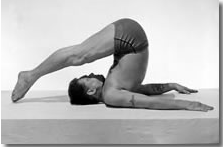
Preliminary studies are showing that some people with Parkinson's Disease can benefit greatly from regular, consistent Pilates classes and exercises. The mind-body connection that Pilates offers may help with brain disorders that affect the body's muscles and movement, like Parkinson's. Sounds like a great reason to make Pilates a regular part of every one's exercise routine.
I've been a big believer in Pilates for several years so I hope that researchers will look carefully at the mind-body effects of exercises like Pilates. Longitudinal studies, along the lines of those looking at lifestyle choices that reduce the probabilities of diseases like Alzheimer's, would be great to see.
I also understand what is meant by the "small, powerful movements" of Pilates. They're challenging to do but deeply satisfying. As in Yoga, breathing, balance, and concentration are important (and good exercise for the brain and the body). Pilates also works on the body's core strength and flexibility and is particularly good for increasing abdominal strength and therefore reducing lower back tension and pain.
Happiness Is All in Our Brains
I've been fascinated by the recent research findings on happiness. As in so many other areas of neuroscience, scientists have assumed that our happiness quotient is hard-wired in our brains. We humans are sort of stuck with a glass that's either half-full or half-empty. Period. And for some people, there's nothing in the glass. We have a "happiness setting." And guess what? Just as researchers have found that our brains are plastic and capable of change in so many other areas--it's beginning to look like we can change our happiness settings, too--short-term and long-term.
For many years, the emphasis has been on finding a pill that will lift depression. Although many people have been helped enormously by these pharmacological palliatives, many others have not been helped or have had serious side-effects and complications from the drugs. Finally, neuropsychologists and neuroscientists are asking the other side of the question: what makes us happy? how can we feel happier? are there simple ways to lift our spirits to chronic happiness? optimism, even? And do we even need to discuss how critical these feelings are to our quality of life at every age?
The holidays are an especially good time to release the findings of these studies, given that so many people feel particularly lonely and depressed during this time of year.
OK, so what can we do? As psychologist Ed Diener of the University of Illinois says, "Set-point is not destiny." Promising methods coming out of the research include (l) focusing on "signature" strengths (through a questionnaire) and then using those strengths to choose more satisfying daily activities; and (2) thinking of three good things that happen each day just before going to sleep. According to Sonja Lyubomirsky from the University of California, Riverside, these two exercises made a significant difference in people's happiness when they regularly and consistently used them. Of course, as the pu-pu platter of happiness exercises that are proven to work increases, we will each need to experiment to find our own best method.
In other research on happiness, several researchers have been looking at the link between money and happiness. Most people seem to believe that money buys happiness. In fact, folks who move from abject poverty to a more comfortable relationship with money do become measurably happier. But as we move up the wealth scale, it appears that money becomes less and less important to our overall happiness. Makes sense.
I think Diener has it right when he points out that happiness is really all about "process and striving." What he didn't say, in my mind, is more important: happiness is all about feeling purpose in life.
For many years, the emphasis has been on finding a pill that will lift depression. Although many people have been helped enormously by these pharmacological palliatives, many others have not been helped or have had serious side-effects and complications from the drugs. Finally, neuropsychologists and neuroscientists are asking the other side of the question: what makes us happy? how can we feel happier? are there simple ways to lift our spirits to chronic happiness? optimism, even? And do we even need to discuss how critical these feelings are to our quality of life at every age?
The holidays are an especially good time to release the findings of these studies, given that so many people feel particularly lonely and depressed during this time of year.
OK, so what can we do? As psychologist Ed Diener of the University of Illinois says, "Set-point is not destiny." Promising methods coming out of the research include (l) focusing on "signature" strengths (through a questionnaire) and then using those strengths to choose more satisfying daily activities; and (2) thinking of three good things that happen each day just before going to sleep. According to Sonja Lyubomirsky from the University of California, Riverside, these two exercises made a significant difference in people's happiness when they regularly and consistently used them. Of course, as the pu-pu platter of happiness exercises that are proven to work increases, we will each need to experiment to find our own best method.
In other research on happiness, several researchers have been looking at the link between money and happiness. Most people seem to believe that money buys happiness. In fact, folks who move from abject poverty to a more comfortable relationship with money do become measurably happier. But as we move up the wealth scale, it appears that money becomes less and less important to our overall happiness. Makes sense.
I think Diener has it right when he points out that happiness is really all about "process and striving." What he didn't say, in my mind, is more important: happiness is all about feeling purpose in life.
Friday, November 17, 2006
Compound in Red Wine: Endurance and Longevity Go Up, Obesity Goes Down
Nicholas Wade's article in today's NY Times summarizes even more research results coming out of the studies of mice that consumed resveratrol, one of the main ingredients in red wine. The study of resveratrol, given in huge quantities to the mice, may open up a whole new field of drugs to prevent diabetes and reduce obesity, which in and of itself is likely to lower the incidences of stroke and heart attacks, at the very least, and prolong life. This ingredient in red wine has also been shown to dramatically increase endurance and longevity in the mice who took it compared to the ones who didn't. In fact, they resembled "trained athletes" without the training, with lowered heart rate and similar muscle fibers. The latest findings were published in Online Cell and the study was led by Dr. Johan Auwerx at the Institute of Genetics and Molecular and Cellular Biology in Illkirch, France.
The articles and the research point out that the same effects in humans would require the consumption of about 100 bottles of red wine a day. Since that's not possible, it makes sense to wait for the scientists to figure out how to isolate and condense resverarol into capsule form.
For a great series of articles on this research, check out Rob Stein's summaries in the Washington Post of the various aspects of the research: "A second pour of good news about substance in red wine, " "A compound in red wine makes fat mice healthy."and "Red wine compound promises longevity, study finds."
The articles and the research point out that the same effects in humans would require the consumption of about 100 bottles of red wine a day. Since that's not possible, it makes sense to wait for the scientists to figure out how to isolate and condense resverarol into capsule form.
For a great series of articles on this research, check out Rob Stein's summaries in the Washington Post of the various aspects of the research: "A second pour of good news about substance in red wine, " "A compound in red wine makes fat mice healthy."and "Red wine compound promises longevity, study finds."
Sunday, November 12, 2006
Routine Sleep Good for Our Brains
Regular, consistent sleep routines along with short naps are good for our brains, as these recent research findings show:
Researchers at Stanford University School of Medicine found that doctors who took short naps improved their performance and alertness, compared to a control group who did not take sleep breaks. Previous studies of truck drivers and pilots have found the same thing. In our generally sleep-deprived culture, we might wonder if a little nap (30 minutes or less) might also improve our own alertness and performance. Ironically, our culture dictates that naps are a sign of laziness.
In a finding which I believe is related to the pace and sleep-deprivation that we all think is necessary for good performance, researchers at the University of Virginia studied the "mortality link" and found that jet-lag conditions hasten death in older mice. We may not want to study that one in humans.
Let's face it. More studies than we can count conclude the same thing: regular, consistent sleep, regular, consistent physical exercise, regular, consistent mental stimulation, and a consistently nutritious diet help keep us fit and healthy: body, mind, and probably soul. And equally interesting, to balance all that regular, consistent stuff, we also seem to be programmed to search for new challenges and learn about new things. We're just healthier and happier when we do.
Researchers at Stanford University School of Medicine found that doctors who took short naps improved their performance and alertness, compared to a control group who did not take sleep breaks. Previous studies of truck drivers and pilots have found the same thing. In our generally sleep-deprived culture, we might wonder if a little nap (30 minutes or less) might also improve our own alertness and performance. Ironically, our culture dictates that naps are a sign of laziness.
In a finding which I believe is related to the pace and sleep-deprivation that we all think is necessary for good performance, researchers at the University of Virginia studied the "mortality link" and found that jet-lag conditions hasten death in older mice. We may not want to study that one in humans.
Let's face it. More studies than we can count conclude the same thing: regular, consistent sleep, regular, consistent physical exercise, regular, consistent mental stimulation, and a consistently nutritious diet help keep us fit and healthy: body, mind, and probably soul. And equally interesting, to balance all that regular, consistent stuff, we also seem to be programmed to search for new challenges and learn about new things. We're just healthier and happier when we do.
Friday, November 10, 2006
Regular Exercise Increases Our Energy
I love this new finding by University of Georgia researchers, Patrick O'Connor, co-director of the UGA exercise psychology laboratory and a kinesiology professor, and Tim Tuetz, a recent doctoral program graduate. Their findings were published in the November issue of Psychological Bulletin. They found that "sedentary people who completed a regular exercise program reported improved fatigue compared to groups that did not exercise." Further, their analysis found that "every group studied--from healthy adults to cancer patients to those with chronic conditions such as diabetes and heart disease--benefited from exercise.
Although it may seem odd that using energy by exercising actually gives us more energy, we also know from many previous animal studies that exercise promotes higher levels of neurotransmitters, such as dopamine and serotonin, in the animals' brains. Once again, the evidence is clear: regular, consistent exercise is just what we're supposed to do.
Personally, I have known for a long time that if I'm really fatigued and burned out, a fast-paced swim or a challenging yoga class or a brisk walk can re-energize me like nothing else. And the more regular exercise I get, the more my body--and yes, my mind, too--cry out for it.
Technorati tags: cognition, brain, neuroscience, exercise, energy, health and wellness, brain health
Although it may seem odd that using energy by exercising actually gives us more energy, we also know from many previous animal studies that exercise promotes higher levels of neurotransmitters, such as dopamine and serotonin, in the animals' brains. Once again, the evidence is clear: regular, consistent exercise is just what we're supposed to do.
Personally, I have known for a long time that if I'm really fatigued and burned out, a fast-paced swim or a challenging yoga class or a brisk walk can re-energize me like nothing else. And the more regular exercise I get, the more my body--and yes, my mind, too--cry out for it.
Technorati tags: cognition, brain, neuroscience, exercise, energy, health and wellness, brain health
Tuesday, November 07, 2006
Cross-Train Your Brain!
An article in the Nov.6 Fortune Magazine highlights some very interesting research on the brain's ability to learn skills faster through cross-training rather than through repetitive practice on just one skill. Senior Fortune writer Jerry Useem and Jia Lynn Jang write about Dr. Rachael Seidler's research and J. Cog Neuroscience article.
Traditionally, we have believed that to be good or even expert at a particular skill or activity, we must learn skills specifically related to that activity. Dr. Seidler hypothesized that learning skills across several activities could quicken learning and increase overall expertise. She in fact found that subjects exposed to multiple visuomotor skills (compared to a group that focused on acquiring just one skill) were able to transfer skills and parts of skills to acquire new skills more quickly than the other group. In other words, more experience helped create more neural connections and helped make learning faster for those who "cross-trained." They were able to transfer all or parts of skills they knew to learn new skills so they could not only learn them faster but move to higher levels of expertise more quickly.
The authors go on to give fascinating examples of well-known personalities who "cross-trained" in multiple areas and became expert in multiple skills, using experience in one area to apply to others for quicker learning. A couple of examples: Leonardo da Vinci--architect, painter, sculptor, inventor, mathematician, anatomist; Gordon Parks: Life Photographer, Director of Shaft, author, musician. And Condi Rice--diplomat, university professor and administrator, concert-level pianist who plays with Yo-Yo Ma in her spare time.
Gen. Peter Pace, chairman of the Joint Chiefs of Staff, was asked to relate his undergraduate training in nuclear propulsion systems to what he's doing today: "I'm not applying those exact skills every day, but it taught me ways to think through problems--visualizing, conceptualizing--that I do use every day. Your mind touches on these resources and you're not even aware of it."
My take-away from these findings: the hypothesis of cognitive reserve makes more and more sense. Cross-training on multiple cognitive skills aids new learning, builds on the brain's experience, and creates new pathways and connections that can in fact build a mental savings account. Cross-training our brains can only help mental agility over time--cha-ching, cha-ching, cha-ching in that savings account upstairs. As this article points out, "The more varied our skills. . . the more varied the neural pathways in use."
Technorati tags: cognition, brain, longevity, aging, brain exercise, Alzheimer's, health and wellness, brain health
Traditionally, we have believed that to be good or even expert at a particular skill or activity, we must learn skills specifically related to that activity. Dr. Seidler hypothesized that learning skills across several activities could quicken learning and increase overall expertise. She in fact found that subjects exposed to multiple visuomotor skills (compared to a group that focused on acquiring just one skill) were able to transfer skills and parts of skills to acquire new skills more quickly than the other group. In other words, more experience helped create more neural connections and helped make learning faster for those who "cross-trained." They were able to transfer all or parts of skills they knew to learn new skills so they could not only learn them faster but move to higher levels of expertise more quickly.
The authors go on to give fascinating examples of well-known personalities who "cross-trained" in multiple areas and became expert in multiple skills, using experience in one area to apply to others for quicker learning. A couple of examples: Leonardo da Vinci--architect, painter, sculptor, inventor, mathematician, anatomist; Gordon Parks: Life Photographer, Director of Shaft, author, musician. And Condi Rice--diplomat, university professor and administrator, concert-level pianist who plays with Yo-Yo Ma in her spare time.
Gen. Peter Pace, chairman of the Joint Chiefs of Staff, was asked to relate his undergraduate training in nuclear propulsion systems to what he's doing today: "I'm not applying those exact skills every day, but it taught me ways to think through problems--visualizing, conceptualizing--that I do use every day. Your mind touches on these resources and you're not even aware of it."
My take-away from these findings: the hypothesis of cognitive reserve makes more and more sense. Cross-training on multiple cognitive skills aids new learning, builds on the brain's experience, and creates new pathways and connections that can in fact build a mental savings account. Cross-training our brains can only help mental agility over time--cha-ching, cha-ching, cha-ching in that savings account upstairs. As this article points out, "The more varied our skills. . . the more varied the neural pathways in use."
Technorati tags: cognition, brain, longevity, aging, brain exercise, Alzheimer's, health and wellness, brain health
Monday, November 06, 2006
The Slow But Gradual End of Alzheimer's As We Know It
As noted in Sunday's LA Times and this month's Science magazine, November 3 (or 4, depending on which publication you read) marked the hundredth anniversary of Dr. Alois Alzheimer's medical conference presentation of a patient's case with a neurogenerative disease that has come to be known as Alzheimer's Disease. The Neurophilopher's Weblog also did a fine recounting of the history. The LA Times states that another event will also be marked: "the slow but gradual end of Alzheimer's as we know it--and the Americanization of dementia science."
For the last 100 years, scientists have been trying to figure out what causes Alzheimer's plaques and tangles in the brain. Sadly, very few actual advances in therapies have occurred for people who have been diagnosed with AD. But as author Greg Critser points out, President Ronald Reagan and his family's openness about their struggles with AD have motivated researchers to begin looking at AD differently, both in ways to prevent it and therapies to deal with this tragic disease. In the therapeutic arena, stem cell research is one possibility. We know from research on brain plasticity that we can already "rewire" our brains so why not get a little help from transplanted neurons to make connections stifled by AD's plaques and tangles?
On the prevention side, researchers are looking at diet, exercise, mental stimulation, and "dysfunction" of brain cells due to other potentially controllable brain environmental factors, such as the way certain brain cells use glucose. Scientists are realizing that AD does not have to be totally linear in its progression. We are beginning to see solid research on strategies that can prevent or slow down AD and dementia as well as compensation strategies to help the brain create additional connections and pathways through mental stimulation and learning. Many, many scientists are now looking closely at these lifestyle decisions and concluding that it really does matter how you live your life and the choices you make along the way.
Technorati tags: cognition, brain, longevity, aging, brain exercise, Alzheimer's, health and wellness, brain health,
For the last 100 years, scientists have been trying to figure out what causes Alzheimer's plaques and tangles in the brain. Sadly, very few actual advances in therapies have occurred for people who have been diagnosed with AD. But as author Greg Critser points out, President Ronald Reagan and his family's openness about their struggles with AD have motivated researchers to begin looking at AD differently, both in ways to prevent it and therapies to deal with this tragic disease. In the therapeutic arena, stem cell research is one possibility. We know from research on brain plasticity that we can already "rewire" our brains so why not get a little help from transplanted neurons to make connections stifled by AD's plaques and tangles?
On the prevention side, researchers are looking at diet, exercise, mental stimulation, and "dysfunction" of brain cells due to other potentially controllable brain environmental factors, such as the way certain brain cells use glucose. Scientists are realizing that AD does not have to be totally linear in its progression. We are beginning to see solid research on strategies that can prevent or slow down AD and dementia as well as compensation strategies to help the brain create additional connections and pathways through mental stimulation and learning. Many, many scientists are now looking closely at these lifestyle decisions and concluding that it really does matter how you live your life and the choices you make along the way.
Technorati tags: cognition, brain, longevity, aging, brain exercise, Alzheimer's, health and wellness, brain health,
Tuesday, October 31, 2006
Cut Calories: One Way to Live Better and Longer
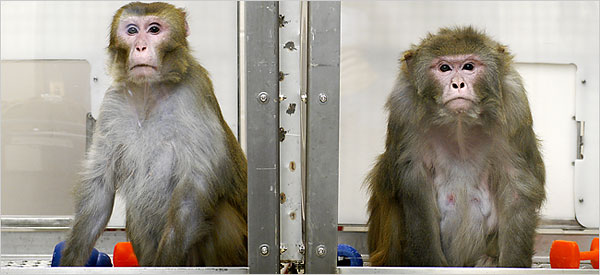
Jeff Miller of the University of Wisconsin-Madison caught Canto and Owen on camera for the NY Times Science News today. "Canto, left, a rhesus monkey, is aging fairly well at 25 on a calorie restriction diet. Owen, though only a year older than Canto, is frail and moves slowly. He eats a normal diet."
Thanks to Michael Mason, who wrote about the research at the Wisconsin National Primate Research Center. We've all heard about calorie restricted diets for quite some time and some good indicators about improved overall health have come out of the research. But now, it's beginning to look more real. Mason says it best, "In the last year, calorie-restricted diets have been shown in various animals to affect molecular pathways likely to be involved in the progression of Alzheimer's disease, diabetes, heart disease, Parkinson's disease, and cancer." Some researchers are beginning to say this approach is even better than exercise at preventing or delay typical age-related diseases. Of course, a balanced diet is critical, even with restricted caloric intake of about 30% below typical levels, and must include the vitamins and minerals that our bodies need. Pushing away from the table sooner is looking better and better.
The article goes on to discuss other ways of extending the quality of life and longevity with the idea that slowing down aging also slows down diseases, such as heart disease and Alzheimer's.
Technorati tags: cognition, brain, longevity, aging, calorie restriction, Alzheimer's, health and wellness, brain health,
Thanks to Michael Mason, who wrote about the research at the Wisconsin National Primate Research Center. We've all heard about calorie restricted diets for quite some time and some good indicators about improved overall health have come out of the research. But now, it's beginning to look more real. Mason says it best, "In the last year, calorie-restricted diets have been shown in various animals to affect molecular pathways likely to be involved in the progression of Alzheimer's disease, diabetes, heart disease, Parkinson's disease, and cancer." Some researchers are beginning to say this approach is even better than exercise at preventing or delay typical age-related diseases. Of course, a balanced diet is critical, even with restricted caloric intake of about 30% below typical levels, and must include the vitamins and minerals that our bodies need. Pushing away from the table sooner is looking better and better.
The article goes on to discuss other ways of extending the quality of life and longevity with the idea that slowing down aging also slows down diseases, such as heart disease and Alzheimer's.
Technorati tags: cognition, brain, longevity, aging, calorie restriction, Alzheimer's, health and wellness, brain health,
Monday, October 30, 2006
AARP: Working to Keep Our Brains Fit
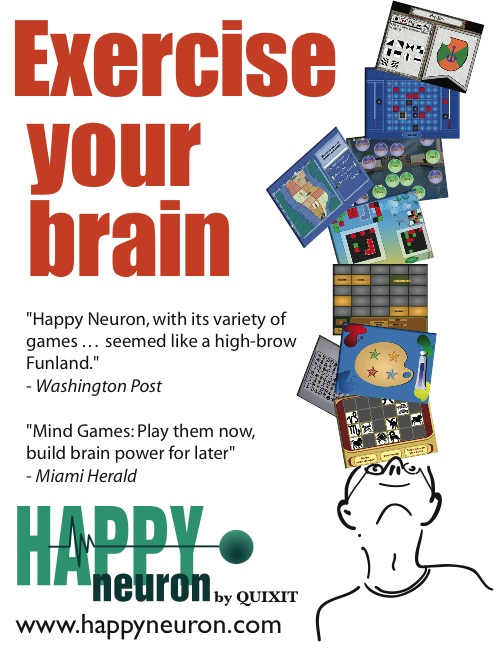
Since our company, Quixit, Inc., is located in the Bay Area and the AARP convention was in Anaheim, California, we decided that we should showcase our newly relaunched www.HappyNeuron.com there. After all, brain health and fitness should be of interest to AARP members, especially games that are fun to play and promote wellness. We worked hard to get our booth, signage, and handouts ready and rolled into Anaheim ready to share our enthusiasm. After 10 hours a day of standing in front of the huge video monitor we rented for our small booth, with postcards and posters in our hands (like the one above), and our 30-second pitch primed to perfection, three of us met the oncoming hordes of men and women strolling the many exhibitor aisles of the huge convention hall.
"Interested in games? Interested in having a fit brain?" we asked endlessly. Most people said yes (of course) and many zoomed down the aisle directly to us. They were familiar with the challenge and wanted to know what they could do.
A few just walked by. One in particular was memorable. He walked quickly by. "I still work," he said.
"Great," I said, "what do you do?"
"I can't tell you," he said.
"Why?"
"Because if I do, I'll have to kill you."
Hmm.m.m. A bit unexpected at the AARP convention.
The theme was "life@50+." So, how do we feel about our AARP exhibitor experience? We are all energized by the enthusiastic reception we received but our brains are fried, our feet are permanently sore, and I want to burn the shoes I wore. It was fun to talk to so many nice folks from all over the US interested in continuing to learn and keeping their brains fit and healthy. Many people had already researched the "use it or lose it" approach to brain fitness. And they wanted to know what to do about it. What is really beyond crossword puzzles, they asked?
Our booth was located just across the aisle from the Nintendo folks who showcased their "BrainAge" software for the Nintendo DS and their Wii suite of games, including bowling, tennis, baseball, golf, and other sports. It was great to take a break every now and then and hit a few tennis serves. Nice people, too, at the Nintendo booth.
I must admit that I had never considered attending an AARP convention before this one. So I was surprised at its size (22,000+), the range for high-quality offerings (Bill Cosby, Maya Angelou, Geena Davis, Don Rather, Connie Chung, etc. as speakers and lesser known but expert speakers on all kinds of tantalizing topics), the friendliness of the staff, the 60s live music in corners around the convention hall and outside, and the high level of interest in brain fitness. And the really nice AARP members who were there.
According to the AARP literature, the average age of the attendees has fallen from 72 about five years ago to about 60. There goes that Baby Boomer effect again! Next year, it will probably be in the high 50s and falling.
I would definitely go to another one. And by the way, next year's will be in Boston.
Technorati tags: cognition, brain, neuroscience, aging, Baby Boomers, AARP, Happy Neuron, brain health,
Tuesday, October 24, 2006
We Are What They Think We Are
In the October 20 issue of Science, researchers Dar-Nimrod and Heine from the University of British Columbia reported on a study they conducted. They told one group of women that women do not perform well in science and math, using a disguised research study report as the basis of this "fact." The other group was not shown the "study results." And guess what? Well, of course. The women who thought that women were naturally bad at math and science performed much more poorly than the group that just got to wing it, using their own perceptions and skills. Chris Lee at Nobel Intent also commented on this study and as he points out, "scientific theories that promulgate genetic explanations for performance difference become self-fulfilling. . . there are enough high-performing women scientists in all fields to indicate that genetics is unlikely to be a major contributor to women's average under-performance in math and science."
These results are amazingly similar to the research conducted with blue and brown-eyed children in the 50s. One group was inferior one day and the other group was deemed inferior the next day with the expected results: huge drops in self-esteem, feelings of interiority and associated behaviors, such as shyness, loss of humor, etc.
This study also reminds me of the recent finding regarding people who ignore the stereotypes associated with a certain age. Researchers found that indeed they behaved in every way like people many years younger. We seem to want to fit the stereotype one way or another. Are these behaviors a result of mirror-psych neurons?
Technorati tags: cognition, brain, neuroscience, aging,
These results are amazingly similar to the research conducted with blue and brown-eyed children in the 50s. One group was inferior one day and the other group was deemed inferior the next day with the expected results: huge drops in self-esteem, feelings of interiority and associated behaviors, such as shyness, loss of humor, etc.
This study also reminds me of the recent finding regarding people who ignore the stereotypes associated with a certain age. Researchers found that indeed they behaved in every way like people many years younger. We seem to want to fit the stereotype one way or another. Are these behaviors a result of mirror-psych neurons?
Technorati tags: cognition, brain, neuroscience, aging,
Monday, October 23, 2006
Mother Was Right: Eat Your Vegetables (They're Good for Your Brain)
Martha Clare Morris, associate professor at Rush University Medical Center in Chicago, has been observing the effects of diet on aging and the brain. She and her team have found that eating vegetables, especially green leafy ones, every day can make a big difference in the brains of those who crunched through kale, spinach, lettuce, chard, and other green leafies and those who didn't: faster thinking. Or, as she put it, the equivalent of being five years younger in age for the veggie-consumers.
The study involved six years of observation of 3,718 participants who were 65 and older and is part of the Chicago Health and Aging Project.
The reason? "Morris suspects that vegetables may help protect memory and thinking speed because they contain high amounts of vitamin E, an antioxidant that can help reduce the damage caused by free radicals, unstable oxygen molecules generated by normal metabolism that can damage neurons in the brain and contribute to dementia." These research results were reported in the Oct. 24 issue of the journal Neurology.
In another report issued by the AMA last year, Morris concluded that eating fish at least once a week increases brain fitness, too, equaling a brain-age three-to-four years younger. Fruit-eaters did not experience such brain-related benefits.
I think by now we all know that green leafy veggies and fish are good diet choices. We didn't know that they could make that much difference. Berkeley Professor of Integrative Biology, Marion Diamond, has been saying this for quite some time, however.
Technorati tags: cognition, brain, Alzheimer's, dementia, memory, brain fitness, diet
The study involved six years of observation of 3,718 participants who were 65 and older and is part of the Chicago Health and Aging Project.
The reason? "Morris suspects that vegetables may help protect memory and thinking speed because they contain high amounts of vitamin E, an antioxidant that can help reduce the damage caused by free radicals, unstable oxygen molecules generated by normal metabolism that can damage neurons in the brain and contribute to dementia." These research results were reported in the Oct. 24 issue of the journal Neurology.
In another report issued by the AMA last year, Morris concluded that eating fish at least once a week increases brain fitness, too, equaling a brain-age three-to-four years younger. Fruit-eaters did not experience such brain-related benefits.
I think by now we all know that green leafy veggies and fish are good diet choices. We didn't know that they could make that much difference. Berkeley Professor of Integrative Biology, Marion Diamond, has been saying this for quite some time, however.
Technorati tags: cognition, brain, Alzheimer's, dementia, memory, brain fitness, diet
Sunday, October 22, 2006
Regular Exercise Works Best for Our Brains
The LA Times Health section featured an article by Greg Miller on Friday which summed up current research on keeping our brains healthy and fit throughout our lives. According to the article, a panel of experts assembled by the National Institutes of Health earlier this year reviewed the scientific literature on cognitive aging. They concluded that regular, consistent mental workouts, physical exercise, social interactions, and attention to cardiovascular health are critical to keeping mental edge as we get older. The regular and consistent part turns out to be extremely important. We already know that quick fixes don't work with exercise or diet. Now it's clear that regular workouts for our brains are also important. Marilyn Albert, a cognitive neuroscientist from Johns Hopkins University summed it up:
"The fab four. . . are physical activity, mental activity, social engagement and cardiovascular health." And researchers say, there's very little difference between men and women in the cognitive aging arena.
Denise Park, another respected researcher in aging and cognition from the University of Illinois adds that it is very important to learn new things with new challenges instead of getting stuck in the same old rut. If you already play the flute, take up a language. If you love cooking, try gardening, too, etc. The message: stay active, physically and mentally, and continue to challenge yourself to stay fit.
Lately in several articles about keeping the brain fit as we age, Dr. Timothy Salthouse has been quoted as the contrarian, based on the large study called A.C.T.I.V.E, that he led. He concluded that mental training is not particularly helpful.
I think it's very important to look at the A.C.T.I.V.E research design to be able to understand why Dr. Salthouse is as negative as he is, at least in the soundbites from newspaper articles. The study lasted for 24 months and tested specific intervals of training in a group of men and women between the ages of 65 and 94. Three of the four groups received ten sessions stretched over several weeks of 60-75 minutes each of training on a particular cognitive skill like reasoning, memory, or processing speed. Then 11 months later, they got three more hours of training (called booster sessions).
The groups were tested three times: after the first set of sessions, after the Booster, and then 24 months after the first sessions. They found a decline in each of the skills at the second and third test points.
In other words, Salthouse et al. found that quick fixes don't work. Why does this surprise anyone? If I don't speak French for a year or two (even with three hours of study in between), my French is less than it used to be. If I speak and study regularly and consistently, I notice that my fluency improves dramatically. Same thing with piano playing, with Sudoku, bridge, and practically any other pursuit that involves my brain that I can think of. Regular practice makes me better and faster at the task at hand. If I don't practice, I slow down. Sounds remarkably like what happens when I don't cycle or swim for a few weeks. I have to work on retraining my muscles and my breathing.
"The fab four. . . are physical activity, mental activity, social engagement and cardiovascular health." And researchers say, there's very little difference between men and women in the cognitive aging arena.
Denise Park, another respected researcher in aging and cognition from the University of Illinois adds that it is very important to learn new things with new challenges instead of getting stuck in the same old rut. If you already play the flute, take up a language. If you love cooking, try gardening, too, etc. The message: stay active, physically and mentally, and continue to challenge yourself to stay fit.
Lately in several articles about keeping the brain fit as we age, Dr. Timothy Salthouse has been quoted as the contrarian, based on the large study called A.C.T.I.V.E, that he led. He concluded that mental training is not particularly helpful.
I think it's very important to look at the A.C.T.I.V.E research design to be able to understand why Dr. Salthouse is as negative as he is, at least in the soundbites from newspaper articles. The study lasted for 24 months and tested specific intervals of training in a group of men and women between the ages of 65 and 94. Three of the four groups received ten sessions stretched over several weeks of 60-75 minutes each of training on a particular cognitive skill like reasoning, memory, or processing speed. Then 11 months later, they got three more hours of training (called booster sessions).
The groups were tested three times: after the first set of sessions, after the Booster, and then 24 months after the first sessions. They found a decline in each of the skills at the second and third test points.
In other words, Salthouse et al. found that quick fixes don't work. Why does this surprise anyone? If I don't speak French for a year or two (even with three hours of study in between), my French is less than it used to be. If I speak and study regularly and consistently, I notice that my fluency improves dramatically. Same thing with piano playing, with Sudoku, bridge, and practically any other pursuit that involves my brain that I can think of. Regular practice makes me better and faster at the task at hand. If I don't practice, I slow down. Sounds remarkably like what happens when I don't cycle or swim for a few weeks. I have to work on retraining my muscles and my breathing.
Thursday, October 19, 2006
Online Brain Exercises

On Tuesday, the Washington Post published an article, "Pumping Neurons," about online brain gyms. We were happy to see that Happy Neuron was one of the sites reviewed and glad to supply all of the pictures of games used in the article. Stacey Weiner, the author, actually went to three different sites and tried them out. She called the broad spectrum of Happy Neuron games a "high-brow Funland" and noted that its workouts were developed by neuroscientists and physicians, who are experts in the field of aging and the prevention of Alzheimer's and dementia. She also noted that the HappyNeuron.com site explains the cognitive skills involved in each game and the real-world applications and connections.
Our team is still working hard on the Happy Neuron site. We want to match the huge amount of scientific research on Alzheimer's prevention with games and exercises that people will actually enjoy playing. We believe that marrying science, achievement, challenge, and fun is the only way that most folks will be motivated to return again and again and again to meet new challenges, be constantly aware of what is involved in keeping our brains and bodies fit, and expand those challenges to everyday activities.
Thanks to Mind Hacks for writing about the article. I commented there on the large number of studies (with many peer-reviewed scientific articles published on them) that contribute to our knowledge about specific activities that can help us keep our brains healthy and fit. Games are high on the list although many other activities can be helpful, too (such as dancing, for example).
Sunday, October 15, 2006
Scheherazade
My mother sits in her grandfather's wing chair upholstered many times over, now covered in worn fabric with a creamy yellow background with small blue flowers. We have just moved all of her things, again. Her paintings fill the opposite wall, two and three deep, almost up to the ceiling. The high ceiling of the room, which we call an apartment, provides the space for my mother's precious drawings, prints, paintings, and found art that make up the framework of familiarity and memory of her 80-something-year-old life. We feel comforted by that and hope she is, too. Her children, my sister, the baby and now in her 40s, my brother who is retired, and myself, the oldest, have moved her choices of furniture and keepsakes into the "apartment" with one door leading out into the world and one door leading to the nurses' station and the cheerful atrium with dining tables and comfortable living room sofas.
I sense that Mother feels numb. I think she wants to laugh and smile and cry again. She wants to be interested again in life, love and adventure. She has always had such a strong inner life, protecting her most prized possession, her creativity. But now, her eyes have lost their gleam, their energy and willfulness, their life. Her life. She often complains of the intense pain in her lower back and has focused on her pain, the pain of going on and on and on, the pain of living beyond her routine, her fulfillments, her husband, her friends, the pain of having to learn everything, and every person, in a new place, all over again. She seems tired, worn with living. She often falls, sometimes head first, sometimes against the bed or the bureau, leading to more pain, more confusion. And fear.
Her muscles have contracted to nothing, her thin-skinned arms hang with flesh instead of flexing with taut muscles as they did in her gardening days, symbolic of all that has faded, evaporated, gone away. Her skin is paper-thin and so wrinkled, cream crepe with dark purple, light mauve and brown tie-dyed colorations, in strange patterns. her own patterns. She always covers her arms now with fabric, not with the lively colored stones of her many, many bracelets. She avoids deep v-neck shirts and blouses, for the same reason, and has lost interest in her vast collection of earrings and necklaces. She still takes some glory in her beautiful silver white hair. She hangs on to her weekly hair appointments like they're the last life raft available from the sinking ship of age. And she does perk up visibly after having her shampoo and coif; she clearly feels comfortable reminiscences of her former beauty and self.
I flew in from California to see her. We have had a heavy schedule of movies this week. My mother loves for me to take her to movies and restaurants when I am in town. We go in the early afternoon to avoid the crowds. Moving her body from car to wheelchair through the thick, slow-opening doors of the theaters is hard work. She always goes to the restroom afterwards, which is arduous for both of us.
"Mother, do you need anything or would you like anything?" I ask as my mother and I return from an art movie. We've had an early dinner at the French cafe next door to the film house, sitting on the terrace, enjoying the sun in our faces. My mother looks so small in her wheelchair. "Would you like some particular kind of food? Or books?"
She shakes her head and then suddenly brightens. "Classical music," she whispers.
"Great. So you've been using that CD player I got you?" She nods. "OK, what would you like? Mozart, Bach, Brahms, Vivaldi?"
"Yes, yes," she shakes her head up and down slowly, looking at me intensely. "I've missed music."
I hope so, I thought. This is a woman who has always had music in her life. I feel a pang. My sister and I sold her beautiful white enameled grand piano. She loved playing and owning that piano. She loved composing. She loved singing and playing for others. She loved to dance, too. Music brought joy to my mother's face, everyday as she played a few pieces alone for herself. As a child, I felt calmer and somehow more loved when I heard her magical soft touch on the piano. It meant Mother was having a happy, small spiritual energizing interlude. And I was included if I was in hearing distance.
Her short-term memory is shot. Her body is frail and broken. Her hand-eye coordination is pitiful. She's lost her sense of humor, her saucy edge, her flirtatious kick, and her multitude of interests. She has had many batches of TIA's, those nasty clusters of little strokes that put roadblocks on the brain's neural paths. We call them MIA's because the mother we knew is missing in action now.
I stop by the local music store and run in to buy an armload of classical CDs: Brahms, Beethoven, Rimsky-Korsakov. "Art, music, reading, writing, travel, and appreciation of nature are all manifestations of the great spirit within us that needs to be heard, " my mother often told me as I was growing up.
"Can you help me dress for bed?" Mother says, even though it's just now 6 p.m. We've arrived at her apartment after our afternoon foray into movies, food, and CD-buying.
"Sure." I carefully pull her pink sweater over her newly coiffed hairdo. Multiple folds of flaccid skin hang from her upper arms but her shoulders look like those of a young girl. I pull her black synthetic trousers down her legs, careful to keep her diaper and her dignity in place. I pull her pink nylon nightie over her head and gently lie her down on her bed.
"Please tuck me in," she says sweetly, like a small child trying to do the right thing.
I pull the covers up under her chin and give her a big kiss on her cheek. "I love you, Mother. Is there anything else you'd like me to do?"
"Yes, I want to listen to Scheherazade forever. Can you make it keep playing?" She softly sighs, worried.
"Yes, Mother, I will." As the wistful and sweet strains of that paean to exotic adventure begins to play, big tears roll from the edge of my eyes. I am overcome with grief and sadness.
I sense that Mother feels numb. I think she wants to laugh and smile and cry again. She wants to be interested again in life, love and adventure. She has always had such a strong inner life, protecting her most prized possession, her creativity. But now, her eyes have lost their gleam, their energy and willfulness, their life. Her life. She often complains of the intense pain in her lower back and has focused on her pain, the pain of going on and on and on, the pain of living beyond her routine, her fulfillments, her husband, her friends, the pain of having to learn everything, and every person, in a new place, all over again. She seems tired, worn with living. She often falls, sometimes head first, sometimes against the bed or the bureau, leading to more pain, more confusion. And fear.
Her muscles have contracted to nothing, her thin-skinned arms hang with flesh instead of flexing with taut muscles as they did in her gardening days, symbolic of all that has faded, evaporated, gone away. Her skin is paper-thin and so wrinkled, cream crepe with dark purple, light mauve and brown tie-dyed colorations, in strange patterns. her own patterns. She always covers her arms now with fabric, not with the lively colored stones of her many, many bracelets. She avoids deep v-neck shirts and blouses, for the same reason, and has lost interest in her vast collection of earrings and necklaces. She still takes some glory in her beautiful silver white hair. She hangs on to her weekly hair appointments like they're the last life raft available from the sinking ship of age. And she does perk up visibly after having her shampoo and coif; she clearly feels comfortable reminiscences of her former beauty and self.
I flew in from California to see her. We have had a heavy schedule of movies this week. My mother loves for me to take her to movies and restaurants when I am in town. We go in the early afternoon to avoid the crowds. Moving her body from car to wheelchair through the thick, slow-opening doors of the theaters is hard work. She always goes to the restroom afterwards, which is arduous for both of us.
"Mother, do you need anything or would you like anything?" I ask as my mother and I return from an art movie. We've had an early dinner at the French cafe next door to the film house, sitting on the terrace, enjoying the sun in our faces. My mother looks so small in her wheelchair. "Would you like some particular kind of food? Or books?"
She shakes her head and then suddenly brightens. "Classical music," she whispers.
"Great. So you've been using that CD player I got you?" She nods. "OK, what would you like? Mozart, Bach, Brahms, Vivaldi?"
"Yes, yes," she shakes her head up and down slowly, looking at me intensely. "I've missed music."
I hope so, I thought. This is a woman who has always had music in her life. I feel a pang. My sister and I sold her beautiful white enameled grand piano. She loved playing and owning that piano. She loved composing. She loved singing and playing for others. She loved to dance, too. Music brought joy to my mother's face, everyday as she played a few pieces alone for herself. As a child, I felt calmer and somehow more loved when I heard her magical soft touch on the piano. It meant Mother was having a happy, small spiritual energizing interlude. And I was included if I was in hearing distance.
Her short-term memory is shot. Her body is frail and broken. Her hand-eye coordination is pitiful. She's lost her sense of humor, her saucy edge, her flirtatious kick, and her multitude of interests. She has had many batches of TIA's, those nasty clusters of little strokes that put roadblocks on the brain's neural paths. We call them MIA's because the mother we knew is missing in action now.
I stop by the local music store and run in to buy an armload of classical CDs: Brahms, Beethoven, Rimsky-Korsakov. "Art, music, reading, writing, travel, and appreciation of nature are all manifestations of the great spirit within us that needs to be heard, " my mother often told me as I was growing up.
"Can you help me dress for bed?" Mother says, even though it's just now 6 p.m. We've arrived at her apartment after our afternoon foray into movies, food, and CD-buying.
"Sure." I carefully pull her pink sweater over her newly coiffed hairdo. Multiple folds of flaccid skin hang from her upper arms but her shoulders look like those of a young girl. I pull her black synthetic trousers down her legs, careful to keep her diaper and her dignity in place. I pull her pink nylon nightie over her head and gently lie her down on her bed.
"Please tuck me in," she says sweetly, like a small child trying to do the right thing.
I pull the covers up under her chin and give her a big kiss on her cheek. "I love you, Mother. Is there anything else you'd like me to do?"
"Yes, I want to listen to Scheherazade forever. Can you make it keep playing?" She softly sighs, worried.
"Yes, Mother, I will." As the wistful and sweet strains of that paean to exotic adventure begins to play, big tears roll from the edge of my eyes. I am overcome with grief and sadness.
Subscribe to:
Posts (Atom)


