How many studies do we have to see before we accept that exercising our brains makes them highly likely to be healthy throughout our lives? The Chicago Aging Study from the Rush University Medical Center has just released results of yet another aspect of their large, multi-year study. This time, more 700 than folks with an average age of 80 were observed. The people who regularly and consistently engaged in cognitively stimulating activities--reading the newspaper, playing chess, seeing plays, reading and visiting the library--were 2.6 times less likely (almost three times less likely!) to develop dementia and Alzheimer's than those who did not engage in such activities. Even mild cognitive impairment, typically associated with age, was greatly delayed and reduced.
I find it interesting that so many of the activities described were interactive ones. In other words, other people were involved, as in a chess partner or seeing a play or going to the library. I believe we will find in future studies that positive interactions with others is a significant method of motivating us to keep our minds in gear.
Showing posts with label Alzheimer's. Show all posts
Showing posts with label Alzheimer's. Show all posts
Friday, July 06, 2007


Tuesday, June 26, 2007
More Transitions
Quixit, Inc., the company I started in 2005 to distribute scientifically based casual online games that focus on specific cognitive skills, such as attention and memory, was acquired yesterday by SBT, a French firm based in Lyon, France. As of today, I will no longer be affiliated with the new company, now called HappyNeuron, Inc. In my roles as CEO of neuroscience technology companies, Quixit and previously Scientific Learning Corporation, I have enjoyed getting to know the scientists, researchers, journalists, publishers, and many others so keenly interested in trying to figure out how to add to our knowledge base about healthy lifestyle choices, the impact of nutrition and exercise on brain health, and the major effects of mental stimulation in keeping our minds healthy and agile. So much is known yet so little has made its way to most people. And there is so much work that needs to be done. I look forward to the now-frequent research reports coming out almost on a weekly basis from respected research institutions on these topics and applaud those in the trenches working to prevent and treat diseases of the mind.
I continue to be curious about and interested in brain fitness and how we all can lower the probabilities of age-related cognitive decline, especially Alzheimer's and other kinds of dementia. I've seen first-hand how devastating the effects can be on the patient, family, and friends. The good news? We can all hope and expect that we will see great strides in our lifetimes in what we know about these horrific diseases of the mind.
Change typically forces new learning and is an excellent way to keep our brains in shape. So change is in the air for me and I welcome this opportunity to move into something new and different.
I continue to be curious about and interested in brain fitness and how we all can lower the probabilities of age-related cognitive decline, especially Alzheimer's and other kinds of dementia. I've seen first-hand how devastating the effects can be on the patient, family, and friends. The good news? We can all hope and expect that we will see great strides in our lifetimes in what we know about these horrific diseases of the mind.
Change typically forces new learning and is an excellent way to keep our brains in shape. So change is in the air for me and I welcome this opportunity to move into something new and different.
Wednesday, March 14, 2007
Our Brains Keep Working, Even in Illness
I made a special trip to see my Mother for a few days around her birthday. Her brown eyes always get big and round with excitement when I walk into the Renaissance wing of Remington House, the assisted living facility where she lives in northeast Georgia about fifty miles from Atlanta. She usually walks herself, using her blue aluminum walker for support, around and around and around the nurses' station in the center of the wing and is often seated at one of the colonial-style sofas in the entrance way, watching all the comings and goings of visitors, residents, and staff. She concentrates, intently, purposefully. Her back is bent with severe arthritis but she lifts her upper body and chin and manages to seemingly observe everything and everyone. She never speaks except when spoken to although she is always polite, her good Southern upbringing never failing her.
I asked her, very specifically, "what would you like for your birthday? Something special to eat?" I imagined myself running all over Atlanta trying to find gourmet goodies. Mother always enjoyed trying new things and loved good food.
She wrinkled her brow and whispered, simply "oysters, fried oysters." Whenever I'm there, I always ask, "want to go to a movie, want to go for a ride, want to go to a restaurant, want to go to an art museum?" And my mother always nods yes, her eyes brightening.
So I did race all over Atlanta to find fresh, shucked oysters, along with tartar and tangy tomato sauce. And we had really fresh, lovely oysters breaded in corn meal and fried in the Remington House kitchen. A very special birthday dinner.
When I left the next day, Mother escorted me, slowly moving her walker along, to the double doors of the entrance way and stood there, balancing one hand on the walker and raising the other. She waved as I drove down the long drive to the highway, until we could no longer see each other. Just as she always used to, my entire life, as I have returned and left again, over and over. I've missed her sweet waving, I realized, in these last years. And this time, more poignantly, I felt the familiar tear well up in the corner of my eye. I was seeing a remnant of my deeply feeling, emotional, articulate, intelligent, creative Mother, who loved me with great affection and suppport. I was remembering that person, who I haven't seen in a long time.
My mother has frontotemporal dementia, or FTD, little known by the general public but well known among physicians as the second most prevalent kind of dementia, trailing only Alzheimer's in the US with as many as 4.5 million people afflicted. A recent article in the San Francisco Chronicle Magazine stated: "Though many similarities with Alzheimer's disease exist, the key difference is that FTD patients display only limited memory loss. Results of intelligence tests can remain normal, and individuals with unimpaired motor control can stay athletic for a long time, conveying the illusion of good health." My mother has almost perfect long-term memory, even today. She can look at a photo and tell you the time of day it was taken (along with the date and the middle names of the people in it).
In typical FTD pattern, my mother was struck in her early 60s (many show signs in their 40s and 50s). Always an excellent money manager, my mother began compulsively subscribing to magazines, with piles of at least 30 different ones around the house; she became positive she would win Publishers' Clearinghouse. She then began writing checks for every imaginable contest on TV and in the mail, followed by checks to anyone who asked. She supported Democrats and Republicans, pro-life and pro-abortion, and orphans in Central America.
My mother had a wry sense of humor and loved all things intellectual and artistic. She rarely missed giving a strong opinion, which she voiced, in most conversation. We noticed that for a person who always laughed and cried easily, she began to have little facial affect, no sense of humor, and in fact, very little emotional reaction to anything, no matter how deeply it must have affected her. She simply stared at the casket when my father was buried, never shedding a tear, never reacting at all in any way. We thought she was depressed, as many family members and even doctors do when FTD appears.
Dr. Bruce Miller at the University of California at San Francisco has been studying FTD for a number of years and has found another interesting pattern in many patients with FTD, one which my mother also experienced. His team's research has found that FTD ". . . has been traced to a mutation in a gene called tau, which leads to the destruction of a part of the cortex used for speech and social skills but which may spare regions for visual perception." As a result, "patients stopped talking, withdrew socially, became irritable, developed odd obsessions and failed at memory tests. But . . . the most severe problems were preceded by a period of exceptional creativity. " Dr. Miller notes that many people with FTD became prolific artists in many different media.
My mother's decline in judgment, language, and social skills was definitely preceded by a burst of creativity. She had always been creative, playing the piano, writing, decorating, designing, drawing. But she suddenly began obsessively composing music and painting oils, which now decorate the high wall of her Renaissance House room. Experts believe that "creativity may not be so much a direct product . . . but rather part of a person's way of coping with the disease."
How amazing that our brains continue to compensate for weakness, always seeking to learn and grow, even in the midst of grave illness.
I asked her, very specifically, "what would you like for your birthday? Something special to eat?" I imagined myself running all over Atlanta trying to find gourmet goodies. Mother always enjoyed trying new things and loved good food.
She wrinkled her brow and whispered, simply "oysters, fried oysters." Whenever I'm there, I always ask, "want to go to a movie, want to go for a ride, want to go to a restaurant, want to go to an art museum?" And my mother always nods yes, her eyes brightening.
So I did race all over Atlanta to find fresh, shucked oysters, along with tartar and tangy tomato sauce. And we had really fresh, lovely oysters breaded in corn meal and fried in the Remington House kitchen. A very special birthday dinner.
When I left the next day, Mother escorted me, slowly moving her walker along, to the double doors of the entrance way and stood there, balancing one hand on the walker and raising the other. She waved as I drove down the long drive to the highway, until we could no longer see each other. Just as she always used to, my entire life, as I have returned and left again, over and over. I've missed her sweet waving, I realized, in these last years. And this time, more poignantly, I felt the familiar tear well up in the corner of my eye. I was seeing a remnant of my deeply feeling, emotional, articulate, intelligent, creative Mother, who loved me with great affection and suppport. I was remembering that person, who I haven't seen in a long time.
My mother has frontotemporal dementia, or FTD, little known by the general public but well known among physicians as the second most prevalent kind of dementia, trailing only Alzheimer's in the US with as many as 4.5 million people afflicted. A recent article in the San Francisco Chronicle Magazine stated: "Though many similarities with Alzheimer's disease exist, the key difference is that FTD patients display only limited memory loss. Results of intelligence tests can remain normal, and individuals with unimpaired motor control can stay athletic for a long time, conveying the illusion of good health." My mother has almost perfect long-term memory, even today. She can look at a photo and tell you the time of day it was taken (along with the date and the middle names of the people in it).
In typical FTD pattern, my mother was struck in her early 60s (many show signs in their 40s and 50s). Always an excellent money manager, my mother began compulsively subscribing to magazines, with piles of at least 30 different ones around the house; she became positive she would win Publishers' Clearinghouse. She then began writing checks for every imaginable contest on TV and in the mail, followed by checks to anyone who asked. She supported Democrats and Republicans, pro-life and pro-abortion, and orphans in Central America.
My mother had a wry sense of humor and loved all things intellectual and artistic. She rarely missed giving a strong opinion, which she voiced, in most conversation. We noticed that for a person who always laughed and cried easily, she began to have little facial affect, no sense of humor, and in fact, very little emotional reaction to anything, no matter how deeply it must have affected her. She simply stared at the casket when my father was buried, never shedding a tear, never reacting at all in any way. We thought she was depressed, as many family members and even doctors do when FTD appears.
Dr. Bruce Miller at the University of California at San Francisco has been studying FTD for a number of years and has found another interesting pattern in many patients with FTD, one which my mother also experienced. His team's research has found that FTD ". . . has been traced to a mutation in a gene called tau, which leads to the destruction of a part of the cortex used for speech and social skills but which may spare regions for visual perception." As a result, "patients stopped talking, withdrew socially, became irritable, developed odd obsessions and failed at memory tests. But . . . the most severe problems were preceded by a period of exceptional creativity. " Dr. Miller notes that many people with FTD became prolific artists in many different media.
My mother's decline in judgment, language, and social skills was definitely preceded by a burst of creativity. She had always been creative, playing the piano, writing, decorating, designing, drawing. But she suddenly began obsessively composing music and painting oils, which now decorate the high wall of her Renaissance House room. Experts believe that "creativity may not be so much a direct product . . . but rather part of a person's way of coping with the disease."
How amazing that our brains continue to compensate for weakness, always seeking to learn and grow, even in the midst of grave illness.
Thursday, January 25, 2007
Creativity and the Brain
Last night I saw Bobby McFerrin in concert, accompanied by 12-singer Voicestra. Those 12 voices included well-known and great voices, like that of Janis Siegel, one of the original singers in the Manhattan Transfer. As the program stated, "Voicestra serves as rich compositional palate for Bobby McFerrin's expeditions into the musical universe." Every single rendition we saw on the stage was totally improvised, thoroughly entertaining, original, and energizing. For those of you who may not know Bobby McFerrin, he started his career with that very famous tune, "Don't Worry Be Happy" and has gone on to become one of the most original musicians in the world, easily moving from classical to opera to jazz to any other kind of music and using his voice as a musical instrument. Improvisation is clearly his sweet spot. He even included the audience in some of the improvisations. My advice: travel for miles and miles to get a ticket to a Bobby McFerrin concert!
As I watched the energy and expertise and great entertainment on the stage, I couldn't help but think about the part that creativity plays in brain health.
And along those lines--thanks to Dave Munger of Cognitive Daily for pointing me to recent research by Eviatar and Just that looked at how the brain processes irony and metaphor. I think we need creative skills to figure out language puzzles like metaphors and irony. Using fMRI studies, the researchers discovered that our brains process common metaphors and ironic statement differently from ordinary language, going beyond the usual language centers (usually on the left side of the brain if you're right-handed) to include different areas on both sides of the brain. For reference, regular literal language all gets translated in the usual language centers. I'm not surprised, given the research that has already shown that creative endeavors and creative people use many parts of the brain for creative expression.
I suspect that is why creative expression gets good marks for keeping our brain healthy and fit and reducing the probabilities of Alzheimer's and dementia. I'm just trying to visualize the fMRIs of McFerrin and Voicestra's brains during that concert: lots of big splashes of color all over both sides, I suspect. I also wonder what happened to our brains in the audience as we watched this creativity in process. We were not passive. We jumped at the chance to interact when McFerrin pointed to us. I bet our brains were pretty busy, too (on both sides).
As I watched the energy and expertise and great entertainment on the stage, I couldn't help but think about the part that creativity plays in brain health.
And along those lines--thanks to Dave Munger of Cognitive Daily for pointing me to recent research by Eviatar and Just that looked at how the brain processes irony and metaphor. I think we need creative skills to figure out language puzzles like metaphors and irony. Using fMRI studies, the researchers discovered that our brains process common metaphors and ironic statement differently from ordinary language, going beyond the usual language centers (usually on the left side of the brain if you're right-handed) to include different areas on both sides of the brain. For reference, regular literal language all gets translated in the usual language centers. I'm not surprised, given the research that has already shown that creative endeavors and creative people use many parts of the brain for creative expression.
I suspect that is why creative expression gets good marks for keeping our brain healthy and fit and reducing the probabilities of Alzheimer's and dementia. I'm just trying to visualize the fMRIs of McFerrin and Voicestra's brains during that concert: lots of big splashes of color all over both sides, I suspect. I also wonder what happened to our brains in the audience as we watched this creativity in process. We were not passive. We jumped at the chance to interact when McFerrin pointed to us. I bet our brains were pretty busy, too (on both sides).
Monday, January 22, 2007
Study Finds Happy Neuron Helped Brain Activity
 The Des Moines Register published a nice summary article today by Dawn Sagario about brain health and how to maintain it. In addition to suggestions about learning new languages and physical exercise, the article also described the recently released results of the pilot study led by Dr. Bob Bender, a geriatrician in Des Moines. The study was funded by the Centers for Disease Control and Prevention. The "Brain Wellness" study included regular, consistent physical exercise, nutritution advice, meditation, and regular mental workouts with Happy Neuron games. The participants who complied with this program had positive results, including significantly more brain activity, as measured by pre-and post-PET scans and clinical examinations. Dr. Bender and his team are very enthusiastic about the potential for prevention, using these lifestyle choices and brain exercises like Happy Neuron.
The illustration above is by Mark Marturello/Register Illustration.
Wednesday, January 10, 2007
Brain Fitness Buzz
The last couple of weeks have been filled with media reports about brain fitness programs. The NY Times weighed in on the topic on the front page on December 27 with "As Minds Age, What's Next? Brain Calisthenics?" This article was quickly syndicated across the US and around the world (the International Herald-Tribune) and became the number one-emailed article of the week. I think we can say with some certainty that brain fitness is a topic of interest to millions and millions of people. Several blogs picked up the drum beat, too. The Today show on NBC put their own spin on the topic on Tuesday morning. Happy Neuron was one of the programs showcased in the NY Times and on the Today show.
I think it's great that the media is picking up on the very real interests of so many people, who are really thinking hard and searching high and low for good science on keeping their mental edge as the years go by (another way to say prevention of Alzheimer's and dementia). I admit that I was irritated by two comments: (l) "just do crosswords" because we know from numerous research studies that crosswords may be fun but don't do much for the brain--they're just too one-dimensional; and (2) why turn to software for brain exercise? why not do something free like learn a language or learn to play a new musical instrument? Hey, last time I checked, those two learning adventures were far from free.
Let's look at the real value of sites like Happy Neuron. Most of us would prefer to take a walk in the park every day but some days it's rainy or we don't have time so we hit the treadmill. Some days we don't have time for learning the cello or practicing Chinese either so one convenient thing to do is go online and exercise specific cognitive skills, like memory, concentration, reasoning, visual-spatial and language skills--all keys to learning and everyday living.
I'm extremely glad that awareness is building: brain exercise should be a part of a healthy lifestyle just like good nutrition and physical exercise. All are critical to our overall health and quality of life.
I think it's great that the media is picking up on the very real interests of so many people, who are really thinking hard and searching high and low for good science on keeping their mental edge as the years go by (another way to say prevention of Alzheimer's and dementia). I admit that I was irritated by two comments: (l) "just do crosswords" because we know from numerous research studies that crosswords may be fun but don't do much for the brain--they're just too one-dimensional; and (2) why turn to software for brain exercise? why not do something free like learn a language or learn to play a new musical instrument? Hey, last time I checked, those two learning adventures were far from free.
Let's look at the real value of sites like Happy Neuron. Most of us would prefer to take a walk in the park every day but some days it's rainy or we don't have time so we hit the treadmill. Some days we don't have time for learning the cello or practicing Chinese either so one convenient thing to do is go online and exercise specific cognitive skills, like memory, concentration, reasoning, visual-spatial and language skills--all keys to learning and everyday living.
I'm extremely glad that awareness is building: brain exercise should be a part of a healthy lifestyle just like good nutrition and physical exercise. All are critical to our overall health and quality of life.
Wednesday, November 29, 2006
Brain Health: We're Starting to Test the Right Things
As the director of a longevity center at a respected research institution said to me recently, "We just haven't figured out what to test. We haven't been creative enough." She was referring to our discussion of what kinds of exercises really keep our brains fit. That seems to be changing.
Jonathan McNulty of the School of Medicine and Medical Science, University College, Dublin, has tried a different approach. And it works. His team found that simple yet intensive memorization followed by a rest period resulted in ". . . both metabolic changes in the brain and improved memory performance." The 55- to 70-year-old volunteers were given six weeks for intensive rote memorization tasks, such as memorizing a newspaper article or poetry, of 500 words. They then had six weeks of rest.
Here's the kicker: when tested immediately after the memorization work, there was no change in brain metabolism or memory performance. But after the six-week rest, all of the volunteers showed improvements in verbal and episodic memory (the ability to relate story or tell a joke).
This reminds me of a trick I've long used: if I have a problem I need to figure out, I assign my brain the task, usually before going to sleep, and forget about it. Typically, later (and sometimes immediately when I wake up the next morning), a solution or at least a way of thinking about the problem pops up (without being summoned) in my mind. Our brains clearly need some down time to work on their own without our conscious interference.
Recently, there have been several studies using the Stroop test. That's the one with color words written in a different color (the word blue written in yellow, for example) and you're asked to identify the color of the letters. The distraction of automatic reading of the word makes it challenging to identify the letter color. Several researchers have shown that intensive work on the Stroop test (or similar tests or games) can substantially improve driving skills. Why? Because driving requires concentration--the ability to override distractions and automatic responses and choose the required response.
To me, these studies test the right things and are beginning to prove that practice on cognitive process (fluid intelligence) is just as important as acquired knowledge (crystallized intelligence). It takes both to keep our mental edge.
Jonathan McNulty of the School of Medicine and Medical Science, University College, Dublin, has tried a different approach. And it works. His team found that simple yet intensive memorization followed by a rest period resulted in ". . . both metabolic changes in the brain and improved memory performance." The 55- to 70-year-old volunteers were given six weeks for intensive rote memorization tasks, such as memorizing a newspaper article or poetry, of 500 words. They then had six weeks of rest.
Here's the kicker: when tested immediately after the memorization work, there was no change in brain metabolism or memory performance. But after the six-week rest, all of the volunteers showed improvements in verbal and episodic memory (the ability to relate story or tell a joke).
This reminds me of a trick I've long used: if I have a problem I need to figure out, I assign my brain the task, usually before going to sleep, and forget about it. Typically, later (and sometimes immediately when I wake up the next morning), a solution or at least a way of thinking about the problem pops up (without being summoned) in my mind. Our brains clearly need some down time to work on their own without our conscious interference.
Recently, there have been several studies using the Stroop test. That's the one with color words written in a different color (the word blue written in yellow, for example) and you're asked to identify the color of the letters. The distraction of automatic reading of the word makes it challenging to identify the letter color. Several researchers have shown that intensive work on the Stroop test (or similar tests or games) can substantially improve driving skills. Why? Because driving requires concentration--the ability to override distractions and automatic responses and choose the required response.
To me, these studies test the right things and are beginning to prove that practice on cognitive process (fluid intelligence) is just as important as acquired knowledge (crystallized intelligence). It takes both to keep our mental edge.
Tuesday, November 28, 2006
A Little Spice in Our Lives: Good Brain Food
In my Peace Corps days as a volunteer teacher in North Africa, I vividly remember buying spices from large burlap spice bags at the Thursday morning open-air market on the main street of my little town, Grombalia, Tunisia. The women selling the spices had colorful orange and brown scarves wrapped around their heads with long, silver earrings dangling from their ears in the Berber style . They were friendly and I often bought spices, taking their advice on how to use them in cooking. That's where I learned to love turmeric, also called curcumin. It's a bright yellow spice which colors everything in its path yellow (including your hands if you're not careful) and is a key ingredient in curry, which accounts for the yellow color of most curries. I like curries of all kinds, mild to spicy, but I learned from the Berber women that turmeric is also great on baked or roasted fish.
Lately, several studies have looked at the effects of turmeric on the prevention of Alzheimer's. Previous research efforts have noted that the rate of Alzheimer's in people over 65 in the US is four times that of the same demographic in India. In fact, in some towns in India, less than one percent of the population over 65 have Alzheimer's. Naturally, diet is one place to look for the differences. And yes, turmeric is a grand antioxidant, which appears to significantly help prevent the plaques and tangles and related inflammation of Alzheimer's in the brain.
This finding, the latest in a series of similar findings over the last few months, came from research at the University of California, Los Angeles, led by Dr. Sally Frautschy.
Lately, several studies have looked at the effects of turmeric on the prevention of Alzheimer's. Previous research efforts have noted that the rate of Alzheimer's in people over 65 in the US is four times that of the same demographic in India. In fact, in some towns in India, less than one percent of the population over 65 have Alzheimer's. Naturally, diet is one place to look for the differences. And yes, turmeric is a grand antioxidant, which appears to significantly help prevent the plaques and tangles and related inflammation of Alzheimer's in the brain.
This finding, the latest in a series of similar findings over the last few months, came from research at the University of California, Los Angeles, led by Dr. Sally Frautschy.
Tuesday, November 07, 2006
Cross-Train Your Brain!
An article in the Nov.6 Fortune Magazine highlights some very interesting research on the brain's ability to learn skills faster through cross-training rather than through repetitive practice on just one skill. Senior Fortune writer Jerry Useem and Jia Lynn Jang write about Dr. Rachael Seidler's research and J. Cog Neuroscience article.
Traditionally, we have believed that to be good or even expert at a particular skill or activity, we must learn skills specifically related to that activity. Dr. Seidler hypothesized that learning skills across several activities could quicken learning and increase overall expertise. She in fact found that subjects exposed to multiple visuomotor skills (compared to a group that focused on acquiring just one skill) were able to transfer skills and parts of skills to acquire new skills more quickly than the other group. In other words, more experience helped create more neural connections and helped make learning faster for those who "cross-trained." They were able to transfer all or parts of skills they knew to learn new skills so they could not only learn them faster but move to higher levels of expertise more quickly.
The authors go on to give fascinating examples of well-known personalities who "cross-trained" in multiple areas and became expert in multiple skills, using experience in one area to apply to others for quicker learning. A couple of examples: Leonardo da Vinci--architect, painter, sculptor, inventor, mathematician, anatomist; Gordon Parks: Life Photographer, Director of Shaft, author, musician. And Condi Rice--diplomat, university professor and administrator, concert-level pianist who plays with Yo-Yo Ma in her spare time.
Gen. Peter Pace, chairman of the Joint Chiefs of Staff, was asked to relate his undergraduate training in nuclear propulsion systems to what he's doing today: "I'm not applying those exact skills every day, but it taught me ways to think through problems--visualizing, conceptualizing--that I do use every day. Your mind touches on these resources and you're not even aware of it."
My take-away from these findings: the hypothesis of cognitive reserve makes more and more sense. Cross-training on multiple cognitive skills aids new learning, builds on the brain's experience, and creates new pathways and connections that can in fact build a mental savings account. Cross-training our brains can only help mental agility over time--cha-ching, cha-ching, cha-ching in that savings account upstairs. As this article points out, "The more varied our skills. . . the more varied the neural pathways in use."
Technorati tags: cognition, brain, longevity, aging, brain exercise, Alzheimer's, health and wellness, brain health
Traditionally, we have believed that to be good or even expert at a particular skill or activity, we must learn skills specifically related to that activity. Dr. Seidler hypothesized that learning skills across several activities could quicken learning and increase overall expertise. She in fact found that subjects exposed to multiple visuomotor skills (compared to a group that focused on acquiring just one skill) were able to transfer skills and parts of skills to acquire new skills more quickly than the other group. In other words, more experience helped create more neural connections and helped make learning faster for those who "cross-trained." They were able to transfer all or parts of skills they knew to learn new skills so they could not only learn them faster but move to higher levels of expertise more quickly.
The authors go on to give fascinating examples of well-known personalities who "cross-trained" in multiple areas and became expert in multiple skills, using experience in one area to apply to others for quicker learning. A couple of examples: Leonardo da Vinci--architect, painter, sculptor, inventor, mathematician, anatomist; Gordon Parks: Life Photographer, Director of Shaft, author, musician. And Condi Rice--diplomat, university professor and administrator, concert-level pianist who plays with Yo-Yo Ma in her spare time.
Gen. Peter Pace, chairman of the Joint Chiefs of Staff, was asked to relate his undergraduate training in nuclear propulsion systems to what he's doing today: "I'm not applying those exact skills every day, but it taught me ways to think through problems--visualizing, conceptualizing--that I do use every day. Your mind touches on these resources and you're not even aware of it."
My take-away from these findings: the hypothesis of cognitive reserve makes more and more sense. Cross-training on multiple cognitive skills aids new learning, builds on the brain's experience, and creates new pathways and connections that can in fact build a mental savings account. Cross-training our brains can only help mental agility over time--cha-ching, cha-ching, cha-ching in that savings account upstairs. As this article points out, "The more varied our skills. . . the more varied the neural pathways in use."
Technorati tags: cognition, brain, longevity, aging, brain exercise, Alzheimer's, health and wellness, brain health
Monday, November 06, 2006
The Slow But Gradual End of Alzheimer's As We Know It
As noted in Sunday's LA Times and this month's Science magazine, November 3 (or 4, depending on which publication you read) marked the hundredth anniversary of Dr. Alois Alzheimer's medical conference presentation of a patient's case with a neurogenerative disease that has come to be known as Alzheimer's Disease. The Neurophilopher's Weblog also did a fine recounting of the history. The LA Times states that another event will also be marked: "the slow but gradual end of Alzheimer's as we know it--and the Americanization of dementia science."
For the last 100 years, scientists have been trying to figure out what causes Alzheimer's plaques and tangles in the brain. Sadly, very few actual advances in therapies have occurred for people who have been diagnosed with AD. But as author Greg Critser points out, President Ronald Reagan and his family's openness about their struggles with AD have motivated researchers to begin looking at AD differently, both in ways to prevent it and therapies to deal with this tragic disease. In the therapeutic arena, stem cell research is one possibility. We know from research on brain plasticity that we can already "rewire" our brains so why not get a little help from transplanted neurons to make connections stifled by AD's plaques and tangles?
On the prevention side, researchers are looking at diet, exercise, mental stimulation, and "dysfunction" of brain cells due to other potentially controllable brain environmental factors, such as the way certain brain cells use glucose. Scientists are realizing that AD does not have to be totally linear in its progression. We are beginning to see solid research on strategies that can prevent or slow down AD and dementia as well as compensation strategies to help the brain create additional connections and pathways through mental stimulation and learning. Many, many scientists are now looking closely at these lifestyle decisions and concluding that it really does matter how you live your life and the choices you make along the way.
Technorati tags: cognition, brain, longevity, aging, brain exercise, Alzheimer's, health and wellness, brain health,
For the last 100 years, scientists have been trying to figure out what causes Alzheimer's plaques and tangles in the brain. Sadly, very few actual advances in therapies have occurred for people who have been diagnosed with AD. But as author Greg Critser points out, President Ronald Reagan and his family's openness about their struggles with AD have motivated researchers to begin looking at AD differently, both in ways to prevent it and therapies to deal with this tragic disease. In the therapeutic arena, stem cell research is one possibility. We know from research on brain plasticity that we can already "rewire" our brains so why not get a little help from transplanted neurons to make connections stifled by AD's plaques and tangles?
On the prevention side, researchers are looking at diet, exercise, mental stimulation, and "dysfunction" of brain cells due to other potentially controllable brain environmental factors, such as the way certain brain cells use glucose. Scientists are realizing that AD does not have to be totally linear in its progression. We are beginning to see solid research on strategies that can prevent or slow down AD and dementia as well as compensation strategies to help the brain create additional connections and pathways through mental stimulation and learning. Many, many scientists are now looking closely at these lifestyle decisions and concluding that it really does matter how you live your life and the choices you make along the way.
Technorati tags: cognition, brain, longevity, aging, brain exercise, Alzheimer's, health and wellness, brain health,
Tuesday, October 31, 2006
Cut Calories: One Way to Live Better and Longer
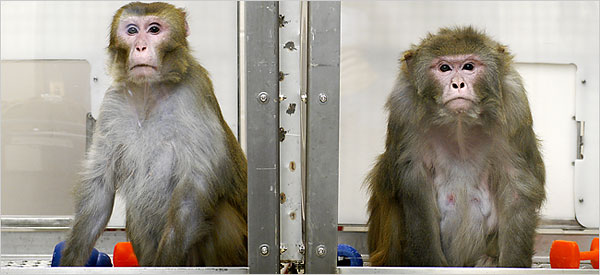
Jeff Miller of the University of Wisconsin-Madison caught Canto and Owen on camera for the NY Times Science News today. "Canto, left, a rhesus monkey, is aging fairly well at 25 on a calorie restriction diet. Owen, though only a year older than Canto, is frail and moves slowly. He eats a normal diet."
Thanks to Michael Mason, who wrote about the research at the Wisconsin National Primate Research Center. We've all heard about calorie restricted diets for quite some time and some good indicators about improved overall health have come out of the research. But now, it's beginning to look more real. Mason says it best, "In the last year, calorie-restricted diets have been shown in various animals to affect molecular pathways likely to be involved in the progression of Alzheimer's disease, diabetes, heart disease, Parkinson's disease, and cancer." Some researchers are beginning to say this approach is even better than exercise at preventing or delay typical age-related diseases. Of course, a balanced diet is critical, even with restricted caloric intake of about 30% below typical levels, and must include the vitamins and minerals that our bodies need. Pushing away from the table sooner is looking better and better.
The article goes on to discuss other ways of extending the quality of life and longevity with the idea that slowing down aging also slows down diseases, such as heart disease and Alzheimer's.
Technorati tags: cognition, brain, longevity, aging, calorie restriction, Alzheimer's, health and wellness, brain health,
Thanks to Michael Mason, who wrote about the research at the Wisconsin National Primate Research Center. We've all heard about calorie restricted diets for quite some time and some good indicators about improved overall health have come out of the research. But now, it's beginning to look more real. Mason says it best, "In the last year, calorie-restricted diets have been shown in various animals to affect molecular pathways likely to be involved in the progression of Alzheimer's disease, diabetes, heart disease, Parkinson's disease, and cancer." Some researchers are beginning to say this approach is even better than exercise at preventing or delay typical age-related diseases. Of course, a balanced diet is critical, even with restricted caloric intake of about 30% below typical levels, and must include the vitamins and minerals that our bodies need. Pushing away from the table sooner is looking better and better.
The article goes on to discuss other ways of extending the quality of life and longevity with the idea that slowing down aging also slows down diseases, such as heart disease and Alzheimer's.
Technorati tags: cognition, brain, longevity, aging, calorie restriction, Alzheimer's, health and wellness, brain health,
Monday, October 23, 2006
Mother Was Right: Eat Your Vegetables (They're Good for Your Brain)
Martha Clare Morris, associate professor at Rush University Medical Center in Chicago, has been observing the effects of diet on aging and the brain. She and her team have found that eating vegetables, especially green leafy ones, every day can make a big difference in the brains of those who crunched through kale, spinach, lettuce, chard, and other green leafies and those who didn't: faster thinking. Or, as she put it, the equivalent of being five years younger in age for the veggie-consumers.
The study involved six years of observation of 3,718 participants who were 65 and older and is part of the Chicago Health and Aging Project.
The reason? "Morris suspects that vegetables may help protect memory and thinking speed because they contain high amounts of vitamin E, an antioxidant that can help reduce the damage caused by free radicals, unstable oxygen molecules generated by normal metabolism that can damage neurons in the brain and contribute to dementia." These research results were reported in the Oct. 24 issue of the journal Neurology.
In another report issued by the AMA last year, Morris concluded that eating fish at least once a week increases brain fitness, too, equaling a brain-age three-to-four years younger. Fruit-eaters did not experience such brain-related benefits.
I think by now we all know that green leafy veggies and fish are good diet choices. We didn't know that they could make that much difference. Berkeley Professor of Integrative Biology, Marion Diamond, has been saying this for quite some time, however.
Technorati tags: cognition, brain, Alzheimer's, dementia, memory, brain fitness, diet
The study involved six years of observation of 3,718 participants who were 65 and older and is part of the Chicago Health and Aging Project.
The reason? "Morris suspects that vegetables may help protect memory and thinking speed because they contain high amounts of vitamin E, an antioxidant that can help reduce the damage caused by free radicals, unstable oxygen molecules generated by normal metabolism that can damage neurons in the brain and contribute to dementia." These research results were reported in the Oct. 24 issue of the journal Neurology.
In another report issued by the AMA last year, Morris concluded that eating fish at least once a week increases brain fitness, too, equaling a brain-age three-to-four years younger. Fruit-eaters did not experience such brain-related benefits.
I think by now we all know that green leafy veggies and fish are good diet choices. We didn't know that they could make that much difference. Berkeley Professor of Integrative Biology, Marion Diamond, has been saying this for quite some time, however.
Technorati tags: cognition, brain, Alzheimer's, dementia, memory, brain fitness, diet
Sunday, October 15, 2006
Scheherazade
My mother sits in her grandfather's wing chair upholstered many times over, now covered in worn fabric with a creamy yellow background with small blue flowers. We have just moved all of her things, again. Her paintings fill the opposite wall, two and three deep, almost up to the ceiling. The high ceiling of the room, which we call an apartment, provides the space for my mother's precious drawings, prints, paintings, and found art that make up the framework of familiarity and memory of her 80-something-year-old life. We feel comforted by that and hope she is, too. Her children, my sister, the baby and now in her 40s, my brother who is retired, and myself, the oldest, have moved her choices of furniture and keepsakes into the "apartment" with one door leading out into the world and one door leading to the nurses' station and the cheerful atrium with dining tables and comfortable living room sofas.
I sense that Mother feels numb. I think she wants to laugh and smile and cry again. She wants to be interested again in life, love and adventure. She has always had such a strong inner life, protecting her most prized possession, her creativity. But now, her eyes have lost their gleam, their energy and willfulness, their life. Her life. She often complains of the intense pain in her lower back and has focused on her pain, the pain of going on and on and on, the pain of living beyond her routine, her fulfillments, her husband, her friends, the pain of having to learn everything, and every person, in a new place, all over again. She seems tired, worn with living. She often falls, sometimes head first, sometimes against the bed or the bureau, leading to more pain, more confusion. And fear.
Her muscles have contracted to nothing, her thin-skinned arms hang with flesh instead of flexing with taut muscles as they did in her gardening days, symbolic of all that has faded, evaporated, gone away. Her skin is paper-thin and so wrinkled, cream crepe with dark purple, light mauve and brown tie-dyed colorations, in strange patterns. her own patterns. She always covers her arms now with fabric, not with the lively colored stones of her many, many bracelets. She avoids deep v-neck shirts and blouses, for the same reason, and has lost interest in her vast collection of earrings and necklaces. She still takes some glory in her beautiful silver white hair. She hangs on to her weekly hair appointments like they're the last life raft available from the sinking ship of age. And she does perk up visibly after having her shampoo and coif; she clearly feels comfortable reminiscences of her former beauty and self.
I flew in from California to see her. We have had a heavy schedule of movies this week. My mother loves for me to take her to movies and restaurants when I am in town. We go in the early afternoon to avoid the crowds. Moving her body from car to wheelchair through the thick, slow-opening doors of the theaters is hard work. She always goes to the restroom afterwards, which is arduous for both of us.
"Mother, do you need anything or would you like anything?" I ask as my mother and I return from an art movie. We've had an early dinner at the French cafe next door to the film house, sitting on the terrace, enjoying the sun in our faces. My mother looks so small in her wheelchair. "Would you like some particular kind of food? Or books?"
She shakes her head and then suddenly brightens. "Classical music," she whispers.
"Great. So you've been using that CD player I got you?" She nods. "OK, what would you like? Mozart, Bach, Brahms, Vivaldi?"
"Yes, yes," she shakes her head up and down slowly, looking at me intensely. "I've missed music."
I hope so, I thought. This is a woman who has always had music in her life. I feel a pang. My sister and I sold her beautiful white enameled grand piano. She loved playing and owning that piano. She loved composing. She loved singing and playing for others. She loved to dance, too. Music brought joy to my mother's face, everyday as she played a few pieces alone for herself. As a child, I felt calmer and somehow more loved when I heard her magical soft touch on the piano. It meant Mother was having a happy, small spiritual energizing interlude. And I was included if I was in hearing distance.
Her short-term memory is shot. Her body is frail and broken. Her hand-eye coordination is pitiful. She's lost her sense of humor, her saucy edge, her flirtatious kick, and her multitude of interests. She has had many batches of TIA's, those nasty clusters of little strokes that put roadblocks on the brain's neural paths. We call them MIA's because the mother we knew is missing in action now.
I stop by the local music store and run in to buy an armload of classical CDs: Brahms, Beethoven, Rimsky-Korsakov. "Art, music, reading, writing, travel, and appreciation of nature are all manifestations of the great spirit within us that needs to be heard, " my mother often told me as I was growing up.
"Can you help me dress for bed?" Mother says, even though it's just now 6 p.m. We've arrived at her apartment after our afternoon foray into movies, food, and CD-buying.
"Sure." I carefully pull her pink sweater over her newly coiffed hairdo. Multiple folds of flaccid skin hang from her upper arms but her shoulders look like those of a young girl. I pull her black synthetic trousers down her legs, careful to keep her diaper and her dignity in place. I pull her pink nylon nightie over her head and gently lie her down on her bed.
"Please tuck me in," she says sweetly, like a small child trying to do the right thing.
I pull the covers up under her chin and give her a big kiss on her cheek. "I love you, Mother. Is there anything else you'd like me to do?"
"Yes, I want to listen to Scheherazade forever. Can you make it keep playing?" She softly sighs, worried.
"Yes, Mother, I will." As the wistful and sweet strains of that paean to exotic adventure begins to play, big tears roll from the edge of my eyes. I am overcome with grief and sadness.
I sense that Mother feels numb. I think she wants to laugh and smile and cry again. She wants to be interested again in life, love and adventure. She has always had such a strong inner life, protecting her most prized possession, her creativity. But now, her eyes have lost their gleam, their energy and willfulness, their life. Her life. She often complains of the intense pain in her lower back and has focused on her pain, the pain of going on and on and on, the pain of living beyond her routine, her fulfillments, her husband, her friends, the pain of having to learn everything, and every person, in a new place, all over again. She seems tired, worn with living. She often falls, sometimes head first, sometimes against the bed or the bureau, leading to more pain, more confusion. And fear.
Her muscles have contracted to nothing, her thin-skinned arms hang with flesh instead of flexing with taut muscles as they did in her gardening days, symbolic of all that has faded, evaporated, gone away. Her skin is paper-thin and so wrinkled, cream crepe with dark purple, light mauve and brown tie-dyed colorations, in strange patterns. her own patterns. She always covers her arms now with fabric, not with the lively colored stones of her many, many bracelets. She avoids deep v-neck shirts and blouses, for the same reason, and has lost interest in her vast collection of earrings and necklaces. She still takes some glory in her beautiful silver white hair. She hangs on to her weekly hair appointments like they're the last life raft available from the sinking ship of age. And she does perk up visibly after having her shampoo and coif; she clearly feels comfortable reminiscences of her former beauty and self.
I flew in from California to see her. We have had a heavy schedule of movies this week. My mother loves for me to take her to movies and restaurants when I am in town. We go in the early afternoon to avoid the crowds. Moving her body from car to wheelchair through the thick, slow-opening doors of the theaters is hard work. She always goes to the restroom afterwards, which is arduous for both of us.
"Mother, do you need anything or would you like anything?" I ask as my mother and I return from an art movie. We've had an early dinner at the French cafe next door to the film house, sitting on the terrace, enjoying the sun in our faces. My mother looks so small in her wheelchair. "Would you like some particular kind of food? Or books?"
She shakes her head and then suddenly brightens. "Classical music," she whispers.
"Great. So you've been using that CD player I got you?" She nods. "OK, what would you like? Mozart, Bach, Brahms, Vivaldi?"
"Yes, yes," she shakes her head up and down slowly, looking at me intensely. "I've missed music."
I hope so, I thought. This is a woman who has always had music in her life. I feel a pang. My sister and I sold her beautiful white enameled grand piano. She loved playing and owning that piano. She loved composing. She loved singing and playing for others. She loved to dance, too. Music brought joy to my mother's face, everyday as she played a few pieces alone for herself. As a child, I felt calmer and somehow more loved when I heard her magical soft touch on the piano. It meant Mother was having a happy, small spiritual energizing interlude. And I was included if I was in hearing distance.
Her short-term memory is shot. Her body is frail and broken. Her hand-eye coordination is pitiful. She's lost her sense of humor, her saucy edge, her flirtatious kick, and her multitude of interests. She has had many batches of TIA's, those nasty clusters of little strokes that put roadblocks on the brain's neural paths. We call them MIA's because the mother we knew is missing in action now.
I stop by the local music store and run in to buy an armload of classical CDs: Brahms, Beethoven, Rimsky-Korsakov. "Art, music, reading, writing, travel, and appreciation of nature are all manifestations of the great spirit within us that needs to be heard, " my mother often told me as I was growing up.
"Can you help me dress for bed?" Mother says, even though it's just now 6 p.m. We've arrived at her apartment after our afternoon foray into movies, food, and CD-buying.
"Sure." I carefully pull her pink sweater over her newly coiffed hairdo. Multiple folds of flaccid skin hang from her upper arms but her shoulders look like those of a young girl. I pull her black synthetic trousers down her legs, careful to keep her diaper and her dignity in place. I pull her pink nylon nightie over her head and gently lie her down on her bed.
"Please tuck me in," she says sweetly, like a small child trying to do the right thing.
I pull the covers up under her chin and give her a big kiss on her cheek. "I love you, Mother. Is there anything else you'd like me to do?"
"Yes, I want to listen to Scheherazade forever. Can you make it keep playing?" She softly sighs, worried.
"Yes, Mother, I will." As the wistful and sweet strains of that paean to exotic adventure begins to play, big tears roll from the edge of my eyes. I am overcome with grief and sadness.
Subscribe to:
Posts (Atom)




