Showing posts with label brain. Show all posts

Sunday, March 30, 2008

Travel: Food for Our Learning Machines (Our Brains)


As I was consulting the map for the upteemth time in Sydney, I was thinking about standing on my head to get a more realistic view of where I wanted to walk next. I began thinking about how good traveling is for our brains. I walked miles and miles (or km and km) everyday. I know that's good for me. I read maps (straightforwardly or on my head). I planned ahead--where would I go, what did I want to see, where would I be likely to have lunch or dinner, what would I do, what did I want to accomplish? My goodness! I was using those executive function skills to excess.

And Sydney was great! I went to all the museums and especially enjoyed the Aboriginal art. I walked around Darlinghurst and Paddington and went to lots of great galleries and shops. I ferried over to Manly and took the bus to Bondi Beach. I then walked the Spit Bridge to Manly walk (10 km) and the fabulous Bondi Beach to Coogee Walk, one of the great walks in the world.

My favorite: the rockpools. I felt like Burt Lancaser in "The Swimmer." Haven't seen that one? Get it from Netflicks. He relived his life swimming pool to swimming pool in Westchester County, NY (where I used to live). The Rockpools are the swimming pools that have been built into the rock formations along the coast of Sydney. They typically have two concrete walls built into the rocks that then form a pool, anywhere from 20-30 meters to 50-60 meters. They're all salt water pools. The tide washes over and refreshes the pool with a few new fish every day. I love these pools. With my goggles on, it's like the best snorkeling in Hawaii. There are 26 of them around Sydney. Why in the world doesn't the rest of the world have these? They are wonderful! I roamed around Sydney, swimming from pool to pool along my walks. Fabulous.

One of my favorites was the women's pool near Coogee. Although small--20 meters or so-- it was so lovely and friendly. Lots of scantily clad women and kids were jumping in the water, climbing over the crabs crawling along the walkway. I loved the outdoor shower and I unabashedly climbed out of my suit and into my clothes for the rest of the walk. Refreshing to be among the mermaids on the hill.

Everywhere I went, swimming, people asked me: "what about the presidential process?" They all admitted easily to hating Bush. But they were curious about what was next? They were worried about us.

I said, " I don't know what will happen but we hate Bush, too. We're just in a terrible mess. In every possible way."

All the men who wanted to race me in the rockpools nodded in agreement. They want things to be better for us. Because it will be better for them, too.

Tuesday, June 26, 2007

More Transitions

Quixit, Inc., the company I started in 2005 to distribute scientifically based casual online games that focus on specific cognitive skills, such as attention and memory, was acquired yesterday by SBT, a French firm based in Lyon, France. As of today, I will no longer be affiliated with the new company, now called HappyNeuron, Inc. In my roles as CEO of neuroscience technology companies, Quixit and previously Scientific Learning Corporation, I have enjoyed getting to know the scientists, researchers, journalists, publishers, and many others so keenly interested in trying to figure out how to add to our knowledge base about healthy lifestyle choices, the impact of nutrition and exercise on brain health, and the major effects of mental stimulation in keeping our minds healthy and agile. So much is known yet so little has made its way to most people. And there is so much work that needs to be done. I look forward to the now-frequent research reports coming out almost on a weekly basis from respected research institutions on these topics and applaud those in the trenches working to prevent and treat diseases of the mind.

I continue to be curious about and interested in brain fitness and how we all can lower the probabilities of age-related cognitive decline, especially Alzheimer's and other kinds of dementia. I've seen first-hand how devastating the effects can be on the patient, family, and friends. The good news? We can all hope and expect that we will see great strides in our lifetimes in what we know about these horrific diseases of the mind.

Change typically forces new learning and is an excellent way to keep our brains in shape. So change is in the air for me and I welcome this opportunity to move into something new and different.

Friday, June 15, 2007

In Search of Memory

In Search of Memory, the Emergence of a New Science of Mind, by Eric R. Kandel, is not what I had in mind for summer reading. I was looking for a mystery when I wandered over to the nonfiction area of my little neighborhood bookstore. Kandel's book looked interesting, was highly portable in paperback, and a possible choice for my upcoming plane trip. I knew Eric Kandel was at Columbia and was a Nobel Prize winner for his work on the mind but that was about it.

I read a few pages, overcame my belief that this one could likely be dry as dust and bought it. It turns out that Mr. Kandel is quite a writer in addition to being a great scientist. He pulled me in immediately with his descriptions of his early life in Vienna and I never got out again. From there, I was whisked into his love affair with medicine and science and the mind, not to mention real people, like his wife and children. He intertwined his love of art, music, fine wines, and good friends with his fascination with the behavior of the aplysia's cells and the biology of memory. He also managed to sneak in a chronology of scientific research on cognition and the mind from its early beginnings until today and in an understandable, extremely interesting way.

He included a poem, written by his young daughter, titled (of course) "The Aplisa." "An aplisa is like a squishy snail. In rain in snow in sleet in hail. When it is angry, it shoots out ink. The ink is purple, not pink. An aplisa cannot live onland. It doesn't have feet so it can't stand. It has a very funny mouth, And in winter it goes to the south." Kandel was clearly obsessed and his family knew it. The rest of us on the planet should be thankful for his compulsive curiosity about what was happening in the cells of the aplysia. We are also fortunate that a number of other creative scientists were beginning to think about the mind differently than in the past at around the same time so they could build on each others' work. They were beginning to realize that so many of the mind's functions are controlled by the biology of the cell. Amazing that understanding the chemical reactions in the cells of one of earth's smallest organisms has enabled gigantic progress in our understanding of what we like to think is one of the most complicated organs on earth, the human brain.

For a magnificent review, please take a look at the Neurophilosophy blog. Better yet, read the book. A great story. A wonderful life.

Tuesday, March 20, 2007

A Strong, Active Body Helps Build a Strong, Active Mind

This week's Newsweek has a done a nice job of emphasizing and summarizing the critical part that physical exercise plays in brain fitness. It's true: whatever is good for our hearts is twice as good for our brains. Exercise helps our bodies efficiently route oxygen to our hearts and brains. I, for one, believe that the complexities of everyday exercises and sports, like walking or dancing or swimming, call on multiple cognitive and physical skills, which we keep trying to separate but are forever and crucially entwined. They should just go together, along with nutrition, as important pieces of the fitness puzzle.

I like the suggestion in the article of an "exercise snack plan": run up and down steps in your house during a TV commercial, walk around your office floor, pace when you talk on the telephone, etc. Hopefully, these will be taken as starters or supplements with ramp-ups in activity the goal.

I personally find that regular exercise enables me to sleep less, sleep better, de-stress, makes my mood more positive and balanced, and energizes me. How can all of that not be good for my brain? Nevermind the other skills needed for my dance class, for example: long-term memory of the basic routine and choreography, concentration (or I'll look like a fool), balance, rhythm, short-term memory to adapt to my partner or the teacher's instructions, hand-eye coordination, visual-spatial skills so I don't bump into the other people, deductive reasoning (what comes next in the sequence?), etc., etc. Wonderful cross-training for the mind and the body and the mind-body connection.

Of course, the danger is that folks will think physical exercise is the magic bullet for brain fitness. As the Newsweek article points out, "Having a big, gorgeous, healthy brain isn't enough, of course; it also has to be full." Yep, exercising those neurons (also called learning) once we've gone them is also a must.

Wednesday, March 14, 2007

Our Brains Keep Working, Even in Illness

I made a special trip to see my Mother for a few days around her birthday. Her brown eyes always get big and round with excitement when I walk into the Renaissance wing of Remington House, the assisted living facility where she lives in northeast Georgia about fifty miles from Atlanta. She usually walks herself, using her blue aluminum walker for support, around and around and around the nurses' station in the center of the wing and is often seated at one of the colonial-style sofas in the entrance way, watching all the comings and goings of visitors, residents, and staff. She concentrates, intently, purposefully. Her back is bent with severe arthritis but she lifts her upper body and chin and manages to seemingly observe everything and everyone. She never speaks except when spoken to although she is always polite, her good Southern upbringing never failing her.

I asked her, very specifically, "what would you like for your birthday? Something special to eat?" I imagined myself running all over Atlanta trying to find gourmet goodies. Mother always enjoyed trying new things and loved good food.

She wrinkled her brow and whispered, simply "oysters, fried oysters." Whenever I'm there, I always ask, "want to go to a movie, want to go for a ride, want to go to a restaurant, want to go to an art museum?" And my mother always nods yes, her eyes brightening.

So I did race all over Atlanta to find fresh, shucked oysters, along with tartar and tangy tomato sauce. And we had really fresh, lovely oysters breaded in corn meal and fried in the Remington House kitchen. A very special birthday dinner.

When I left the next day, Mother escorted me, slowly moving her walker along, to the double doors of the entrance way and stood there, balancing one hand on the walker and raising the other. She waved as I drove down the long drive to the highway, until we could no longer see each other. Just as she always used to, my entire life, as I have returned and left again, over and over. I've missed her sweet waving, I realized, in these last years. And this time, more poignantly, I felt the familiar tear well up in the corner of my eye. I was seeing a remnant of my deeply feeling, emotional, articulate, intelligent, creative Mother, who loved me with great affection and suppport. I was remembering that person, who I haven't seen in a long time.

My mother has frontotemporal dementia, or FTD, little known by the general public but well known among physicians as the second most prevalent kind of dementia, trailing only Alzheimer's in the US with as many as 4.5 million people afflicted. A recent article in the San Francisco Chronicle Magazine stated: "Though many similarities with Alzheimer's disease exist, the key difference is that FTD patients display only limited memory loss. Results of intelligence tests can remain normal, and individuals with unimpaired motor control can stay athletic for a long time, conveying the illusion of good health." My mother has almost perfect long-term memory, even today. She can look at a photo and tell you the time of day it was taken (along with the date and the middle names of the people in it).

In typical FTD pattern, my mother was struck in her early 60s (many show signs in their 40s and 50s). Always an excellent money manager, my mother began compulsively subscribing to magazines, with piles of at least 30 different ones around the house; she became positive she would win Publishers' Clearinghouse. She then began writing checks for every imaginable contest on TV and in the mail, followed by checks to anyone who asked. She supported Democrats and Republicans, pro-life and pro-abortion, and orphans in Central America.

My mother had a wry sense of humor and loved all things intellectual and artistic. She rarely missed giving a strong opinion, which she voiced, in most conversation. We noticed that for a person who always laughed and cried easily, she began to have little facial affect, no sense of humor, and in fact, very little emotional reaction to anything, no matter how deeply it must have affected her. She simply stared at the casket when my father was buried, never shedding a tear, never reacting at all in any way. We thought she was depressed, as many family members and even doctors do when FTD appears.

Dr. Bruce Miller at the University of California at San Francisco has been studying FTD for a number of years and has found another interesting pattern in many patients with FTD, one which my mother also experienced. His team's research has found that FTD ". . . has been traced to a mutation in a gene called tau, which leads to the destruction of a part of the cortex used for speech and social skills but which may spare regions for visual perception." As a result, "patients stopped talking, withdrew socially, became irritable, developed odd obsessions and failed at memory tests. But . . . the most severe problems were preceded by a period of exceptional creativity. " Dr. Miller notes that many people with FTD became prolific artists in many different media.

My mother's decline in judgment, language, and social skills was definitely preceded by a burst of creativity. She had always been creative, playing the piano, writing, decorating, designing, drawing. But she suddenly began obsessively composing music and painting oils, which now decorate the high wall of her Renaissance House room. Experts believe that "creativity may not be so much a direct product . . . but rather part of a person's way of coping with the disease."

How amazing that our brains continue to compensate for weakness, always seeking to learn and grow, even in the midst of grave illness.

Wednesday, February 07, 2007

Brain: Work on Working

I think it's entirely appropriate, and maybe a bit poetic, that I waited for a couple of weeks to write about findings on procrastination. Maybe they were just new findings for John Tierney, now blogging for the NY Times. He alerted me to them. But I don't care. It got me off the task at hand and into the mood to contemplate various aspects of my life before completing that or any other work. It seems that Piers Steel, a psychologist from the University of Calgary, has published several papers on the subject of procrastination and now has an online survey to measure how much of a procrastinator you are and help you figure out ways to stop it. Your filling it out also helps with his research. Tierney's right. There's no more alluring way to dawdle than to fill out a questionnaire. So have at it. I did.

I thought these excerpts from the site's Treatment page, presumably for those of us who have a really bad case, were helpful: "Too tired to work" was one of the main reason students use to explain their procrastination. . . . Work, especially work, that requires intensive concentration or physical exertion, becomes increasingly unpleasant when our "get-up-and-go" has "got-up-and-gone." So Steele goes on to mention the importance of sleep and exercise as well as structured goal setting, that is specific, challenging, realistic enough to really do, and with few choice points. Many of us go off the rails whenever we have choices. For example, do I search endlessly on the Internet for my old high school buddy or do I write the proposal I need to finish? Do I get a snack or organize my tax documents? etc. etc. I'm reminded of the story that Mrs. Melville chained Herman to his desk while he wrote Moby Dick. Who knows how he might have spent his time otherwise?

And the treatise on "learned industriousness:" "You may have heard that success breeds success, and this appears to be true. . . .If you start a new task, and you fail the first few times, instead of learned industriousness occurring, you might get learned helplessness. . . .When you start a new task, it is very important that you structure it so that your earlier efforts lead to success."

Uh-oh, I meant to do that. I know all these ideas are good for me. And I'm good at them too, but usually only if there's a deadline and real money involved. Need to assign this one to my brain: work on working.

Oh and, when you go to fill out your online survey (why not be distracted and amused for a few?), don't miss the Quotations page. Hilarious!

Wednesday, December 20, 2006

Reading Shakespeare Sparks Peak in Brain Activity

Thanks to the Science Blog for bringing this one to my attention. Researchers from the School of English and the MRI Analysis Center at the University of Liverpool collaborated to discover that when participants in their study read Shakespeare, their brains felt a little twinkle dust and magically peaked, indicating heavy-duty thinking. What caused this sparkle? Shakespeare used common words differently. He employed, linguistically speaking, functional shift, meaning he sometimes used a verb as a noun or a noun as an adjective or a verb as noun, all of which make our minds backtrack and rethink what's going on, to figure out the meaning of the word before we fit it into the meaning of the sentence or phrase. According to the researchers, the brain goes boom and we also begin to understand multiple meanings of a line or phrase, giving dramatic umph to the words. We also feel satisfaction and delight that we figured out the puzzle, making the whole event very entertaining. The researchers compared the mind's work in this situation to putting a jigsaw puzzle together. If you see how it all fits immediately, it becomes boring. If you have to work on it, it's much more interesting, offering surprises and creating the need for bursts of activity. And our brains really like that. And we do, too, if we enjoy the surprise and/or successfully solve the puzzle.

Monday, November 27, 2006

Pilates' Small, Powerful Moves: Good for Our Brains


Preliminary studies are showing that some people with Parkinson's Disease can benefit greatly from regular, consistent Pilates classes and exercises. The mind-body connection that Pilates offers may help with brain disorders that affect the body's muscles and movement, like Parkinson's. Sounds like a great reason to make Pilates a regular part of every one's exercise routine.

I've been a big believer in Pilates for several years so I hope that researchers will look carefully at the mind-body effects of exercises like Pilates. Longitudinal studies, along the lines of those looking at lifestyle choices that reduce the probabilities of diseases like Alzheimer's, would be great to see.

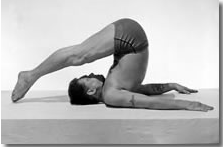
I also understand what is meant by the "small, powerful movements" of Pilates. They're challenging to do but deeply satisfying. As in Yoga, breathing, balance, and concentration are important (and good exercise for the brain and the body). Pilates also works on the body's core strength and flexibility and is particularly good for increasing abdominal strength and therefore reducing lower back tension and pain.

Happiness Is All in Our Brains

I've been fascinated by the recent research findings on happiness. As in so many other areas of neuroscience, scientists have assumed that our happiness quotient is hard-wired in our brains. We humans are sort of stuck with a glass that's either half-full or half-empty. Period. And for some people, there's nothing in the glass. We have a "happiness setting." And guess what? Just as researchers have found that our brains are plastic and capable of change in so many other areas--it's beginning to look like we can change our happiness settings, too--short-term and long-term.

For many years, the emphasis has been on finding a pill that will lift depression. Although many people have been helped enormously by these pharmacological palliatives, many others have not been helped or have had serious side-effects and complications from the drugs. Finally, neuropsychologists and neuroscientists are asking the other side of the question: what makes us happy? how can we feel happier? are there simple ways to lift our spirits to chronic happiness? optimism, even? And do we even need to discuss how critical these feelings are to our quality of life at every age?

The holidays are an especially good time to release the findings of these studies, given that so many people feel particularly lonely and depressed during this time of year.

OK, so what can we do? As psychologist Ed Diener of the University of Illinois says, "Set-point is not destiny." Promising methods coming out of the research include (l) focusing on "signature" strengths (through a questionnaire) and then using those strengths to choose more satisfying daily activities; and (2) thinking of three good things that happen each day just before going to sleep. According to Sonja Lyubomirsky from the University of California, Riverside, these two exercises made a significant difference in people's happiness when they regularly and consistently used them. Of course, as the pu-pu platter of happiness exercises that are proven to work increases, we will each need to experiment to find our own best method.

In other research on happiness, several researchers have been looking at the link between money and happiness. Most people seem to believe that money buys happiness. In fact, folks who move from abject poverty to a more comfortable relationship with money do become measurably happier. But as we move up the wealth scale, it appears that money becomes less and less important to our overall happiness. Makes sense.

I think Diener has it right when he points out that happiness is really all about "process and striving." What he didn't say, in my mind, is more important: happiness is all about feeling purpose in life.

Friday, November 10, 2006

Regular Exercise Increases Our Energy

I love this new finding by University of Georgia researchers, Patrick O'Connor, co-director of the UGA exercise psychology laboratory and a kinesiology professor, and Tim Tuetz, a recent doctoral program graduate. Their findings were published in the November issue of Psychological Bulletin. They found that "sedentary people who completed a regular exercise program reported improved fatigue compared to groups that did not exercise." Further, their analysis found that "every group studied--from healthy adults to cancer patients to those with chronic conditions such as diabetes and heart disease--benefited from exercise.

Although it may seem odd that using energy by exercising actually gives us more energy, we also know from many previous animal studies that exercise promotes higher levels of neurotransmitters, such as dopamine and serotonin, in the animals' brains. Once again, the evidence is clear: regular, consistent exercise is just what we're supposed to do.

Personally, I have known for a long time that if I'm really fatigued and burned out, a fast-paced swim or a challenging yoga class or a brisk walk can re-energize me like nothing else. And the more regular exercise I get, the more my body--and yes, my mind, too--cry out for it.

, , , , ,,

Tuesday, November 07, 2006

Cross-Train Your Brain!

An article in the Nov.6 Fortune Magazine highlights some very interesting research on the brain's ability to learn skills faster through cross-training rather than through repetitive practice on just one skill. Senior Fortune writer Jerry Useem and Jia Lynn Jang write about Dr. Rachael Seidler's research and J. Cog Neuroscience article.

Traditionally, we have believed that to be good or even expert at a particular skill or activity, we must learn skills specifically related to that activity. Dr. Seidler hypothesized that learning skills across several activities could quicken learning and increase overall expertise. She in fact found that subjects exposed to multiple visuomotor skills (compared to a group that focused on acquiring just one skill) were able to transfer skills and parts of skills to acquire new skills more quickly than the other group. In other words, more experience helped create more neural connections and helped make learning faster for those who "cross-trained." They were able to transfer all or parts of skills they knew to learn new skills so they could not only learn them faster but move to higher levels of expertise more quickly.

The authors go on to give fascinating examples of well-known personalities who "cross-trained" in multiple areas and became expert in multiple skills, using experience in one area to apply to others for quicker learning. A couple of examples: Leonardo da Vinci--architect, painter, sculptor, inventor, mathematician, anatomist; Gordon Parks: Life Photographer, Director of Shaft, author, musician. And Condi Rice--diplomat, university professor and administrator, concert-level pianist who plays with Yo-Yo Ma in her spare time.

Gen. Peter Pace, chairman of the Joint Chiefs of Staff, was asked to relate his undergraduate training in nuclear propulsion systems to what he's doing today: "I'm not applying those exact skills every day, but it taught me ways to think through problems--visualizing, conceptualizing--that I do use every day. Your mind touches on these resources and you're not even aware of it."

My take-away from these findings: the hypothesis of cognitive reserve makes more and more sense. Cross-training on multiple cognitive skills aids new learning, builds on the brain's experience, and creates new pathways and connections that can in fact build a mental savings account. Cross-training our brains can only help mental agility over time--cha-ching, cha-ching, cha-ching in that savings account upstairs. As this article points out, "The more varied our skills. . . the more varied the neural pathways in use."

, , , , ,,,

Monday, November 06, 2006

The Slow But Gradual End of Alzheimer's As We Know It

As noted in Sunday's LA Times and this month's Science magazine, November 3 (or 4, depending on which publication you read) marked the hundredth anniversary of Dr. Alois Alzheimer's medical conference presentation of a patient's case with a neurogenerative disease that has come to be known as Alzheimer's Disease. The Neurophilopher's Weblog also did a fine recounting of the history. The LA Times states that another event will also be marked: "the slow but gradual end of Alzheimer's as we know it--and the Americanization of dementia science."

For the last 100 years, scientists have been trying to figure out what causes Alzheimer's plaques and tangles in the brain. Sadly, very few actual advances in therapies have occurred for people who have been diagnosed with AD. But as author Greg Critser points out, President Ronald Reagan and his family's openness about their struggles with AD have motivated researchers to begin looking at AD differently, both in ways to prevent it and therapies to deal with this tragic disease. In the therapeutic arena, stem cell research is one possibility. We know from research on brain plasticity that we can already "rewire" our brains so why not get a little help from transplanted neurons to make connections stifled by AD's plaques and tangles?

On the prevention side, researchers are looking at diet, exercise, mental stimulation, and "dysfunction" of brain cells due to other potentially controllable brain environmental factors, such as the way certain brain cells use glucose. Scientists are realizing that AD does not have to be totally linear in its progression. We are beginning to see solid research on strategies that can prevent or slow down AD and dementia as well as compensation strategies to help the brain create additional connections and pathways through mental stimulation and learning. Many, many scientists are now looking closely at these lifestyle decisions and concluding that it really does matter how you live your life and the choices you make along the way.


, , , , ,,,,

Tuesday, October 31, 2006

Cut Calories: One Way to Live Better and Longer


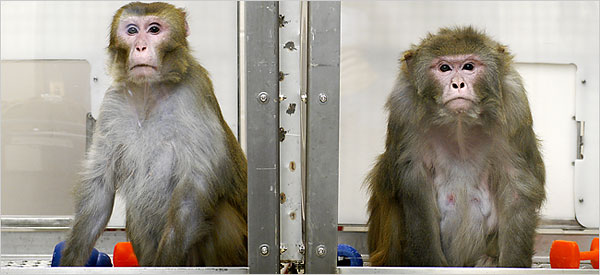
Jeff Miller of the University of Wisconsin-Madison caught Canto and Owen on camera for the NY Times Science News today. "Canto, left, a rhesus monkey, is aging fairly well at 25 on a calorie restriction diet. Owen, though only a year older than Canto, is frail and moves slowly. He eats a normal diet."

Thanks to Michael Mason, who wrote about the research at the Wisconsin National Primate Research Center. We've all heard about calorie restricted diets for quite some time and some good indicators about improved overall health have come out of the research. But now, it's beginning to look more real. Mason says it best, "In the last year, calorie-restricted diets have been shown in various animals to affect molecular pathways likely to be involved in the progression of Alzheimer's disease, diabetes, heart disease, Parkinson's disease, and cancer." Some researchers are beginning to say this approach is even better than exercise at preventing or delay typical age-related diseases. Of course, a balanced diet is critical, even with restricted caloric intake of about 30% below typical levels, and must include the vitamins and minerals that our bodies need. Pushing away from the table sooner is looking better and better.

The article goes on to discuss other ways of extending the quality of life and longevity with the idea that slowing down aging also slows down diseases, such as heart disease and Alzheimer's.

, , , , ,,,,


Monday, October 30, 2006

AARP: Working to Keep Our Brains Fit


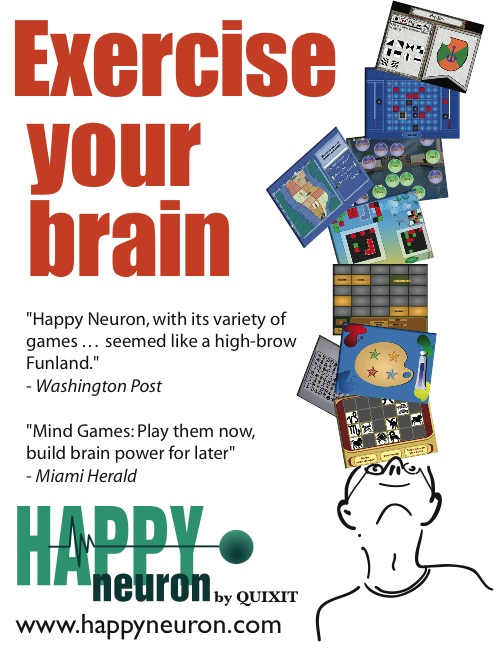
Since our company, Quixit, Inc., is located in the Bay Area and the AARP convention was in Anaheim, California, we decided that we should showcase our newly relaunched www.HappyNeuron.com there. After all, brain health and fitness should be of interest to AARP members, especially games that are fun to play and promote wellness. We worked hard to get our booth, signage, and handouts ready and rolled into Anaheim ready to share our enthusiasm. After 10 hours a day of standing in front of the huge video monitor we rented for our small booth, with postcards and posters in our hands (like the one above), and our 30-second pitch primed to perfection, three of us met the oncoming hordes of men and women strolling the many exhibitor aisles of the huge convention hall.

"Interested in games? Interested in having a fit brain?" we asked endlessly. Most people said yes (of course) and many zoomed down the aisle directly to us. They were familiar with the challenge and wanted to know what they could do.

A few just walked by. One in particular was memorable. He walked quickly by. "I still work," he said.

"Great," I said, "what do you do?"

"I can't tell you," he said.

"Why?"

"Because if I do, I'll have to kill you."

Hmm.m.m. A bit unexpected at the AARP convention.

The theme was "life@50+." So, how do we feel about our AARP exhibitor experience? We are all energized by the enthusiastic reception we received but our brains are fried, our feet are permanently sore, and I want to burn the shoes I wore. It was fun to talk to so many nice folks from all over the US interested in continuing to learn and keeping their brains fit and healthy. Many people had already researched the "use it or lose it" approach to brain fitness. And they wanted to know what to do about it. What is really beyond crossword puzzles, they asked?

Our booth was located just across the aisle from the Nintendo folks who showcased their "BrainAge" software for the Nintendo DS and their Wii suite of games, including bowling, tennis, baseball, golf, and other sports. It was great to take a break every now and then and hit a few tennis serves. Nice people, too, at the Nintendo booth.

I must admit that I had never considered attending an AARP convention before this one. So I was surprised at its size (22,000+), the range for high-quality offerings (Bill Cosby, Maya Angelou, Geena Davis, Don Rather, Connie Chung, etc. as speakers and lesser known but expert speakers on all kinds of tantalizing topics), the friendliness of the staff, the 60s live music in corners around the convention hall and outside, and the high level of interest in brain fitness. And the really nice AARP members who were there.

According to the AARP literature, the average age of the attendees has fallen from 72 about five years ago to about 60. There goes that Baby Boomer effect again! Next year, it will probably be in the high 50s and falling.

I would definitely go to another one. And by the way, next year's will be in Boston.

, , , , ,,,,

Tuesday, October 24, 2006

We Are What They Think We Are

In the October 20 issue of Science, researchers Dar-Nimrod and Heine from the University of British Columbia reported on a study they conducted. They told one group of women that women do not perform well in science and math, using a disguised research study report as the basis of this "fact." The other group was not shown the "study results." And guess what? Well, of course. The women who thought that women were naturally bad at math and science performed much more poorly than the group that just got to wing it, using their own perceptions and skills. Chris Lee at Nobel Intent also commented on this study and as he points out, "scientific theories that promulgate genetic explanations for performance difference become self-fulfilling. . . there are enough high-performing women scientists in all fields to indicate that genetics is unlikely to be a major contributor to women's average under-performance in math and science."

These results are amazingly similar to the research conducted with blue and brown-eyed children in the 50s. One group was inferior one day and the other group was deemed inferior the next day with the expected results: huge drops in self-esteem, feelings of interiority and associated behaviors, such as shyness, loss of humor, etc.

This study also reminds me of the recent finding regarding people who ignore the stereotypes associated with a certain age. Researchers found that indeed they behaved in every way like people many years younger. We seem to want to fit the stereotype one way or another. Are these behaviors a result of mirror-psych neurons?

, , , ,

Monday, October 23, 2006

Mother Was Right: Eat Your Vegetables (They're Good for Your Brain)

Martha Clare Morris, associate professor at Rush University Medical Center in Chicago, has been observing the effects of diet on aging and the brain. She and her team have found that eating vegetables, especially green leafy ones, every day can make a big difference in the brains of those who crunched through kale, spinach, lettuce, chard, and other green leafies and those who didn't: faster thinking. Or, as she put it, the equivalent of being five years younger in age for the veggie-consumers.

The study involved six years of observation of 3,718 participants who were 65 and older and is part of the Chicago Health and Aging Project.

The reason? "Morris suspects that vegetables may help protect memory and thinking speed because they contain high amounts of vitamin E, an antioxidant that can help reduce the damage caused by free radicals, unstable oxygen molecules generated by normal metabolism that can damage neurons in the brain and contribute to dementia." These research results were reported in the Oct. 24 issue of the journal Neurology.

In another report issued by the AMA last year, Morris concluded that eating fish at least once a week increases brain fitness, too, equaling a brain-age three-to-four years younger. Fruit-eaters did not experience such brain-related benefits.

I think by now we all know that green leafy veggies and fish are good diet choices. We didn't know that they could make that much difference. Berkeley Professor of Integrative Biology, Marion Diamond, has been saying this for quite some time, however.

, , , , , ,

Saturday, October 14, 2006

Music, Language, and the Brain

I've had music on the brain lately, with my thinking mostly centered on the relationship between language development and music. We know, for example, that the one thing that typically distinguishes non-native speakers is intonation, or the musical tones of a language. Accent, vocabulary, grammar and syntax can all be perfect but if the intonation is off, then somehow we deduce almost immediately that the person speaking is not talking in his or her native tongue. And, of course, as we all are aware, intonation--pitch, for example--can convey meaning more than any other mechanism in language. This was a question I always had when I studied Chomsky's deep structure. What about meaning? What about intonation? Where does it fit in?

I've been wondering if this seemingly innate capability to notice and then learn the differences in pitch, duration, and frequency form the foundation for music in our lives. Or is language development so tied to music that without it, we couldn't develop the ability to understand others and express ourselves? It certainly is the beginning of "hearing" and categorizing phonemes, the smallest sounds in a language that convey meaning. Each phoneme is composed of a very particular pitch, frequency, and duration. Sounds like a description of music, doesn't it? And how does emotion, something we feel so deeply and often when we hear music, fit in? Do we associate touch and sound in a glimmering memory of a mother's coos and rising pitch of delight while cuddling her newborn.

There was a wonderful show today on NPR on Musical Language, produced by Radio Lab. Fortunately, you can access the free podcast. I urge you to take a listen. The relationship between language and music is examined as are tonal languages. One fascinating topic came up: the virtuosity on musical instruments (comparing Chinese students to American kids), which is seemingly quite common at early ages in countries where tonal languages are spoken. There may be very early practice on perfect pitch. Examination of many of the greats in musical composing shows that these artists also had perfect pitch.

And to bring this topic home: what role can music play in keeping our brains healthy? We've all heard that learning to play a new instrument is great for our brains. And learning a new language (with new intonation) helps, too. They both help build cognitive reserve. But what part does listening to, and deeply feeling, music play in keeping our brains healthy throughout our lives?

Wednesday, October 11, 2006

The Need for Friends Is Hardwired in Our Brains

Daniel Goleman's NY Times article yesterday summarized why many neuroscientists believe that the need for human social interaction is so important to us, physically and mentally. We already know that folks with strong social networks of friends and family get well faster after injury or disease and live longer. But why?

Mirror neurons may be a big part of the answer. Our brains are hardwired to "mirror" what other people do or to rapidly synchronize with the feelings of others. This explains empathy and rapport, for example. Or as two researchers, Lisa M. Diamond and Lisa Aspinwall from the University of Utah, put it (in Daniel Goleman's much more accessible words): "emotional closeness allows the biology of one person to influence the other." And John T. Cacioppo from the University of Chicago, says that "the emotional status of our main relationships has a significant impact on our overall pattern of cardiovascular and neuroendocrine activity." We know, for example, that a supportive remark or touch from a friend can actually lower our blood pressure, reduce stress, and certainly make us feel better.

There we go, again: the amazing connection between heart and head. We are in for some exciting research and findings ahead.

On another but related topic, I've just found a new blog (for me), Developing Intelligence. Chris Chatham's last few postings have been on language acquisition and the intersection between language, culture, perception, and meaning. Mirror neurons should definitely be a topic in this discussion.

Language is a crazy salad of categorizing sounds and meaning and perceptions, organizing our thoughts (more categories, which result in, for example, grammar and syntax), and then comprehending others and expressing ourselves. I think it will become clear through more research in areas like "mirror neurons" that language and thinking are closely connected to our need for and response to social interactions. That's where we get the idea about language in the first place. And that's why language is so intertwined with culture, perception, and meaning, occurring through social interactions. Incredibly complex and alarmingly simple, at the same time. Like all really workable systems.

The message: one important part of brain fitness has got to be strong social interactions with friends and family. Our biology is just waiting to be influenced by others and those mirror neurons need to be exercised just like everything else.

Monday, October 09, 2006

Boomeritis

Thanks to Boomer Chronicles for alerting me to Boomeritis, defined by Prime Time Fitness as "a quasi-disease of aging Baby Boomers who are refusing to slow down."

A different attitude has helped me. Aerobic used to be the name of the game for me: backpacking with 40-pound packs up steep mountains, running miles and miles and miles, etc. Now, I swim, love yoga and Pilates and NIA. I still cycle but do so sensibly and enjoy myself on the long hauls with lots of time for lunch and rest stops. The author of Boomer Chronicles, Rhea, recently went on a 32-mile ride. If she cycled with friends, stopped and had lunch and rested whenever she felt like it, it sounds lovely. I do day-hikes now, without huge backpacks. I still love kayaking and whitewater canoeing. But I don't run and I try not to compete with everyone in sight (still hard but I'm trying to be disciplined). I also don't play pick-up basketball any more to show off (I fail at that now). I actually enjoy walking my dogs in the neighborhood. And gardening, too. And I'm thinking of trying Tai Chi because I know balance is so important. I skied until I hurt my knee about five years ago but would like to ski again, with a new, more relaxed attitude. I think I can, this year. One of the best things about skiing anyway is just to have the cold air blowing on my face and the great views unfolding before me as I glide down the mountain. I'll take brush-up lessons first.

Both of my parents had very severe arthritis and I've been determined to avoid it as much as possible. So far, so good. I think regular, and varied, exercise has been one of the best preventive things I could have done. I have a friend who recently defined me as "an athlete" although most people don't know that side of me. I like the idea that I've changed my own definition of what is meant by "athlete." I like the adventure of trying all kinds of new approaches to exercise.

I know exercise is every bit as good for my head as it is for my heart. I wish everyone knew that our brains need more oxygen than our hearts and that physical exercise also tones and flexes many cognitive skills, too . Sad how few folks get the connection.

Sunday, October 08, 2006

Just in Time for Halloween: Scary Brain Story

Erica Good's NY Times' story this past week sent chills up my spine, a loud, ghoulish fright, just in time to haunt my mind for the scary season. Dr. David A. Dunning of Cornell and a graduate student, Justin Kruger, have been studying people who do things badly, who are, in other words, incompetent. These are the people who just keep at it, no matter how many signs and clues they get from others. They found that these folks are supremely confident of their abilities, in fact, often more confident than people who are really experts. Dunning says, "I began to think that there probably lots of things that I was bad at, and I didn't know it."

In the paper they wrote for the Journal of Personality and Social Psychology, they say of these folks, "Not only do they reach erroneous conclusions and make unfortunate choices, but their incompetence robs them of the ability to realize it." Yikes! Then they go on to give examples, which are a little too close to home. This is why, they say, inept joke tellers just keep at it (and you can just guess the rest of the examples). I feel like I'm lost in a Holiday Inn ad. You know, the one where some "expert" (pilot, surgeon, whatever's needed) pops up to solve the crisis. When asked, "are you a surgeon, pilot, whatever? The answer, "no, but I stayed at a Holiday Inn last night." Well, trick or treat.

And once again, Garrison Keillor nails it: "And that's the news from Lake Wobegon, where all the women are strong, all the men are good-looking, and all the children are above average."