Showing posts with label Baby Boomers. Show all posts

Sunday, March 30, 2008

Travel: Food for Our Learning Machines (Our Brains)


As I was consulting the map for the upteemth time in Sydney, I was thinking about standing on my head to get a more realistic view of where I wanted to walk next. I began thinking about how good traveling is for our brains. I walked miles and miles (or km and km) everyday. I know that's good for me. I read maps (straightforwardly or on my head). I planned ahead--where would I go, what did I want to see, where would I be likely to have lunch or dinner, what would I do, what did I want to accomplish? My goodness! I was using those executive function skills to excess.

And Sydney was great! I went to all the museums and especially enjoyed the Aboriginal art. I walked around Darlinghurst and Paddington and went to lots of great galleries and shops. I ferried over to Manly and took the bus to Bondi Beach. I then walked the Spit Bridge to Manly walk (10 km) and the fabulous Bondi Beach to Coogee Walk, one of the great walks in the world.

My favorite: the rockpools. I felt like Burt Lancaser in "The Swimmer." Haven't seen that one? Get it from Netflicks. He relived his life swimming pool to swimming pool in Westchester County, NY (where I used to live). The Rockpools are the swimming pools that have been built into the rock formations along the coast of Sydney. They typically have two concrete walls built into the rocks that then form a pool, anywhere from 20-30 meters to 50-60 meters. They're all salt water pools. The tide washes over and refreshes the pool with a few new fish every day. I love these pools. With my goggles on, it's like the best snorkeling in Hawaii. There are 26 of them around Sydney. Why in the world doesn't the rest of the world have these? They are wonderful! I roamed around Sydney, swimming from pool to pool along my walks. Fabulous.

One of my favorites was the women's pool near Coogee. Although small--20 meters or so-- it was so lovely and friendly. Lots of scantily clad women and kids were jumping in the water, climbing over the crabs crawling along the walkway. I loved the outdoor shower and I unabashedly climbed out of my suit and into my clothes for the rest of the walk. Refreshing to be among the mermaids on the hill.

Everywhere I went, swimming, people asked me: "what about the presidential process?" They all admitted easily to hating Bush. But they were curious about what was next? They were worried about us.

I said, " I don't know what will happen but we hate Bush, too. We're just in a terrible mess. In every possible way."

All the men who wanted to race me in the rockpools nodded in agreement. They want things to be better for us. Because it will be better for them, too.

Thursday, February 07, 2008

In Defense of Food: An Eater's Manifesto

Even though I had read Michael Pollan's lead-up article to this book in the New Yorker and his other books, I found this one a page turner--fun to read and truly informative.

Already oft-quoted, the first words of the book summarize his extensive research and beliefs about food: "Eat food. Not too much. Mostly plants." In other words, don't eat anything that has not traditionally been called food (recognizable by our grandmothers as food), which cuts out most processed concoctions in fast-food chains and much on grocery store shelves.

Eat plants because we need the complex interactions of the nutrients they contain. Pollan points out that there's no way to figure out which traces of what affect the whole nutritional value of what we need to eat. Singling out one vitamin, for example, and taking supplements of it is far, far inferior and may be quite deleterious to our health because we miss out on all the other interactions among minterals and vitamins in our food that we need to be healthy. Bottom-line: we just don't know enough yet so don't mess with the foods that have kept people healthy for centuries. I recognize this argument as one put forth by the scientists involved in the Washington Heights-Inwood-Columbia Aging project. After analyzing the diets of the participants, they concluded that those who had consumed a "Mediterranean Diet" (another way of saying "eat plants") had a dramatically lower risk of Alzheimer's. They hypothesized that one reason was because of the complex interactions of the many, many trace nutrients in plants

We've all been through the butter-margarine as engineered butter debate from the 50s on. And we finally now know that margarine is terrible for us, butter not so much (if we use it with a very light hand). There are many other examples of this kind of food engineering that moves beyond not making sense into really bad stuff.

I never really understood the arguments against genetically modified food until I read this book. I now realize that going for the most calories per acre cuts out the zillion varieties of fruits and vegetables that we have enjoyed--and all the complex mixture of nutients in that vast array. I now shop frequently at my local Farmers' Market and I have enjoyed the aesthetics and the taste of more variety. For example, have you seen those red and green cauliflowers sitting beside the omnipresent white ones? The green ones look like space helmets or part of an animation project. I'm discovering new tastes and new recipes and enjoying myself immensely in the process.

The "not too much" food is especially relevant to Americans who have a huge love of quantity. It's high time we copied the French on this one: quality trumps quantity every time.

I hope this book stays on the bestseller list forever. We all need to be aware of what we've done to our food supply and take steps to make meaningful and lasting changes.

Monday, January 28, 2008

vibrantBrains: San Francisco Brain Gym

vibrantBrains, a gym to exercise our brains, has recently opened in San Francisco. We all buy into the health club idea for our bodies so why not one to tone our brains, too? The vibrantBrains folks have created a pleasant, bright space on Sacramento Street, close to cafes, shops, and residential areas. They have the front of the club filled with interesting books, including some bestsellers, by scientists and others on various aspects of brain research and how the brain works; the middle part of the club is filled with state-of-the-art computers with headphones nearby. A lounge area with comfy chairs and tea, coffee, and water always available fills the floor-to-ceiling windowed alcove at the back of the club and is a great place to chat with other members. They have developed Neurobics Circuit Training, which incorporates a number of scientifically based software programs that enable a club member to work on different skills for each visit or a variety of skills within a workout and at a huge discount over trying to find and purchase these programs individually. These games and exercises, based on hard science, emphasize different skills, such as memory, reasoning, visual scanning, word recall, and quantitative facility, or a combination of many of these skills at once. They also focus on increasing speed and accuracy, with practice.

Just as we need to lift weights to insure that are our muscles are strong enough to swim or dance, we also need to strengthen our speed and accuracy with memory, reasoning, and visual scanning skills to make sudoku or a crossword puzzle fun. Or to make a challenging book enjoyable to read.

For those who want to add more intensity (and hard science), vibrantBrains also makes other programs available at a discount to its members, including Dr. Gary Small's (from the UCLA Center for Aging) Memory Fitness Course and Posit Science's Brain Fitness Program.

The vibrantBrains innovative founders, Jan Zivic and Lisa Schoonerman, may just have latched onto a trend that Boomers and others must incorporate into our lives to keep that notion that "60 is the new 40" alive and well. And just to enjoy our lives more. They will also offer a speaker series soon as well as book clubs and other related activies.

I, along with most people I know, have figured out that I need a variety of exercises for my body, from aerobic ones like swimming and dancing, to weight training to flexibility training, such as yoga and Pilates, just to maintain. It's high time we added in specific exercises to tone the various everyday brain skills we need to maintain and even increase the quality of our lives. Better memory, reasoning, language, quantitative, and visual-spatial skills have to make living just more interesting and more fun.

Saturday, May 19, 2007

Transitions

I flew in on the red-eye from the West Coast to Atlanta, rented a car, and drove the rental car 45 minutes northeast to the small town where my mother lives just as the sun was coming up. I’ve made this trip from west to east coast numerous times over the last few months and several times in a crisis mode, as I am now. My mother has gotten weaker and smaller and more vulnerable with each passing week, kicked off by a debilitating virus at the end of December.

Bleary-eyed, I walk into her darkened room at the assisted living home at around 5:30 a.m. The hospice caretaker is writing on a pad, sitting quietly in the often-reupholstered wing chair, my mother’s favorite place to sit, her grandfather’s chair. Many of her things have been moved to make room for a large, steel-framed hospital bed, with protective bars along the sides of the bed, that takes up most of the space. I slip the cold, metal bars down so I can move closer. I take my mother’s hand, smaller but still soft and smooth, in mine. Her brown eyes open and widen, with great intensity.

“It’s you,” her lips move into an almost smile, with great effort. She looks at me directly, extremely focused.

“Yes, I’m here, Mother. I love you.” I reach down to gather her frail, thin shoulders in my arms to hug her, to touch her, to let her know how much I love her. My ear is close to her lips.

“I’m dying.” She whispers, slowly and deliberately. She pauses. “Good-bye. I love you.”

I hug her. Tighter. Tears flood my eyes and spill in waves down my cheeks. Emotion clogs my throat. My mother has always, even when I was a small child, talked to me with unembellished honesty, sometimes entrusting me with secrets and knowledge well beyond what a child normally receives. She always tried to help me understand why things happen the way they do or the rationale behind her beliefs and values and those of others. She taught me to look at people as individuals. Once again she is sharing her honest assessment of the situation, at once bringing me into the inner circle of her secret thoughts, collaboratively, helping me to understand, and preparing me for what is ahead in her usual thoughtful, loving, and thoroughly open way. And this time, I know that she has summoned from somewhere deep inside her the energy to focus just on me, let me know how much she loves me, and help me with this transition I’m about to experience. She has somehow put her dementia and physical frailty aside to deliver this intense affection directly to me. The nicest gift I could ever receive.

This transition is a much larger one than I expected. I am no longer part of the sandwich generation. My mother has been my only living parent. I will no longer receive direct support and sustenance from my mother, although the dementia that my mother experienced much reduced her ability to express these emotions in the last years. But I still felt them every time her brown eyes got big and excited when I entered her room. She has never failed to recognize me and rejoice in seeing me, in her intense but increasingly smaller ways.

Suddenly, I am no longer arranging my schedule and that of my family to fly to see her as often as possible. I won’t be taking her on shopping excursions, to see movies or museums, or out to lunch and dinner. I won’t be making time in my life for calls and visits or analysis of her prescriptions, medical care, or bills. I won’t be ordering yellow roses or lavender orchids, her favorites, to brighten her room—and her face. I won’t be seeing her big brown eyes widen with joy when I come through the door. The void is huge. The transition is difficult. But I know that death is part of life. My mother taught me that.

Wednesday, January 10, 2007

Brain Fitness Buzz

The last couple of weeks have been filled with media reports about brain fitness programs. The NY Times weighed in on the topic on the front page on December 27 with "As Minds Age, What's Next? Brain Calisthenics?" This article was quickly syndicated across the US and around the world (the International Herald-Tribune) and became the number one-emailed article of the week. I think we can say with some certainty that brain fitness is a topic of interest to millions and millions of people. Several blogs picked up the drum beat, too. The Today show on NBC put their own spin on the topic on Tuesday morning. Happy Neuron was one of the programs showcased in the NY Times and on the Today show.

I think it's great that the media is picking up on the very real interests of so many people, who are really thinking hard and searching high and low for good science on keeping their mental edge as the years go by (another way to say prevention of Alzheimer's and dementia). I admit that I was irritated by two comments: (l) "just do crosswords" because we know from numerous research studies that crosswords may be fun but don't do much for the brain--they're just too one-dimensional; and (2) why turn to software for brain exercise? why not do something free like learn a language or learn to play a new musical instrument? Hey, last time I checked, those two learning adventures were far from free.

Let's look at the real value of sites like Happy Neuron. Most of us would prefer to take a walk in the park every day but some days it's rainy or we don't have time so we hit the treadmill. Some days we don't have time for learning the cello or practicing Chinese either so one convenient thing to do is go online and exercise specific cognitive skills, like memory, concentration, reasoning, visual-spatial and language skills--all keys to learning and everyday living.

I'm extremely glad that awareness is building: brain exercise should be a part of a healthy lifestyle just like good nutrition and physical exercise. All are critical to our overall health and quality of life.

Monday, October 30, 2006

AARP: Working to Keep Our Brains Fit


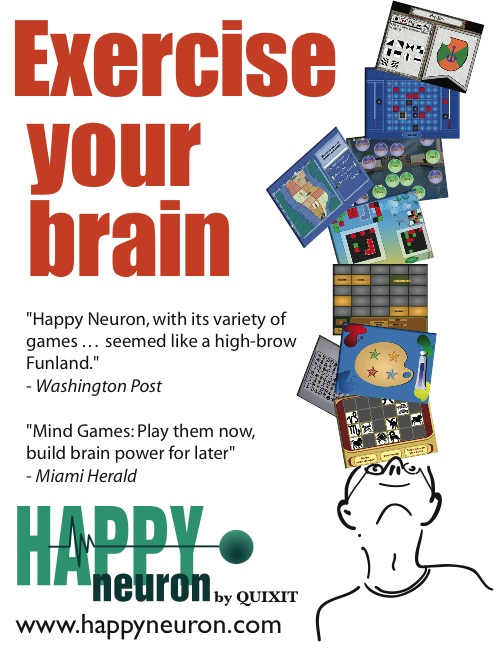
Since our company, Quixit, Inc., is located in the Bay Area and the AARP convention was in Anaheim, California, we decided that we should showcase our newly relaunched www.HappyNeuron.com there. After all, brain health and fitness should be of interest to AARP members, especially games that are fun to play and promote wellness. We worked hard to get our booth, signage, and handouts ready and rolled into Anaheim ready to share our enthusiasm. After 10 hours a day of standing in front of the huge video monitor we rented for our small booth, with postcards and posters in our hands (like the one above), and our 30-second pitch primed to perfection, three of us met the oncoming hordes of men and women strolling the many exhibitor aisles of the huge convention hall.

"Interested in games? Interested in having a fit brain?" we asked endlessly. Most people said yes (of course) and many zoomed down the aisle directly to us. They were familiar with the challenge and wanted to know what they could do.

A few just walked by. One in particular was memorable. He walked quickly by. "I still work," he said.

"Great," I said, "what do you do?"

"I can't tell you," he said.

"Why?"

"Because if I do, I'll have to kill you."

Hmm.m.m. A bit unexpected at the AARP convention.

The theme was "life@50+." So, how do we feel about our AARP exhibitor experience? We are all energized by the enthusiastic reception we received but our brains are fried, our feet are permanently sore, and I want to burn the shoes I wore. It was fun to talk to so many nice folks from all over the US interested in continuing to learn and keeping their brains fit and healthy. Many people had already researched the "use it or lose it" approach to brain fitness. And they wanted to know what to do about it. What is really beyond crossword puzzles, they asked?

Our booth was located just across the aisle from the Nintendo folks who showcased their "BrainAge" software for the Nintendo DS and their Wii suite of games, including bowling, tennis, baseball, golf, and other sports. It was great to take a break every now and then and hit a few tennis serves. Nice people, too, at the Nintendo booth.

I must admit that I had never considered attending an AARP convention before this one. So I was surprised at its size (22,000+), the range for high-quality offerings (Bill Cosby, Maya Angelou, Geena Davis, Don Rather, Connie Chung, etc. as speakers and lesser known but expert speakers on all kinds of tantalizing topics), the friendliness of the staff, the 60s live music in corners around the convention hall and outside, and the high level of interest in brain fitness. And the really nice AARP members who were there.

According to the AARP literature, the average age of the attendees has fallen from 72 about five years ago to about 60. There goes that Baby Boomer effect again! Next year, it will probably be in the high 50s and falling.

I would definitely go to another one. And by the way, next year's will be in Boston.

, , , , ,,,,

Monday, October 09, 2006

Boomeritis

Thanks to Boomer Chronicles for alerting me to Boomeritis, defined by Prime Time Fitness as "a quasi-disease of aging Baby Boomers who are refusing to slow down."

A different attitude has helped me. Aerobic used to be the name of the game for me: backpacking with 40-pound packs up steep mountains, running miles and miles and miles, etc. Now, I swim, love yoga and Pilates and NIA. I still cycle but do so sensibly and enjoy myself on the long hauls with lots of time for lunch and rest stops. The author of Boomer Chronicles, Rhea, recently went on a 32-mile ride. If she cycled with friends, stopped and had lunch and rested whenever she felt like it, it sounds lovely. I do day-hikes now, without huge backpacks. I still love kayaking and whitewater canoeing. But I don't run and I try not to compete with everyone in sight (still hard but I'm trying to be disciplined). I also don't play pick-up basketball any more to show off (I fail at that now). I actually enjoy walking my dogs in the neighborhood. And gardening, too. And I'm thinking of trying Tai Chi because I know balance is so important. I skied until I hurt my knee about five years ago but would like to ski again, with a new, more relaxed attitude. I think I can, this year. One of the best things about skiing anyway is just to have the cold air blowing on my face and the great views unfolding before me as I glide down the mountain. I'll take brush-up lessons first.

Both of my parents had very severe arthritis and I've been determined to avoid it as much as possible. So far, so good. I think regular, and varied, exercise has been one of the best preventive things I could have done. I have a friend who recently defined me as "an athlete" although most people don't know that side of me. I like the idea that I've changed my own definition of what is meant by "athlete." I like the adventure of trying all kinds of new approaches to exercise.

I know exercise is every bit as good for my head as it is for my heart. I wish everyone knew that our brains need more oxygen than our hearts and that physical exercise also tones and flexes many cognitive skills, too . Sad how few folks get the connection.