Quixit, Inc., the company I started in 2005 to distribute scientifically based casual online games that focus on specific cognitive skills, such as attention and memory, was acquired yesterday by SBT, a French firm based in Lyon, France. As of today, I will no longer be affiliated with the new company, now called HappyNeuron, Inc. In my roles as CEO of neuroscience technology companies, Quixit and previously Scientific Learning Corporation, I have enjoyed getting to know the scientists, researchers, journalists, publishers, and many others so keenly interested in trying to figure out how to add to our knowledge base about healthy lifestyle choices, the impact of nutrition and exercise on brain health, and the major effects of mental stimulation in keeping our minds healthy and agile. So much is known yet so little has made its way to most people. And there is so much work that needs to be done. I look forward to the now-frequent research reports coming out almost on a weekly basis from respected research institutions on these topics and applaud those in the trenches working to prevent and treat diseases of the mind.
I continue to be curious about and interested in brain fitness and how we all can lower the probabilities of age-related cognitive decline, especially Alzheimer's and other kinds of dementia. I've seen first-hand how devastating the effects can be on the patient, family, and friends. The good news? We can all hope and expect that we will see great strides in our lifetimes in what we know about these horrific diseases of the mind.
Change typically forces new learning and is an excellent way to keep our brains in shape. So change is in the air for me and I welcome this opportunity to move into something new and different.
Showing posts with label neuroscience. Show all posts
Showing posts with label neuroscience. Show all posts
Tuesday, June 26, 2007


Friday, June 15, 2007
In Search of Memory
In Search of Memory, the Emergence of a New Science of Mind, by Eric R. Kandel, is not what I had in mind for summer reading. I was looking for a mystery when I wandered over to the nonfiction area of my little neighborhood bookstore. Kandel's book looked interesting, was highly portable in paperback, and a possible choice for my upcoming plane trip. I knew Eric Kandel was at Columbia and was a Nobel Prize winner for his work on the mind but that was about it.
I read a few pages, overcame my belief that this one could likely be dry as dust and bought it. It turns out that Mr. Kandel is quite a writer in addition to being a great scientist. He pulled me in immediately with his descriptions of his early life in Vienna and I never got out again. From there, I was whisked into his love affair with medicine and science and the mind, not to mention real people, like his wife and children. He intertwined his love of art, music, fine wines, and good friends with his fascination with the behavior of the aplysia's cells and the biology of memory. He also managed to sneak in a chronology of scientific research on cognition and the mind from its early beginnings until today and in an understandable, extremely interesting way.
He included a poem, written by his young daughter, titled (of course) "The Aplisa." "An aplisa is like a squishy snail. In rain in snow in sleet in hail. When it is angry, it shoots out ink. The ink is purple, not pink. An aplisa cannot live onland. It doesn't have feet so it can't stand. It has a very funny mouth, And in winter it goes to the south." Kandel was clearly obsessed and his family knew it. The rest of us on the planet should be thankful for his compulsive curiosity about what was happening in the cells of the aplysia. We are also fortunate that a number of other creative scientists were beginning to think about the mind differently than in the past at around the same time so they could build on each others' work. They were beginning to realize that so many of the mind's functions are controlled by the biology of the cell. Amazing that understanding the chemical reactions in the cells of one of earth's smallest organisms has enabled gigantic progress in our understanding of what we like to think is one of the most complicated organs on earth, the human brain.
For a magnificent review, please take a look at the Neurophilosophy blog. Better yet, read the book. A great story. A wonderful life.
I read a few pages, overcame my belief that this one could likely be dry as dust and bought it. It turns out that Mr. Kandel is quite a writer in addition to being a great scientist. He pulled me in immediately with his descriptions of his early life in Vienna and I never got out again. From there, I was whisked into his love affair with medicine and science and the mind, not to mention real people, like his wife and children. He intertwined his love of art, music, fine wines, and good friends with his fascination with the behavior of the aplysia's cells and the biology of memory. He also managed to sneak in a chronology of scientific research on cognition and the mind from its early beginnings until today and in an understandable, extremely interesting way.
He included a poem, written by his young daughter, titled (of course) "The Aplisa." "An aplisa is like a squishy snail. In rain in snow in sleet in hail. When it is angry, it shoots out ink. The ink is purple, not pink. An aplisa cannot live onland. It doesn't have feet so it can't stand. It has a very funny mouth, And in winter it goes to the south." Kandel was clearly obsessed and his family knew it. The rest of us on the planet should be thankful for his compulsive curiosity about what was happening in the cells of the aplysia. We are also fortunate that a number of other creative scientists were beginning to think about the mind differently than in the past at around the same time so they could build on each others' work. They were beginning to realize that so many of the mind's functions are controlled by the biology of the cell. Amazing that understanding the chemical reactions in the cells of one of earth's smallest organisms has enabled gigantic progress in our understanding of what we like to think is one of the most complicated organs on earth, the human brain.
For a magnificent review, please take a look at the Neurophilosophy blog. Better yet, read the book. A great story. A wonderful life.
Tuesday, March 20, 2007
A Strong, Active Body Helps Build a Strong, Active Mind
 This week's Newsweek has a done a nice job of emphasizing and summarizing the critical part that physical exercise plays in brain fitness. It's true: whatever is good for our hearts is twice as good for our brains. Exercise helps our bodies efficiently route oxygen to our hearts and brains. I, for one, believe that the complexities of everyday exercises and sports, like walking or dancing or swimming, call on multiple cognitive and physical skills, which we keep trying to separate but are forever and crucially entwined. They should just go together, along with nutrition, as important pieces of the fitness puzzle.
 I like the suggestion in the article of an "exercise snack plan": run up and down steps in your house during a TV commercial, walk around your office floor, pace when you talk on the telephone, etc. Hopefully, these will be taken as starters or supplements with ramp-ups in activity the goal.
I personally find that regular exercise enables me to sleep less, sleep better, de-stress, makes my mood more positive and balanced, and energizes me. How can all of that not be good for my brain? Nevermind the other skills needed for my dance class, for example: long-term memory of the basic routine and choreography, concentration (or I'll look like a fool), balance, rhythm, short-term memory to adapt to my partner or the teacher's instructions, hand-eye coordination, visual-spatial skills so I don't bump into the other people, deductive reasoning (what comes next in the sequence?), etc., etc. Wonderful cross-training for the mind and the body and the mind-body connection.
Of course, the danger is that folks will think physical exercise is the magic bullet for brain fitness. As the Newsweek article points out, "Having a big, gorgeous, healthy brain isn't enough, of course; it also has to be full." Yep, exercising those neurons (also called learning) once we've gone them is also a must.
Tuesday, January 23, 2007
Mental Workouts Delay Alzheimer's in Mice

More evidence builds that mental activity can "dramaticlly delay the progress of Alzheimers' disease."
According to Reuters' Will Dunham, "Researchers at the University of California-Irvine studied hundreds of mice altered to make them develop the plaques and tangles in brain tissue that are considered hallmarks of Alzheimer's Disease in people." The mice received "brain training," which in this case was figuring out a maze in water and which was made available four times a day for a week at intervels between two and 18 months of age. The mice that were exposed to this learning had significantly slower build-up of the beta amyloid protein, which has been shown to be the culprit in the "gooey clumping" outside nerve cells. These mice also experienced less build-up of the protein that causes "twisted fibers" in brain cells.
The research results have just been published in the Journal of Neuroscience. Kim Green, one of the researchers, noted that research is planned which looks at the effects of more frequent and intensive learning experiences and whether they might lead to longer effects.
Monday, January 22, 2007
Study Finds Happy Neuron Helped Brain Activity
 The Des Moines Register published a nice summary article today by Dawn Sagario about brain health and how to maintain it. In addition to suggestions about learning new languages and physical exercise, the article also described the recently released results of the pilot study led by Dr. Bob Bender, a geriatrician in Des Moines. The study was funded by the Centers for Disease Control and Prevention. The "Brain Wellness" study included regular, consistent physical exercise, nutritution advice, meditation, and regular mental workouts with Happy Neuron games. The participants who complied with this program had positive results, including significantly more brain activity, as measured by pre-and post-PET scans and clinical examinations. Dr. Bender and his team are very enthusiastic about the potential for prevention, using these lifestyle choices and brain exercises like Happy Neuron.
The illustration above is by Mark Marturello/Register Illustration.
Tuesday, December 19, 2006
NIA Study: Cognitive Skills Training Keeps Our Brains Sharp
Great news today from the ACTIVE (the Advanced Cognitive Training for Independent and Vital Elderly) study, a large longitudinal study funded by the National Institute on Aging and the National Institute of Nursing Research, both parts of the NIH. People who actively train on specific cognitive skills (in this case, memory, processing speed, and reasoning) experience long-term benefits that generalize into everyday living. The group who trained were much more likely to succeed at everyday tasks like driving, managing money, and general problem-solving than their peers who did not participate in these mental exercises. In other words, they kept their mental edge. The conclusion: "use it or lose it" really does apply to the brain, too, and cognitive training can make a big difference.
Heretofore, one of the researchers--Timothy Salthouse--has been very negative about cognitive skills training and has been quoted widely. He has questioned whether there is any worthwhile effect--short or long-term--or if cognitive training can generalize to real-life situations.
Today we got a very different and much more positive view of this important research. Kudos to everyone involved and especially to lead author Sherry L. Willis, PhD of Pennsylvania State University and her co-authors at six other affiliated institutions.
Heretofore, one of the researchers--Timothy Salthouse--has been very negative about cognitive skills training and has been quoted widely. He has questioned whether there is any worthwhile effect--short or long-term--or if cognitive training can generalize to real-life situations.
Today we got a very different and much more positive view of this important research. Kudos to everyone involved and especially to lead author Sherry L. Willis, PhD of Pennsylvania State University and her co-authors at six other affiliated institutions.
Wednesday, November 29, 2006
Brain Health: We're Starting to Test the Right Things
As the director of a longevity center at a respected research institution said to me recently, "We just haven't figured out what to test. We haven't been creative enough." She was referring to our discussion of what kinds of exercises really keep our brains fit. That seems to be changing.
Jonathan McNulty of the School of Medicine and Medical Science, University College, Dublin, has tried a different approach. And it works. His team found that simple yet intensive memorization followed by a rest period resulted in ". . . both metabolic changes in the brain and improved memory performance." The 55- to 70-year-old volunteers were given six weeks for intensive rote memorization tasks, such as memorizing a newspaper article or poetry, of 500 words. They then had six weeks of rest.
Here's the kicker: when tested immediately after the memorization work, there was no change in brain metabolism or memory performance. But after the six-week rest, all of the volunteers showed improvements in verbal and episodic memory (the ability to relate story or tell a joke).
This reminds me of a trick I've long used: if I have a problem I need to figure out, I assign my brain the task, usually before going to sleep, and forget about it. Typically, later (and sometimes immediately when I wake up the next morning), a solution or at least a way of thinking about the problem pops up (without being summoned) in my mind. Our brains clearly need some down time to work on their own without our conscious interference.
Recently, there have been several studies using the Stroop test. That's the one with color words written in a different color (the word blue written in yellow, for example) and you're asked to identify the color of the letters. The distraction of automatic reading of the word makes it challenging to identify the letter color. Several researchers have shown that intensive work on the Stroop test (or similar tests or games) can substantially improve driving skills. Why? Because driving requires concentration--the ability to override distractions and automatic responses and choose the required response.
To me, these studies test the right things and are beginning to prove that practice on cognitive process (fluid intelligence) is just as important as acquired knowledge (crystallized intelligence). It takes both to keep our mental edge.
Jonathan McNulty of the School of Medicine and Medical Science, University College, Dublin, has tried a different approach. And it works. His team found that simple yet intensive memorization followed by a rest period resulted in ". . . both metabolic changes in the brain and improved memory performance." The 55- to 70-year-old volunteers were given six weeks for intensive rote memorization tasks, such as memorizing a newspaper article or poetry, of 500 words. They then had six weeks of rest.
Here's the kicker: when tested immediately after the memorization work, there was no change in brain metabolism or memory performance. But after the six-week rest, all of the volunteers showed improvements in verbal and episodic memory (the ability to relate story or tell a joke).
This reminds me of a trick I've long used: if I have a problem I need to figure out, I assign my brain the task, usually before going to sleep, and forget about it. Typically, later (and sometimes immediately when I wake up the next morning), a solution or at least a way of thinking about the problem pops up (without being summoned) in my mind. Our brains clearly need some down time to work on their own without our conscious interference.
Recently, there have been several studies using the Stroop test. That's the one with color words written in a different color (the word blue written in yellow, for example) and you're asked to identify the color of the letters. The distraction of automatic reading of the word makes it challenging to identify the letter color. Several researchers have shown that intensive work on the Stroop test (or similar tests or games) can substantially improve driving skills. Why? Because driving requires concentration--the ability to override distractions and automatic responses and choose the required response.
To me, these studies test the right things and are beginning to prove that practice on cognitive process (fluid intelligence) is just as important as acquired knowledge (crystallized intelligence). It takes both to keep our mental edge.
Tuesday, November 28, 2006
A Little Spice in Our Lives: Good Brain Food
In my Peace Corps days as a volunteer teacher in North Africa, I vividly remember buying spices from large burlap spice bags at the Thursday morning open-air market on the main street of my little town, Grombalia, Tunisia. The women selling the spices had colorful orange and brown scarves wrapped around their heads with long, silver earrings dangling from their ears in the Berber style . They were friendly and I often bought spices, taking their advice on how to use them in cooking. That's where I learned to love turmeric, also called curcumin. It's a bright yellow spice which colors everything in its path yellow (including your hands if you're not careful) and is a key ingredient in curry, which accounts for the yellow color of most curries. I like curries of all kinds, mild to spicy, but I learned from the Berber women that turmeric is also great on baked or roasted fish.
Lately, several studies have looked at the effects of turmeric on the prevention of Alzheimer's. Previous research efforts have noted that the rate of Alzheimer's in people over 65 in the US is four times that of the same demographic in India. In fact, in some towns in India, less than one percent of the population over 65 have Alzheimer's. Naturally, diet is one place to look for the differences. And yes, turmeric is a grand antioxidant, which appears to significantly help prevent the plaques and tangles and related inflammation of Alzheimer's in the brain.
This finding, the latest in a series of similar findings over the last few months, came from research at the University of California, Los Angeles, led by Dr. Sally Frautschy.
Lately, several studies have looked at the effects of turmeric on the prevention of Alzheimer's. Previous research efforts have noted that the rate of Alzheimer's in people over 65 in the US is four times that of the same demographic in India. In fact, in some towns in India, less than one percent of the population over 65 have Alzheimer's. Naturally, diet is one place to look for the differences. And yes, turmeric is a grand antioxidant, which appears to significantly help prevent the plaques and tangles and related inflammation of Alzheimer's in the brain.
This finding, the latest in a series of similar findings over the last few months, came from research at the University of California, Los Angeles, led by Dr. Sally Frautschy.
Monday, November 27, 2006
Pilates' Small, Powerful Moves: Good for Our Brains
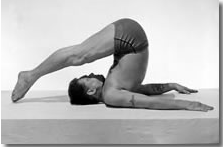
Preliminary studies are showing that some people with Parkinson's Disease can benefit greatly from regular, consistent Pilates classes and exercises. The mind-body connection that Pilates offers may help with brain disorders that affect the body's muscles and movement, like Parkinson's. Sounds like a great reason to make Pilates a regular part of every one's exercise routine.
I've been a big believer in Pilates for several years so I hope that researchers will look carefully at the mind-body effects of exercises like Pilates. Longitudinal studies, along the lines of those looking at lifestyle choices that reduce the probabilities of diseases like Alzheimer's, would be great to see.
I also understand what is meant by the "small, powerful movements" of Pilates. They're challenging to do but deeply satisfying. As in Yoga, breathing, balance, and concentration are important (and good exercise for the brain and the body). Pilates also works on the body's core strength and flexibility and is particularly good for increasing abdominal strength and therefore reducing lower back tension and pain.
Happiness Is All in Our Brains
I've been fascinated by the recent research findings on happiness. As in so many other areas of neuroscience, scientists have assumed that our happiness quotient is hard-wired in our brains. We humans are sort of stuck with a glass that's either half-full or half-empty. Period. And for some people, there's nothing in the glass. We have a "happiness setting." And guess what? Just as researchers have found that our brains are plastic and capable of change in so many other areas--it's beginning to look like we can change our happiness settings, too--short-term and long-term.
For many years, the emphasis has been on finding a pill that will lift depression. Although many people have been helped enormously by these pharmacological palliatives, many others have not been helped or have had serious side-effects and complications from the drugs. Finally, neuropsychologists and neuroscientists are asking the other side of the question: what makes us happy? how can we feel happier? are there simple ways to lift our spirits to chronic happiness? optimism, even? And do we even need to discuss how critical these feelings are to our quality of life at every age?
The holidays are an especially good time to release the findings of these studies, given that so many people feel particularly lonely and depressed during this time of year.
OK, so what can we do? As psychologist Ed Diener of the University of Illinois says, "Set-point is not destiny." Promising methods coming out of the research include (l) focusing on "signature" strengths (through a questionnaire) and then using those strengths to choose more satisfying daily activities; and (2) thinking of three good things that happen each day just before going to sleep. According to Sonja Lyubomirsky from the University of California, Riverside, these two exercises made a significant difference in people's happiness when they regularly and consistently used them. Of course, as the pu-pu platter of happiness exercises that are proven to work increases, we will each need to experiment to find our own best method.
In other research on happiness, several researchers have been looking at the link between money and happiness. Most people seem to believe that money buys happiness. In fact, folks who move from abject poverty to a more comfortable relationship with money do become measurably happier. But as we move up the wealth scale, it appears that money becomes less and less important to our overall happiness. Makes sense.
I think Diener has it right when he points out that happiness is really all about "process and striving." What he didn't say, in my mind, is more important: happiness is all about feeling purpose in life.
For many years, the emphasis has been on finding a pill that will lift depression. Although many people have been helped enormously by these pharmacological palliatives, many others have not been helped or have had serious side-effects and complications from the drugs. Finally, neuropsychologists and neuroscientists are asking the other side of the question: what makes us happy? how can we feel happier? are there simple ways to lift our spirits to chronic happiness? optimism, even? And do we even need to discuss how critical these feelings are to our quality of life at every age?
The holidays are an especially good time to release the findings of these studies, given that so many people feel particularly lonely and depressed during this time of year.
OK, so what can we do? As psychologist Ed Diener of the University of Illinois says, "Set-point is not destiny." Promising methods coming out of the research include (l) focusing on "signature" strengths (through a questionnaire) and then using those strengths to choose more satisfying daily activities; and (2) thinking of three good things that happen each day just before going to sleep. According to Sonja Lyubomirsky from the University of California, Riverside, these two exercises made a significant difference in people's happiness when they regularly and consistently used them. Of course, as the pu-pu platter of happiness exercises that are proven to work increases, we will each need to experiment to find our own best method.
In other research on happiness, several researchers have been looking at the link between money and happiness. Most people seem to believe that money buys happiness. In fact, folks who move from abject poverty to a more comfortable relationship with money do become measurably happier. But as we move up the wealth scale, it appears that money becomes less and less important to our overall happiness. Makes sense.
I think Diener has it right when he points out that happiness is really all about "process and striving." What he didn't say, in my mind, is more important: happiness is all about feeling purpose in life.
Friday, November 10, 2006
Regular Exercise Increases Our Energy
I love this new finding by University of Georgia researchers, Patrick O'Connor, co-director of the UGA exercise psychology laboratory and a kinesiology professor, and Tim Tuetz, a recent doctoral program graduate. Their findings were published in the November issue of Psychological Bulletin. They found that "sedentary people who completed a regular exercise program reported improved fatigue compared to groups that did not exercise." Further, their analysis found that "every group studied--from healthy adults to cancer patients to those with chronic conditions such as diabetes and heart disease--benefited from exercise.
Although it may seem odd that using energy by exercising actually gives us more energy, we also know from many previous animal studies that exercise promotes higher levels of neurotransmitters, such as dopamine and serotonin, in the animals' brains. Once again, the evidence is clear: regular, consistent exercise is just what we're supposed to do.
Personally, I have known for a long time that if I'm really fatigued and burned out, a fast-paced swim or a challenging yoga class or a brisk walk can re-energize me like nothing else. And the more regular exercise I get, the more my body--and yes, my mind, too--cry out for it.
Technorati tags: cognition, brain, neuroscience, exercise, energy, health and wellness, brain health
Although it may seem odd that using energy by exercising actually gives us more energy, we also know from many previous animal studies that exercise promotes higher levels of neurotransmitters, such as dopamine and serotonin, in the animals' brains. Once again, the evidence is clear: regular, consistent exercise is just what we're supposed to do.
Personally, I have known for a long time that if I'm really fatigued and burned out, a fast-paced swim or a challenging yoga class or a brisk walk can re-energize me like nothing else. And the more regular exercise I get, the more my body--and yes, my mind, too--cry out for it.
Technorati tags: cognition, brain, neuroscience, exercise, energy, health and wellness, brain health
Monday, November 06, 2006
The Slow But Gradual End of Alzheimer's As We Know It
As noted in Sunday's LA Times and this month's Science magazine, November 3 (or 4, depending on which publication you read) marked the hundredth anniversary of Dr. Alois Alzheimer's medical conference presentation of a patient's case with a neurogenerative disease that has come to be known as Alzheimer's Disease. The Neurophilopher's Weblog also did a fine recounting of the history. The LA Times states that another event will also be marked: "the slow but gradual end of Alzheimer's as we know it--and the Americanization of dementia science."
For the last 100 years, scientists have been trying to figure out what causes Alzheimer's plaques and tangles in the brain. Sadly, very few actual advances in therapies have occurred for people who have been diagnosed with AD. But as author Greg Critser points out, President Ronald Reagan and his family's openness about their struggles with AD have motivated researchers to begin looking at AD differently, both in ways to prevent it and therapies to deal with this tragic disease. In the therapeutic arena, stem cell research is one possibility. We know from research on brain plasticity that we can already "rewire" our brains so why not get a little help from transplanted neurons to make connections stifled by AD's plaques and tangles?
On the prevention side, researchers are looking at diet, exercise, mental stimulation, and "dysfunction" of brain cells due to other potentially controllable brain environmental factors, such as the way certain brain cells use glucose. Scientists are realizing that AD does not have to be totally linear in its progression. We are beginning to see solid research on strategies that can prevent or slow down AD and dementia as well as compensation strategies to help the brain create additional connections and pathways through mental stimulation and learning. Many, many scientists are now looking closely at these lifestyle decisions and concluding that it really does matter how you live your life and the choices you make along the way.
Technorati tags: cognition, brain, longevity, aging, brain exercise, Alzheimer's, health and wellness, brain health,
For the last 100 years, scientists have been trying to figure out what causes Alzheimer's plaques and tangles in the brain. Sadly, very few actual advances in therapies have occurred for people who have been diagnosed with AD. But as author Greg Critser points out, President Ronald Reagan and his family's openness about their struggles with AD have motivated researchers to begin looking at AD differently, both in ways to prevent it and therapies to deal with this tragic disease. In the therapeutic arena, stem cell research is one possibility. We know from research on brain plasticity that we can already "rewire" our brains so why not get a little help from transplanted neurons to make connections stifled by AD's plaques and tangles?
On the prevention side, researchers are looking at diet, exercise, mental stimulation, and "dysfunction" of brain cells due to other potentially controllable brain environmental factors, such as the way certain brain cells use glucose. Scientists are realizing that AD does not have to be totally linear in its progression. We are beginning to see solid research on strategies that can prevent or slow down AD and dementia as well as compensation strategies to help the brain create additional connections and pathways through mental stimulation and learning. Many, many scientists are now looking closely at these lifestyle decisions and concluding that it really does matter how you live your life and the choices you make along the way.
Technorati tags: cognition, brain, longevity, aging, brain exercise, Alzheimer's, health and wellness, brain health,
Tuesday, October 24, 2006
We Are What They Think We Are
In the October 20 issue of Science, researchers Dar-Nimrod and Heine from the University of British Columbia reported on a study they conducted. They told one group of women that women do not perform well in science and math, using a disguised research study report as the basis of this "fact." The other group was not shown the "study results." And guess what? Well, of course. The women who thought that women were naturally bad at math and science performed much more poorly than the group that just got to wing it, using their own perceptions and skills. Chris Lee at Nobel Intent also commented on this study and as he points out, "scientific theories that promulgate genetic explanations for performance difference become self-fulfilling. . . there are enough high-performing women scientists in all fields to indicate that genetics is unlikely to be a major contributor to women's average under-performance in math and science."
These results are amazingly similar to the research conducted with blue and brown-eyed children in the 50s. One group was inferior one day and the other group was deemed inferior the next day with the expected results: huge drops in self-esteem, feelings of interiority and associated behaviors, such as shyness, loss of humor, etc.
This study also reminds me of the recent finding regarding people who ignore the stereotypes associated with a certain age. Researchers found that indeed they behaved in every way like people many years younger. We seem to want to fit the stereotype one way or another. Are these behaviors a result of mirror-psych neurons?
Technorati tags: cognition, brain, neuroscience, aging,
These results are amazingly similar to the research conducted with blue and brown-eyed children in the 50s. One group was inferior one day and the other group was deemed inferior the next day with the expected results: huge drops in self-esteem, feelings of interiority and associated behaviors, such as shyness, loss of humor, etc.
This study also reminds me of the recent finding regarding people who ignore the stereotypes associated with a certain age. Researchers found that indeed they behaved in every way like people many years younger. We seem to want to fit the stereotype one way or another. Are these behaviors a result of mirror-psych neurons?
Technorati tags: cognition, brain, neuroscience, aging,
Sunday, October 22, 2006
Regular Exercise Works Best for Our Brains
The LA Times Health section featured an article by Greg Miller on Friday which summed up current research on keeping our brains healthy and fit throughout our lives. According to the article, a panel of experts assembled by the National Institutes of Health earlier this year reviewed the scientific literature on cognitive aging. They concluded that regular, consistent mental workouts, physical exercise, social interactions, and attention to cardiovascular health are critical to keeping mental edge as we get older. The regular and consistent part turns out to be extremely important. We already know that quick fixes don't work with exercise or diet. Now it's clear that regular workouts for our brains are also important. Marilyn Albert, a cognitive neuroscientist from Johns Hopkins University summed it up:
"The fab four. . . are physical activity, mental activity, social engagement and cardiovascular health." And researchers say, there's very little difference between men and women in the cognitive aging arena.
Denise Park, another respected researcher in aging and cognition from the University of Illinois adds that it is very important to learn new things with new challenges instead of getting stuck in the same old rut. If you already play the flute, take up a language. If you love cooking, try gardening, too, etc. The message: stay active, physically and mentally, and continue to challenge yourself to stay fit.
Lately in several articles about keeping the brain fit as we age, Dr. Timothy Salthouse has been quoted as the contrarian, based on the large study called A.C.T.I.V.E, that he led. He concluded that mental training is not particularly helpful.
I think it's very important to look at the A.C.T.I.V.E research design to be able to understand why Dr. Salthouse is as negative as he is, at least in the soundbites from newspaper articles. The study lasted for 24 months and tested specific intervals of training in a group of men and women between the ages of 65 and 94. Three of the four groups received ten sessions stretched over several weeks of 60-75 minutes each of training on a particular cognitive skill like reasoning, memory, or processing speed. Then 11 months later, they got three more hours of training (called booster sessions).
The groups were tested three times: after the first set of sessions, after the Booster, and then 24 months after the first sessions. They found a decline in each of the skills at the second and third test points.
In other words, Salthouse et al. found that quick fixes don't work. Why does this surprise anyone? If I don't speak French for a year or two (even with three hours of study in between), my French is less than it used to be. If I speak and study regularly and consistently, I notice that my fluency improves dramatically. Same thing with piano playing, with Sudoku, bridge, and practically any other pursuit that involves my brain that I can think of. Regular practice makes me better and faster at the task at hand. If I don't practice, I slow down. Sounds remarkably like what happens when I don't cycle or swim for a few weeks. I have to work on retraining my muscles and my breathing.
"The fab four. . . are physical activity, mental activity, social engagement and cardiovascular health." And researchers say, there's very little difference between men and women in the cognitive aging arena.
Denise Park, another respected researcher in aging and cognition from the University of Illinois adds that it is very important to learn new things with new challenges instead of getting stuck in the same old rut. If you already play the flute, take up a language. If you love cooking, try gardening, too, etc. The message: stay active, physically and mentally, and continue to challenge yourself to stay fit.
Lately in several articles about keeping the brain fit as we age, Dr. Timothy Salthouse has been quoted as the contrarian, based on the large study called A.C.T.I.V.E, that he led. He concluded that mental training is not particularly helpful.
I think it's very important to look at the A.C.T.I.V.E research design to be able to understand why Dr. Salthouse is as negative as he is, at least in the soundbites from newspaper articles. The study lasted for 24 months and tested specific intervals of training in a group of men and women between the ages of 65 and 94. Three of the four groups received ten sessions stretched over several weeks of 60-75 minutes each of training on a particular cognitive skill like reasoning, memory, or processing speed. Then 11 months later, they got three more hours of training (called booster sessions).
The groups were tested three times: after the first set of sessions, after the Booster, and then 24 months after the first sessions. They found a decline in each of the skills at the second and third test points.
In other words, Salthouse et al. found that quick fixes don't work. Why does this surprise anyone? If I don't speak French for a year or two (even with three hours of study in between), my French is less than it used to be. If I speak and study regularly and consistently, I notice that my fluency improves dramatically. Same thing with piano playing, with Sudoku, bridge, and practically any other pursuit that involves my brain that I can think of. Regular practice makes me better and faster at the task at hand. If I don't practice, I slow down. Sounds remarkably like what happens when I don't cycle or swim for a few weeks. I have to work on retraining my muscles and my breathing.
Subscribe to:
Posts (Atom)




