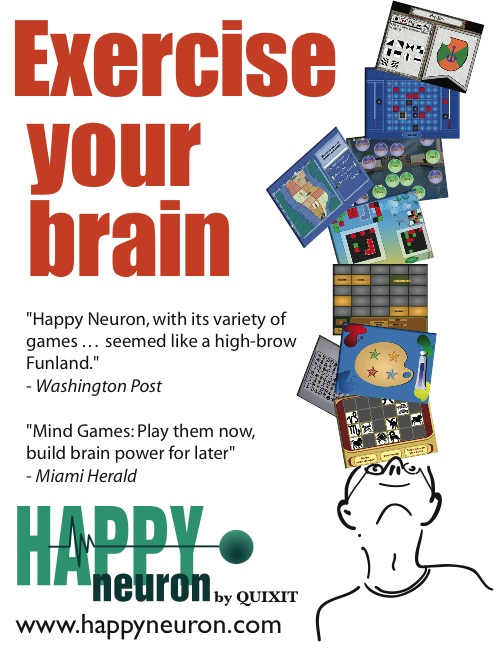
Since our company, Quixit, Inc., is located in the Bay Area and the
AARP convention was in Anaheim, California, we decided that we should showcase our newly relaunched
www.HappyNeuron.com there. After all, brain health and fitness should be of interest to AARP members, especially games that are fun to play and promote wellness. We worked hard to get our booth, signage, and handouts ready and rolled into Anaheim ready to share our enthusiasm. After 10 hours a day of standing in front of the huge video monitor we rented for our small booth, with postcards and posters in our hands (like the one above), and our 30-second pitch primed to perfection, three of us met the oncoming hordes of men and women strolling the many exhibitor aisles of the huge convention hall.
"Interested in games? Interested in having a fit brain?" we asked endlessly. Most people said yes (of course) and many zoomed down the aisle directly to us. They were familiar with the challenge and wanted to know what they could do.
A few just walked by. One in particular was memorable. He walked quickly by. "I still work," he said.
"Great," I said, "what do you do?"
"I can't tell you," he said.
"Why?"
"Because if I do, I'll have to kill you."
Hmm.m.m. A bit unexpected at the AARP convention.
The theme was "life@50+." So, how do we feel about our AARP exhibitor experience? We are all energized by the enthusiastic reception we received but our brains are fried, our feet are permanently sore, and I want to burn the shoes I wore. It was fun to talk to so many nice folks from all over the US interested in continuing to learn and keeping their brains fit and healthy. Many people had already researched the "use it or lose it" approach to brain fitness. And they wanted to know what to do about it. What is really beyond crossword puzzles, they asked?
Our booth was located just across the aisle from the
Nintendo folks who showcased their "BrainAge" software for the Nintendo DS and their Wii suite of games, including bowling, tennis, baseball, golf, and other sports. It was great to take a break every now and then and hit a few tennis serves. Nice people, too, at the Nintendo booth.
I must admit that I had never considered attending an AARP convention before this one. So I was surprised at its size (22,000+), the range for high-quality offerings (Bill Cosby, Maya Angelou, Geena Davis, Don Rather, Connie Chung, etc. as speakers and lesser known but expert speakers on all kinds of tantalizing topics), the friendliness of the staff, the 60s live music in corners around the convention hall and outside, and the high level of interest in brain fitness. And the really nice AARP members who were there.
According to the AARP literature, the average age of the attendees has fallen from 72 about five years ago to about 60. There goes that Baby Boomer effect again! Next year, it will probably be in the high 50s and falling.
I would definitely go to another one. And by the way, next year's will be in Boston.
Technorati tags: cognition,
brain,
neuroscience,
aging,
Baby Boomers,
AARP,
Happy Neuron,
brain health,
 The Des Moines Register published a nice summary article today by Dawn Sagario about brain health and how to maintain it. In addition to suggestions about learning new languages and physical exercise, the article also described the recently released results of the pilot study led by Dr. Bob Bender, a geriatrician in Des Moines. The study was funded by the Centers for Disease Control and Prevention. The "Brain Wellness" study included regular, consistent physical exercise, nutritution advice, meditation, and regular mental workouts with Happy Neuron games. The participants who complied with this program had positive results, including significantly more brain activity, as measured by pre-and post-PET scans and clinical examinations. Dr. Bender and his team are very enthusiastic about the potential for prevention, using these lifestyle choices and brain exercises like Happy Neuron.