Last night I was invited to the first Bay Area screening of Sicko, Michael Moore's new film about health care. Funny, tragic, entertaining, thoughtful, and energizing; see it! The audience cheered and clapped in a standing ovation for almost 10-15 minutes, similar to the reception the film received at the Cannes Film Festival.
Mr. Moore was there for a Q&A. "What can we do to change things? How long will it take us?" were recurring questions in different guises from the audience. In other words, why do so many other countries in the world look after their citizens' health through universal health care but in the US, health care is seen as just another business with the P&L always top of mind, resulting in horrendous treatment for many of our poorer citizens, in debt and bankruptcy for those unable to meet the financial obligations caused by a disease or accident, or in many people avoiding proper care and treatment, resulting in even higher costs for the whole system and for taxpayers.
His answer, "First, we can prevent many health problems by eating fruits and vegetables and moving our bodies." He pointed out that he is now walking 30 minutes a day and has made small changes in his diet that have enabled him to lose 30 pounds in the last three months. And he's right, prevention is the best way to deal with the cost of getting sick in our country and lifestyle changes can result in lower cholesterol, lower blood pressures, and healthy blood sugar levels--all keys to preventing major chronic and debilitating diseases.
Secondly, "follow the money." He encouraged the audience to find out which of our elected officials--Senators, Representatives, the President--are getting financial support (and how much) from the health care industry. We really need to know who has a vested interest in not changing our system, resulting in exclusion of people from adequate care who can't pay and escalating drug and patient care prices. The culprits are pharmaceutical companies, insurance companies, and for-profit HMOs and hospital chains. But even more important and unethical are our elected officials who take big bucks in campaign support from these entities. Of course, they are then beholden to the health care industry and little to no change is the result. We voters and citizens need to demand that this unethical practice stop, immediately.
Given the demographics of our country and the inevitable ills of the aging Boomer generation, the US must solve this health care problem fast. Everyone needs adequate access to good health care. Because we care. Because it the right thing to do. Because it is the only way to keep our country strong.
As Michael Moore pointed out, "We are a wealthy nation. We can find billions when we need to kill people (as in Iraq). Why not use our money to help people live?"
Showing posts with label disease prevention. Show all posts
Showing posts with label disease prevention. Show all posts
Thursday, June 14, 2007


Tuesday, January 23, 2007
Mental Workouts Delay Alzheimer's in Mice

More evidence builds that mental activity can "dramaticlly delay the progress of Alzheimers' disease."
According to Reuters' Will Dunham, "Researchers at the University of California-Irvine studied hundreds of mice altered to make them develop the plaques and tangles in brain tissue that are considered hallmarks of Alzheimer's Disease in people." The mice received "brain training," which in this case was figuring out a maze in water and which was made available four times a day for a week at intervels between two and 18 months of age. The mice that were exposed to this learning had significantly slower build-up of the beta amyloid protein, which has been shown to be the culprit in the "gooey clumping" outside nerve cells. These mice also experienced less build-up of the protein that causes "twisted fibers" in brain cells.
The research results have just been published in the Journal of Neuroscience. Kim Green, one of the researchers, noted that research is planned which looks at the effects of more frequent and intensive learning experiences and whether they might lead to longer effects.
Tuesday, October 31, 2006
Cut Calories: One Way to Live Better and Longer
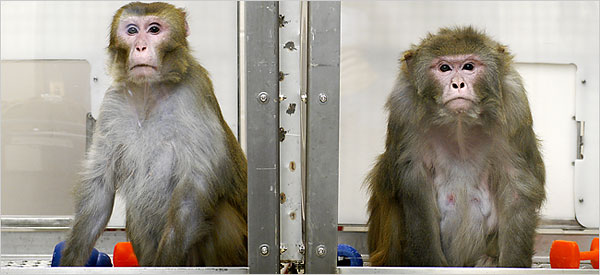
Jeff Miller of the University of Wisconsin-Madison caught Canto and Owen on camera for the NY Times Science News today. "Canto, left, a rhesus monkey, is aging fairly well at 25 on a calorie restriction diet. Owen, though only a year older than Canto, is frail and moves slowly. He eats a normal diet."
Thanks to Michael Mason, who wrote about the research at the Wisconsin National Primate Research Center. We've all heard about calorie restricted diets for quite some time and some good indicators about improved overall health have come out of the research. But now, it's beginning to look more real. Mason says it best, "In the last year, calorie-restricted diets have been shown in various animals to affect molecular pathways likely to be involved in the progression of Alzheimer's disease, diabetes, heart disease, Parkinson's disease, and cancer." Some researchers are beginning to say this approach is even better than exercise at preventing or delay typical age-related diseases. Of course, a balanced diet is critical, even with restricted caloric intake of about 30% below typical levels, and must include the vitamins and minerals that our bodies need. Pushing away from the table sooner is looking better and better.
The article goes on to discuss other ways of extending the quality of life and longevity with the idea that slowing down aging also slows down diseases, such as heart disease and Alzheimer's.
Technorati tags: cognition, brain, longevity, aging, calorie restriction, Alzheimer's, health and wellness, brain health,
Thanks to Michael Mason, who wrote about the research at the Wisconsin National Primate Research Center. We've all heard about calorie restricted diets for quite some time and some good indicators about improved overall health have come out of the research. But now, it's beginning to look more real. Mason says it best, "In the last year, calorie-restricted diets have been shown in various animals to affect molecular pathways likely to be involved in the progression of Alzheimer's disease, diabetes, heart disease, Parkinson's disease, and cancer." Some researchers are beginning to say this approach is even better than exercise at preventing or delay typical age-related diseases. Of course, a balanced diet is critical, even with restricted caloric intake of about 30% below typical levels, and must include the vitamins and minerals that our bodies need. Pushing away from the table sooner is looking better and better.
The article goes on to discuss other ways of extending the quality of life and longevity with the idea that slowing down aging also slows down diseases, such as heart disease and Alzheimer's.
Technorati tags: cognition, brain, longevity, aging, calorie restriction, Alzheimer's, health and wellness, brain health,
Subscribe to:
Posts (Atom)




