Nicholas Wade's article in today's NY Times summarizes even more research results coming out of the studies of mice that consumed resveratrol, one of the main ingredients in red wine. The study of resveratrol, given in huge quantities to the mice, may open up a whole new field of drugs to prevent diabetes and reduce obesity, which in and of itself is likely to lower the incidences of stroke and heart attacks, at the very least, and prolong life. This ingredient in red wine has also been shown to dramatically increase endurance and longevity in the mice who took it compared to the ones who didn't. In fact, they resembled "trained athletes" without the training, with lowered heart rate and similar muscle fibers. The latest findings were published in Online Cell and the study was led by Dr. Johan Auwerx at the Institute of Genetics and Molecular and Cellular Biology in Illkirch, France.
The articles and the research point out that the same effects in humans would require the consumption of about 100 bottles of red wine a day. Since that's not possible, it makes sense to wait for the scientists to figure out how to isolate and condense resverarol into capsule form.
For a great series of articles on this research, check out Rob Stein's summaries in the Washington Post of the various aspects of the research: "A second pour of good news about substance in red wine, " "A compound in red wine makes fat mice healthy."and "Red wine compound promises longevity, study finds."
Showing posts with label longevity. Show all posts
Showing posts with label longevity. Show all posts
Friday, November 17, 2006


Tuesday, October 31, 2006
Cut Calories: One Way to Live Better and Longer
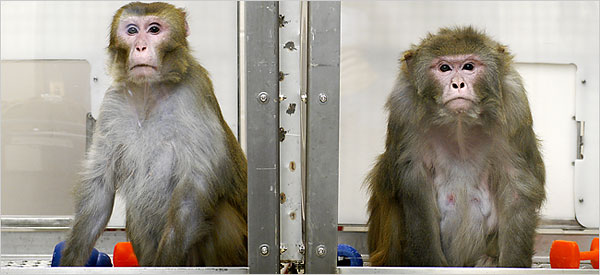
Jeff Miller of the University of Wisconsin-Madison caught Canto and Owen on camera for the NY Times Science News today. "Canto, left, a rhesus monkey, is aging fairly well at 25 on a calorie restriction diet. Owen, though only a year older than Canto, is frail and moves slowly. He eats a normal diet."
Thanks to Michael Mason, who wrote about the research at the Wisconsin National Primate Research Center. We've all heard about calorie restricted diets for quite some time and some good indicators about improved overall health have come out of the research. But now, it's beginning to look more real. Mason says it best, "In the last year, calorie-restricted diets have been shown in various animals to affect molecular pathways likely to be involved in the progression of Alzheimer's disease, diabetes, heart disease, Parkinson's disease, and cancer." Some researchers are beginning to say this approach is even better than exercise at preventing or delay typical age-related diseases. Of course, a balanced diet is critical, even with restricted caloric intake of about 30% below typical levels, and must include the vitamins and minerals that our bodies need. Pushing away from the table sooner is looking better and better.
The article goes on to discuss other ways of extending the quality of life and longevity with the idea that slowing down aging also slows down diseases, such as heart disease and Alzheimer's.
Technorati tags: cognition, brain, longevity, aging, calorie restriction, Alzheimer's, health and wellness, brain health,
Thanks to Michael Mason, who wrote about the research at the Wisconsin National Primate Research Center. We've all heard about calorie restricted diets for quite some time and some good indicators about improved overall health have come out of the research. But now, it's beginning to look more real. Mason says it best, "In the last year, calorie-restricted diets have been shown in various animals to affect molecular pathways likely to be involved in the progression of Alzheimer's disease, diabetes, heart disease, Parkinson's disease, and cancer." Some researchers are beginning to say this approach is even better than exercise at preventing or delay typical age-related diseases. Of course, a balanced diet is critical, even with restricted caloric intake of about 30% below typical levels, and must include the vitamins and minerals that our bodies need. Pushing away from the table sooner is looking better and better.
The article goes on to discuss other ways of extending the quality of life and longevity with the idea that slowing down aging also slows down diseases, such as heart disease and Alzheimer's.
Technorati tags: cognition, brain, longevity, aging, calorie restriction, Alzheimer's, health and wellness, brain health,
Subscribe to:
Posts (Atom)




