Showing posts with label Boomers. Show all posts

Saturday, February 17, 2007

Boomers Put Our Own Twist on Exercise

I've just returned from my health club. My NIA teacher didn't show up (a rare occurrence) so I headed for the weight room where I flipped through magazines and chatted with one of my fellow NIA classmates, while zipping along on the recumbent bike for 20 minutes, scooted through the weight machines, and then headed to the pool for a swim. For some reason, I started noticing that 99% of the people in the room were leading-edge Boomers. Then I began to think about how weight rooms had changed. No more Nordic Track machines. Only one stair-climbing machine and one stationary bike. Now, there are stretching machines, rows of recumbent bikes (great for weak or injured knees), elliptical motion training machines (also good on knees), and big orange and green plastic balls for Pilates and yoga stretches. And of course, many more weight machines. Only one young woman was running on one of the old treadmills.

It turns out my observations are on the money. The research folks at American Sports Data inform me that "older Americans are transforming the landscape of physical fitness." It turns out that the number of people who are 55 belonging to health clubs surged by 33% from 1999-2004 whereas the 18-34 crowd had zero growth in memberships.

". . .the compound measurement of Yoga/Tai Chi has grown by 118% . . . . At 11.2 million participants, Recumbent Cycling, a particularly back-friendly exercise. . . has grown 66%. . . . surpassed only by Fitness Walking and Aquatics." And the conclusion? "Mature exercise enthusiasts are not merely playing havoc with abstract fitness statistics; they are rocking the foundations of fitness facilities across the U.S. "

Interesting facts: Pilates participation has increased 506% during the period of the research report, elliptical training machines, 306%, Yoga, 118%, Nordic ski machines, -40%, aerobic rider exercise, -58%, stair-climbing machines, -29%.

These are great trends to contemplate. Boomers as a group are continuing to value physical exercise and fitness as one important key to a vibrant, active life. And, if we need to find new exercises that put less strain on our joints and backs, then we find them and we continue to stay fit. Boomers may yet succeed at making the concept of wellness and prevention a perfectly natural part of our culture and thinking.

Friday, October 06, 2006

You're Only as Old as You Think You Are!

Gina Kolata's great article in yesterday's NY Times was picked up in numerous other publications, for good reason. Yes, it is all in our heads--and hearts. New research results from the National Institute on Aging have just been released from studies trying to figure out why some people become frail as they age and others don't. The main reasons center around two surprises: (l) hidden heart disease; and (2) mental images connected to chronological age. In the case of the second reason, people who rebel against culturally acceptable norms of how they should act at 50, 60, 70, 80 and on are much more likely to lead active, energetic lives than those who believe that a certain age must result in physical and/or mental decline. Once again, fascinating news with reverberating implications. So, 60 really can be the new 40! We just have to see ourselves as not fitting into our cultural and media-driven stereotypes. Keep rebelling, Boomers!

, , ,

Monday, September 25, 2006

Happy Neuron Exercises Your Brain

Our team at QUIXIT, Inc. has been busy with the first phase of our plan--adapting Happy Neuron to the US market. Please check out what we have accomplished so far and look for continued changes and additions in the coming weeks and months. Happy Neuron offers workouts for your brain based on scientific research on how to increase your probabilities of being sharp and fit for life. Top European neuroscientists developed these workouts, which cross train an array of key thinking skills, such as memory, concentration, visual and spatial skills, language, and reasoning. There are currently almost 40 tiered exercises.

We at Quixit are determined to get the word out to everyone, and especially to Boomers, that there are very concrete ways to keep our brains healthy and our minds lively. Many of us have watched our parents "retire" both physically and mentally. And we just don't want to go there--and we don't have to. We now accept that physical exercise is crucial for overall fitness; it's time to embrace regular, consistent workouts for our brains, too. Do I sound passionate about what I'm doing? I really am.

We welcome your thoughts, ideas, and suggestions as we move forward on this journey.

, , , , ,

Saturday, September 23, 2006

Women Play Games to Exercise Their Brains

According to a market research study financed by PopCap, the game developer, most of the people who play casual online games (those are the quick games that are not violent or competitive, for the men in the audience) are mostly educated Boomer women. They found: (l) that women play to de-stress by moving their minds beyond fatigue or chronic tension or pain; and (2) for mental exercise. How could we possibly be surprised by that? We have the most educated, affluent, and stressed generation ever in history constantly looking for ways to keep sharp and manage stress at the same time. And 25 million of them are women, the health care gatekeepers for their families.

The next step is getting our families to follow our lead, as usual.

, , , ,

Sunday, September 10, 2006

Exercise Prevents Fraility

The scientific evidence is so clear--keep exercising regularly throughout life to prevent fraility, among other commonly accepted conditions previously thought to be a natural part of aging. Guess what? These conditions appear not to be the consequence of years going by. A regiment of aerobic exercise and weight training is highly likely to prevent fraility and has been shown to be able to reverse it in several studies funded by the National Institute on Aging at NIH. The NIA wants to figure out why some people become frail as they age and to understand ways to prevent this vitality-zapping condition. In an article in today's San Francisco Chronicle, writer Alice Dembner of the Boston Globe, points out that, according to this NIH research, we "can throw out another convention of old age. Researchers are finding that fraility may not be the inevitable result of aging but rather is a preventable and perhaps treatable condition."

, , , ,

How to Be a Working Artist--and Stay Sharp

Instead of declining into retirement with age-appropriate activities like cruises, golf, and watching the world go by, move to a community of like-minded souls focused on active lives of creativity and participation. Add in some professional experts for advice and guidance and you have a shot at a spectacular new career. You'll also start reversing general decline of the body, mind, and spirit and preventing future health issues. And you may very well be paid handsomely for your work as playwright, radio personality, artist, composer, or musician.

A front-page NY Times article today by Patricia Leigh Brown, "At New Rentals, the Aim Is to Age with Creativity" highlights a study jointly sponsored by George Washington University and The National Endowment for the Arts called "The Creativity and Aging Study." As Dr. Gene Cohen, one of the directors of the study, says in a summary of the results of this first two-year research of its kind, "Awareness that there is no age limit to tapping human potential affects not only how we view and prepare for our own future development, but it also influences how society nurtures and benefits from its older human resources." Also interesting is that many of the participants had already lived "normal" lifespans and were in their 80s and 90s at the time of the study. So what will happen when Boomers, the first of whom are now reaching 60, demand to be heard--creatively, politically, and as wage-earners? I think we're in for some exciting times.

Dr. Cohen adds in the NY Times article, “We’re thinking beyond the problems of aging to its potential. . . . What’s emerging is a very talented group of people who are an under-recognized national resource.”

, , , ,

Monday, September 04, 2006

Naguib Mahfouz: I'll Miss You!

Naguib Mafouz, one of my favorite authors, died this past week. I am sad. An Egyptian writer, he closely observed his friends, family, neighborhood, and country along multiple dimensions. Mahfouz had an eye for detail that included but went beyond simple sensual description to make his readers feel the universality of life and along the way, empathy, humanity, and acceptance. But even better, he wrote page turners. The three books of The Cairo Trilogy are among the most absorbing books I've ever read. I thought about the people he described after I finished each of them. I wondered what they would do in certain situations. I visualized their comings and goings to and from the houses, cafes, markets, stores, and the Souks of their world. I have these images still settled in my mind to pull up at a moment's notice, as I do for so many really great books I've read. I became a part of these books and they became a part of me.

I was a Peace Corps Volunteer in an Arab country in the late 60s. I discovered amazing warmth and generosity among the people I met and knew. Those experiences made me love his books even more. I knew, from my own insights, that he was telling the truth. And the truth was sensuous, alluring, mysterious, challenging, and an invitation, generously extended, to learn and understand. He never brushed aside differences or weaknesses or for that matter, strengths.

George Bush said, "Mahfouz was a cultural light. . . who brought Arab literature to the world. . . and expressed values of enlightenment and tolerance." I can only dare to hope, and pray, that Mr. Bush has read or is now reading Mahfouz' works.

, , ,

How to Laugh Out Loud


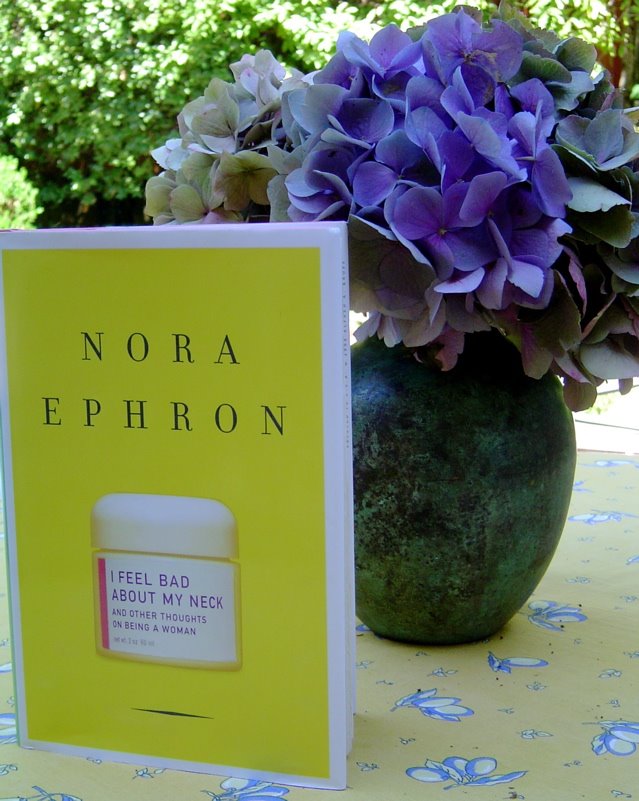
Start reading Nora Ephron's latest book of essays. But don't finish it in one sitting. Decide to take it with you to jury duty. For breaks. To distract yourself from the serious nature of what's at hand. To give your brain a little tickle, something light and amusing. Stick the shiny, new hardback in your gigantic purse, along with your bottle of water, your iPod, your sunglasses, your distance glasses, your TREO, your cosmetics, your old, torn, grimy tissues, money, business cards, extras from your tear-out Sudoku calendar in case you have three minutes somewhere, pencils, pens, receipts from last year's purchases, and vitamins that spilled from their case eons ago and are now in zillions of little crumbs along the bottom and in the built-in pockets on the side. Pull the slim volume out, amongst the throngs waiting to be called into service as jurors, or dismissed. Dust the vitamin crumbs and tissue pieces from the sides. Ignore the fidgeters, the sleepers, the annoyed, the frightened, the horribly bored. Begin reading. Giggle, clear your throat, and then burst into uncontrollable, inappropriate laughter that will just not stay put inside your mind. Ignore the bailiff pointing at you. Ignore the prospective jurors around you, looking wistfully because they'd give anything to have brought along something fun and funny to read. The essay is called, "I Hate My Purse." Ms. Ephron describes her purse and it's just exactly the mess mine is in. Except that mine is pathetic. Hers is hilarious.

If you're a woman over the age of 35 and certainly if you're over 50 (and hey, I think men would love this one, too), you should read Nora Ephron's latest collection of wry, sometimes hilarious and sometimes poignant (and sometimes both simultaneously), always honest, and usually universally applicable group of essays, I Feel Bad About My Neck and Other Thoughts on Being a Woman.

Ephron says she doesn't like getting older. It's not as advertised. I say any big life change, and getting older qualifies, is a great reason to trot out your sense of humor. And Ephron does, with sparkling style. Delightful, all the way through.

Even though I recognized some of these essays as the same ones I read when they were first published in The New Yorker, who cares? They were even better the second time around.

, , ,

Thursday, August 17, 2006

Obnoxious and Cranky? You're Very Intelligent! (If You're 60+)

So the real question is: do our personalities change as we get older? Jacqueline Bichsel and colleagues at Morgan State College in Baltimore say yes. Younger intelligent people explore adventurous avenues to learn new and different things. Older people, according to Bichsel's study, just get cranky. Or maybe impatient. Or maybe really irritated. Maybe when a patronizing person calls a 60+ year-old professional woman "young lady" or raises the voice volume to ear-piercing levels, speaking slowly, as to a child. Maybe then, an intelligent 60+ person may come up with a few choice words, articulate, to the point, OK--cranky! And maybe really intelligent people just have infinitely more word choices available to them to show their displeasure.

I found Mary Blair Immel's "My Turn" in the July 31 Newsweek great for summing up the likely feelings of so many really intelligent people as they get older. Take a look at "I'm Old--And I'm Just Fine With That." The sub-title is even better: "Think I need to hear platitudes and "compliments" to feel good about myself. Think again."

Suppose we could have a study on exactly what incites this crankiness in the 60+ crowd? Which personality traits would those be?

, , ,

Thursday, August 03, 2006

Researchers Devise Test to Predict Dementia Risk

Today a team from the Aging Research Center at the Karolinska Institutet in Finland published findings in the scientific journal, Lancet Neurology, which reinforces numerous other studies looking at parts of the Alzheimer's puzzle. After following more than 1400 people for 20 years, the team concluded that multiple lifestyle issues dramatically affect brain power over the years. Poor management of these factors can increase the probabilities of dementia. Or put in a more positive light, paying attention to these lifestyle choices can increase the probability of remaining mentally sharp and agile throughout life. The factors examined include an emphasis on learning from the get-go and throughout life, low blood pressure, low cholesterol, and staying away from the obese zone. Yep, "use it or lose it" is about to become even more of a Boomer mantra.

Regular physical exercise, stress management, good nutrition, social interactions with friends and family, and yes, brain exercise are all part of the prevention picture. There is currently no cure for Alzheimer's or dementia. Using these findings, the team has come up with a simple test to gauge a particular person's probabilities of remaining healthy or succumbing to Alzheimer's or vascular dementia. And the test will also, no doubt, be a motivational tool for change in many cases. Most of us see a fit brain and healthy mind as the key to quality of life.

The tantalizing tidbit here is that there does appear to be a link between heart disease and dementia. It is so interesting that the same lifestyle considerations factor so hugely in both.

Great to have a study that puts it all together!

, , ,